
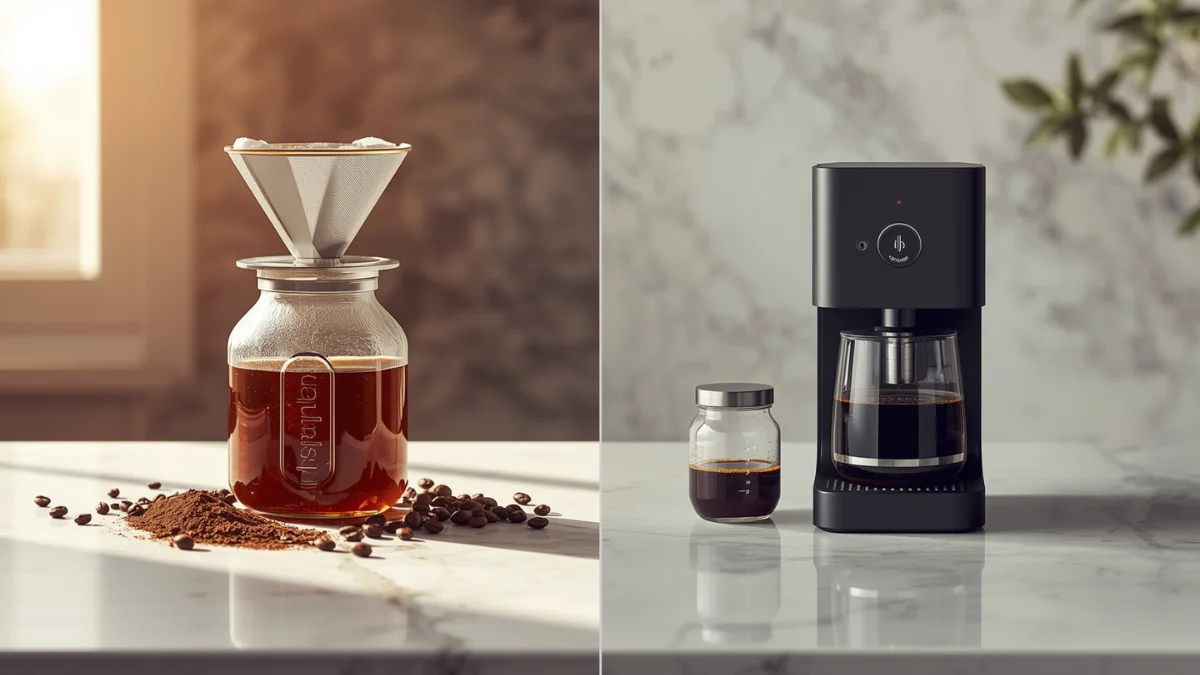
Two Very Different Ways to Make Cold Brew. One Is Right for You — Here’s How to Know Which.
Cold brew has never been more popular. And the equipment designed to make it has never been more varied.
Walk into any kitchen retailer or search online and you’ll find two fundamentally different categories of cold brew maker sitting side by side at very different price points — and with very different promises.
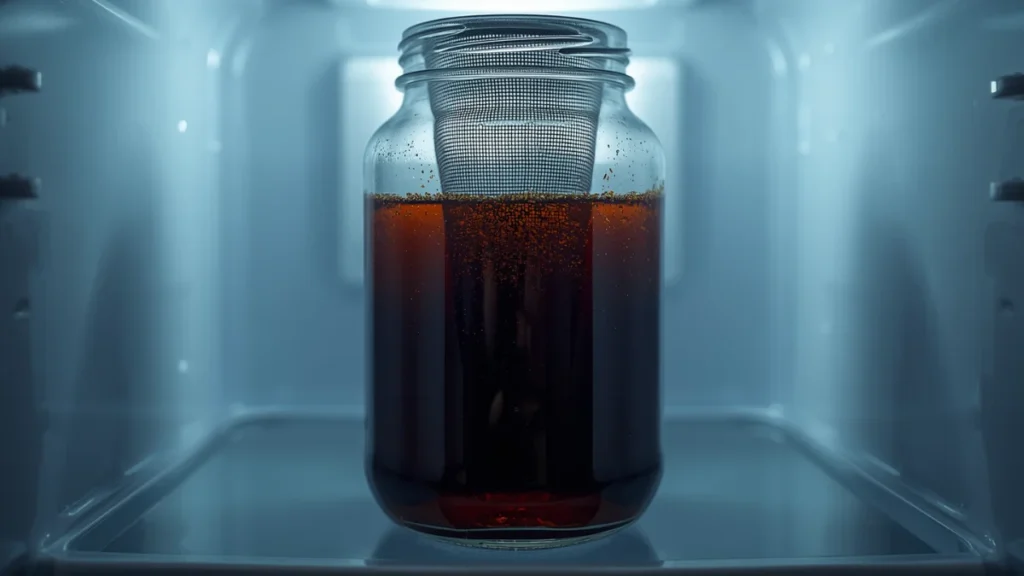
Immersion brewers ask you to be patient. You add coffee and cold water, seal everything up, and wait 12 to 24 hours in the fridge. The result, when done well, is a deeply complex, richly flavoured concentrate that many coffee lovers consider the gold standard of cold brew.
Electric cold brew makers ask you to be present for about ten minutes. You add coffee and water, press a button, and collect your concentrate while it’s still morning. The result is smooth, low-acid, and genuinely good — just produced by a completely different process.
Neither method is objectively better. But one of them is almost certainly better for your life, your fridge, your schedule, and your taste preferences.
This guide helps you figure out which one that is.
Quick Answer
Immersion cold brew delivers richer, more complex concentrate through 12–24 hours of slow steeping, while electric makers use rapid extraction to produce smooth concentrate in 10–25 minutes—choose based on whether you prioritize flavor depth or on-demand convenience.
Immersion cold brew:
- 12–24 hours of slow steeping
- Produces richer, more complex concentrate
- Best for flavor-first coffee drinkers
- Requires advance planning
Electric cold brew makers:
- Rapid, pressurized extraction
- Ready in 10–25 minutes
- Smooth, high-quality concentrate
- Best for busy or spontaneous drinkers
Decision guide:
Overnight planning feels like friction → go electric
Flavor depth is non-negotiable → go immersion
Why the Method Actually Matters
Most people assume cold brew is cold brew. It’s not.
Temperature, duration, and extraction mechanics fundamentally shape what ends up in your cup. Cold brew’s defining characteristics — low acidity, natural sweetness, and smooth body — develop through a slow chemical process that works very differently at cold temperatures than hot brewing does.
When you change how long that process runs, and how much pressure or agitation is involved, you change the flavour profile of the result. Not always dramatically — but noticeably, especially for experienced cold brew drinkers. Understanding the difference between the two methods is the foundation for making the right choice.
How Immersion Cold Brew Works
Immersion cold brew is the original method — and the simplest.
You combine coarsely ground coffee with cold water at a ratio typically between 1:4 and 1:8, depending on whether you want concentrate or ready-to-drink cold brew. The mixture steeps at refrigerator temperature for 12 to 24 hours. The grounds remain fully submerged — immersed — in the water for the entire steeping period.
Cold water is a far less efficient solvent than hot water, so the process takes hours. But that same inefficiency is what makes cold brew taste the way it does. Harsh acids and bitter compounds that extract readily in hot water simply don’t extract in cold water over time. What remains is naturally sweeter, smoother, and lower in acidity.
The quality of the result depends on the coffee, the ratio, and the steep time. Equipment plays a supporting role — better brewers produce more even saturation and cleaner filtration, but the core process is identical whether you’re using a $10 mason jar or a $60 premium system.
Examples: OXO Good Grips, OVALWARE Airtight, Takeya Deluxe, 64oz Mason Jar.
How Electric Cold Brew Works
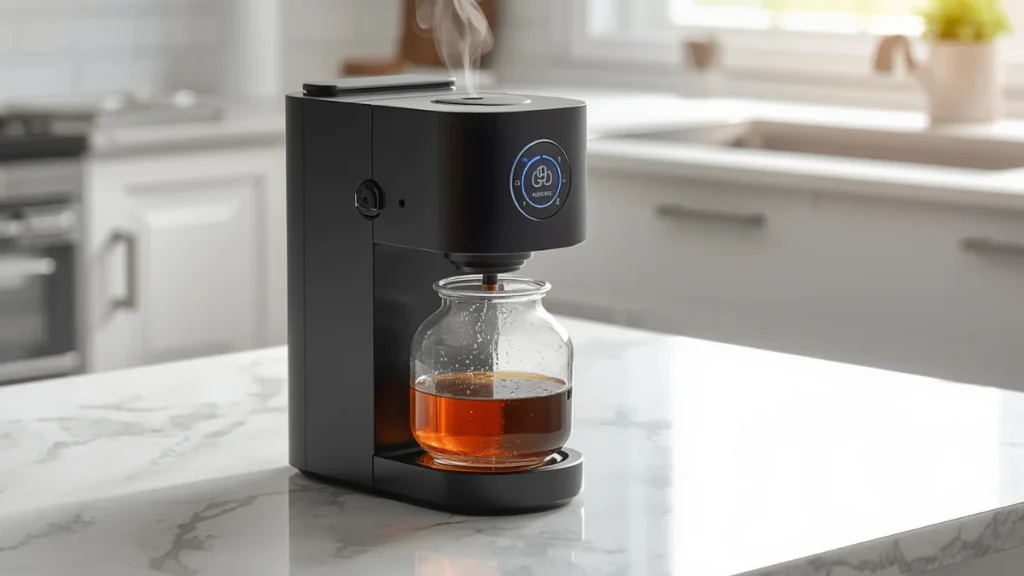
Electric cold brew makers use rapid pressurised extraction instead of passive steeping.
Pressure, agitation, and controlled turbulence accelerate the extraction process dramatically — producing cold brew-style concentrate in 10 to 25 minutes rather than 12 to 24 hours.
The chemistry is meaningfully different. Some complex aromatic compounds that develop gradually during a long steep don’t fully develop in a rapid extraction cycle. The result shares cold brew’s core character — smooth, low-acid, naturally sweet — but with slightly less layered depth than a well-executed slow batch.
For most drinkers who add milk or ice to their cold brew, this difference is subtle. For dedicated purists drinking full-strength concentrate, it’s noticeable.
Example: VINCI Express Electric Cold Brew Coffee Maker.
Flavor: Which Method Tastes Better?
This is the question most buyers want answered first — and it deserves an honest answer.
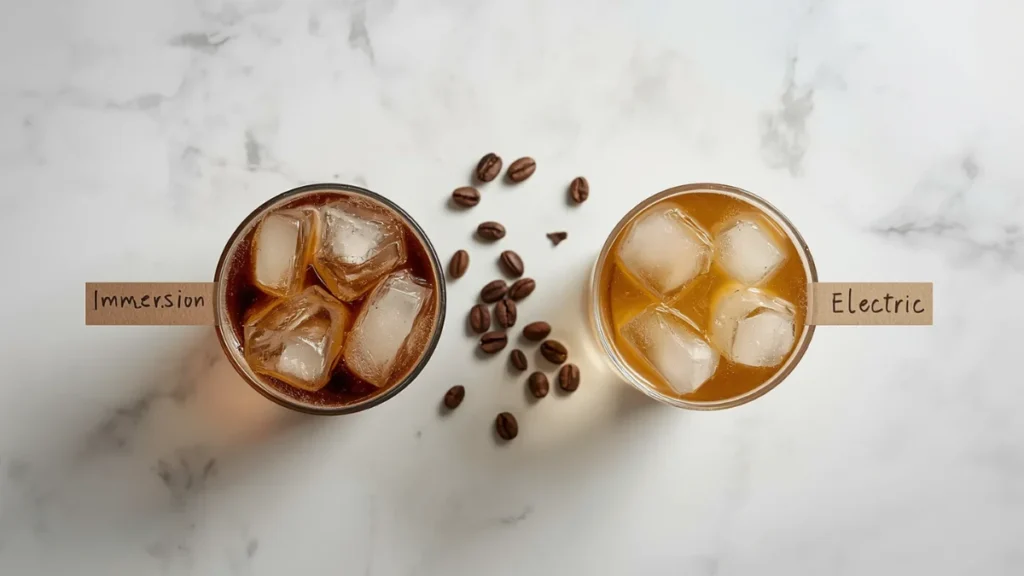
Immersion cold brew has the higher flavour ceiling. A well-executed 18 to 20-hour immersion batch with quality beans, the right grind, and a good ratio produces a concentrate of remarkable depth and complexity. The slow extraction allows aromatic compounds to develop fully. Premium immersion brewers like the OXO Good Grips — with its Rainmaker lid that distributes water evenly across the entire coffee bed — raise that ceiling further by eliminating the uneven extraction that cheaper systems produce.
Electric cold brew is genuinely very good — just different, and with a slightly lower flavour ceiling. The concentrate is smooth, sweet, and satisfying. Diluted over ice with oat milk or water, most people would not identify it as meaningfully different from slow-steeped cold brew. Tasted at full concentration, experienced cold brew drinkers will notice the difference in depth and aromatic complexity.
Practical verdict: If you drink cold brew straight or lightly diluted and care deeply about flavour nuance, immersion wins clearly. If you drink it over ice in a glass with something else added, the difference is small enough that convenience may matter more than method.
Convenience: Which Method Fits Your Life Better?
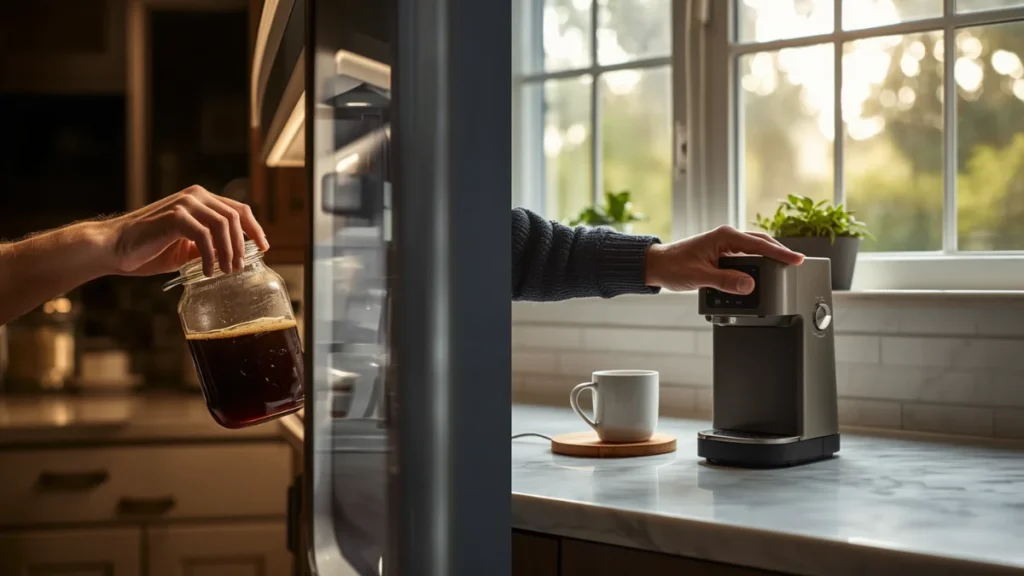
This is where electric cold brew makers make their strongest argument.
Immersion cold brew requires planning. You need to want cold brew tomorrow in order to make it today. You need fridge space for 12 to 24 hours during the steep. You need to remember to start the process before you run out of your current batch. For many drinkers — particularly busy professionals, people with packed fridges, or spontaneous coffee drinkers — this planning overhead is the exact reason they keep buying cold brew from a café instead of making it at home.
Electric cold brew eliminates that overhead entirely. Want cold brew right now? Press a button. It takes up counter space rather than fridge space during brewing. It produces concentrate in the time it takes to make breakfast. There’s no planning, no scheduling, no running out because you forgot to start a new batch.
For households where cold brew consumption is spontaneous rather than habitual and scheduled, the convenience advantage of an electric brewer is genuinely transformative — not just a marketing claim.
Cost: What Are You Actually Paying For?
Immersion brewers range widely:
- Budget (Mason Jar systems): $15–30
- Mid-range (Takeya Deluxe, OVALWARE): $30–55
- Premium (OXO Good Grips): $50–70
Electric brewers start at a premium:
- VINCI Express and comparable systems: $80–130+
The higher electric price reflects the engineering required — motor, pump system, multi-stage filtration, and electrical components that passive systems don’t need.
The key calculation: if you currently spend $5–7 per serving at a café because overnight planning feels unmanageable, an electric brewer pays for itself within weeks. If you’re already comfortable making immersion cold brew at home, electric delivers convenience rather than better results for the money.
Cleaning: Which Is Easier to Maintain?
Both methods require cleaning after each batch — neither has a significant advantage.
Immersion brewers involve rinsing the filter and washing the jar or brewing chamber. Premium models take slightly longer but remain fully dishwasher safe. Mason jar systems are among the easiest appliances in the kitchen to clean.
Electric brewers have removable dishwasher-safe components — extraction chamber, filter assembly, collection vessel. The electrical housing requires a wipe-down only. Cleaning effort is comparable to immersion for the removable parts.
Both methods reward an immediate rinse after use. Dried cold brew residue in filtration components is harder to remove than fresh grounds — in either system.
Fridge Space: A Practical Consideration
Immersion brewers occupy fridge space for 12 to 24 hours per batch. Tall stacked systems like the OXO require an internal shelf. Slimmer designs like the Takeya fit in door shelves. Every immersion brewer lives in your fridge during the steep.
Electric brewers need zero fridge space during brewing. They sit on the counter, extract in under 25 minutes, and the concentrate stores in a small sealed jar. For small apartments or packed fridges, this is a meaningful practical advantage.
Common Mistakes to Avoid
Choosing electric assuming it tastes identical. It tastes very good — not the same. Set realistic expectations and you won’t be disappointed.
Choosing immersion but never planning ahead. If your track record suggests you’ll forget to start a new batch before running out, immersion won’t fix that habit. Be honest with yourself.
Using the wrong grind size. Both methods require a coarse grind — similar to French press. Fine grinds over-extract in slow immersion and clog filters in electric systems. Grind size affects the result more than any equipment upgrade.
Storing concentrate in plastic long-term. Glass preserves cold brew better than plastic over 1–2 weeks of use.
Who Should Choose Immersion Cold Brew?
Choose immersion if you:
- Care deeply about flavor depth and aromatic complexity in your cold brew
- Brew on a regular schedule and plan your batches in advance
- Have consistent fridge space available during the 12–24-hour steep
- Want to start at a low cost and upgrade equipment gradually
- Enjoy the ritual of preparation — the ratio, the timing, the anticipation
Best immersion options: OXO Good Grips (premium), OVALWARE (glass purity), Takeya Deluxe (slim, door-friendly), 64oz Mason Jar (budget, high volume)
Who Should Choose Electric Cold Brew?
Choose electric if you:
- Want cold brew available on demand without overnight planning
- Have limited fridge space and can’t spare a shelf for 12–24 hours
- Have tried immersion cold brew and abandoned it because of the wait time
- Are you a busy professional whose coffee schedule is unpredictable
- Value consistency and push-button simplicity over maximum flavor ceiling
Best electric option: VINCI Express Electric Cold Brew Coffee Maker
Electric vs. Immersion Cold Brew: Frequently Asked Questions
Does electric cold brew actually taste like real cold brew?
Yes — with a nuance. It shares cold brew’s core characteristics (low acidity, natural sweetness, smooth body) but is slightly less complex than a well-executed 18-hour slow-immersion batch. Most daily drinkers find the result completely satisfying, especially when diluted.
Is immersion cold brew worth the wait?
For flavor-first coffee drinkers, yes. The slow extraction produces richness and complexity that rapid methods can’t fully replicate — and the wait itself is passive. The real question is whether you’ll remember to start each batch before the previous one runs out.
Can I use the same coffee beans for both methods?
Yes — both work with any coarsely ground coffee. Freshly ground medium to dark roasts perform well in both. Grind size matters more than bean origin: always use a coarse grind, similar to a French press.
Which method is better for beginners?
Immersion is simpler to understand and cheaper to start. A 64-oz Mason Jar system costs under $25 and requires zero technical knowledge. Electric brewers are easier to operate day-to-day, but cost significantly more as an entry point.
How long does cold brew concentrate keep?
Up to two weeks sealed in a glass container in the refrigerator — from either method. Diluted cold brew is best consumed within 3–4 days.
The Bottom Line

The best cold brew method is the one you’ll actually use consistently.
Immersion cold brew delivers the finest flavor ceiling available at home — and at every price point from budget to premium, it produces genuinely excellent results. If you’re a planning-oriented coffee drinker who values depth of flavor, immersion is your method.
Electric cold brew removes the single biggest barrier to home brewing — the overnight wait — and replaces it with a push-button ten-minute process that delivers smooth, satisfying concentrate on demand. If your lifestyle doesn’t accommodate planning ahead, electric is your method.
Choose based on your habits, not your aspirations.
Keep Exploring on RoastVista
- → Best Cold Brew Coffee Makers 2026 — Full Roundup
- → Cold Brew Ratio Guide: Finding Your Perfect Strength