
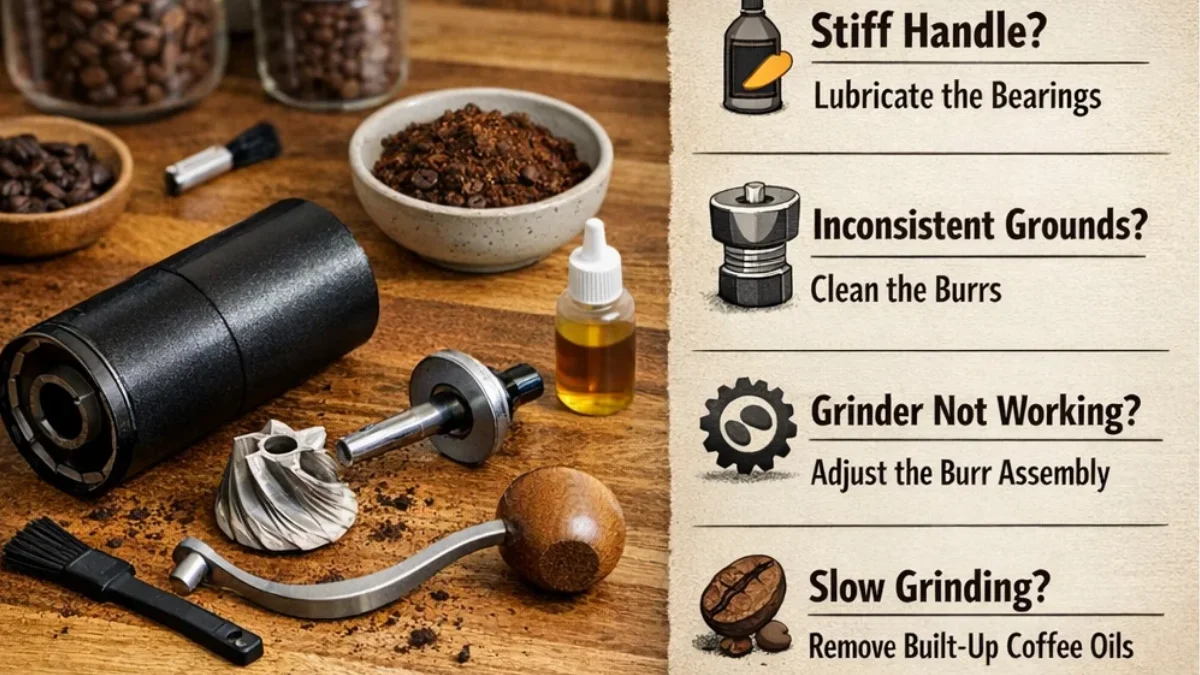
There’s a particular kind of frustration that comes from cranking a manual grinder and feeling almost nothing happen. The handle fights you, the grounds come out in a weird mix of dust and pebbles, or worse, the whole thing just feels broken.
If you’ve ever stood in your kitchen at 6 a.m. wondering whether your grinder died overnight, you’re not alone — and you’re almost certainly not dealing with a broken grinder.
Manual grinders are mechanically simple, which is exactly why they’re so reliable. But “simple” doesn’t mean “maintenance-free.” Most of the problems people run into — stiff handles, inconsistent grounds, grinders that barely grind at all — trace back to one of a handful of root causes, and nearly all of them are fixable in your kitchen in under ten minutes.
This guide walks through what’s actually happening inside your grinder when something feels off, why it happens, and exactly how to fix it.
Quick Answer: Why Your Manual Grinder Isn’t Working Properly
A manual coffee grinder typically misbehaves for one of these reasons:
- Grind setting too fine for the beans or the amount of effort you’re putting in
- Coffee oil and fines buildup clogging the burr chamber
- Worn or misaligned burrs that no longer mesh correctly
- Loose internal components — screws, axles, or the handle assembly
- Old or oily beans that gum up the grinding mechanism
In the vast majority of cases, a quick clean and a grind-size adjustment solve the problem completely. True mechanical failure — burrs wearing out, parts cracking — is rare and usually only shows up after years of heavy use.
Key Takeaways
- Most “broken” manual grinders are actually clogged or misadjusted, not damaged
- A stiff handle is almost always a grind-size or buildup issue, not a sign of failure
- Uneven grounds point to loose components or worn burrs more often than user error
- Regular cleaning (every 1–2 weeks for daily use) prevents the majority of these issues before they start
- Replacement is rarely necessary — most manual grinders can be fully restored to like-new performance
Why Manual Grinders Develop Problems in the First Place
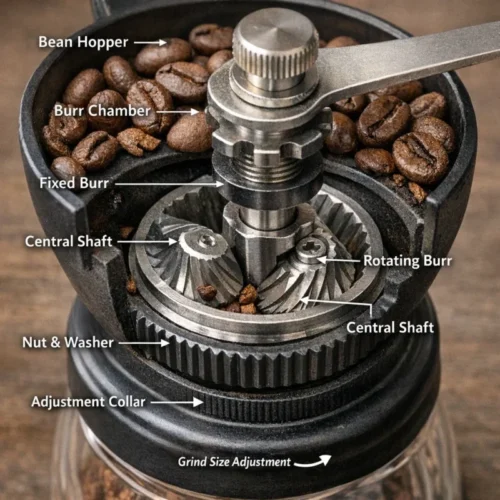
Before getting into individual fixes, it helps to understand what’s actually inside a manual grinder, because that explains why these five problems keep showing up.
Every manual burr grinder works the same basic way: beans drop from a hopper into a chamber where two burrs — one fixed, one rotating — crush and shear them into smaller pieces. The rotating burr is connected to the handle via a central shaft, usually secured with a nut, washer, or clip. The gap between the two burrs determines grind size, and that gap is controlled by an adjustment collar or dial.
Nothing about this system is electronic, and there’s no motor to burn out, overheat, or suddenly fail because a circuit board has given up. In that sense, it can seem almost reassuringly simple: you supply the power by hand, the crank transfers that force through the shaft, and the burrs do the work of cutting the beans.
But “simple” does not mean “rough” or “indestructible.” It is still a precision mechanical fit, and that precision is the entire reason it works well. The burrs need to sit at a consistent, narrow distance from each other, close enough to produce an even grind, but not so close that they scrape, bind, or chew unevenly through the coffee.
That distance also has to stay fixed while you crank with real force, often against dense, lightly roasted beans that place a serious load on the mechanism.
Because of this, even small issues can be obvious. Anything that affects alignment or spacing — a coffee fine caught in the wrong place, oily residue where parts should seat cleanly, an adjustment ring that has shifted a click or two, or a screw that has loosened over time — can change how the grinder feels.
You may notice added resistance, catching, uneven rotation, or a sensation that something is simply “wrong.” The grinder may still work, but the crank feedback tells you the mechanical relationship has changed.
That’s why maintenance and inspection matter, even without electronics or a motor. A manual grinder still relies on clean contact surfaces, tight fasteners, stable alignment, and an adjustment system that holds under pressure. When everything is seated properly, grinding feels steady, controlled, and predictable. When it doesn’t, the cause is usually small and mechanical — and in a precision grinder, small differences matter.
This is good news, actually. It means almost every problem is mechanical and visible, not hidden or electrical. You can usually diagnose a manual grinder issue just by taking it apart and looking.
Common Problems and How to Fix Them
1. The Grinder Is Unusually Hard to Turn
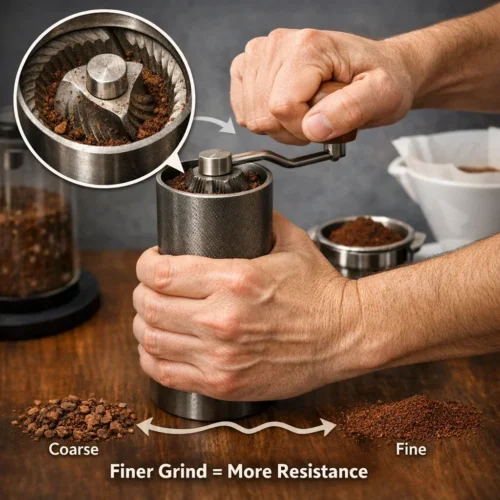
This is the most common complaint, and it usually isn’t a sign that anything is broken.
What’s actually happening
Manual grinders require more effort at finer settings by design — that’s simply physics. A tighter gap between burrs means more bean surface area is being crushed at once, which means more resistance on the handle. If you’ve recently switched to a finer grind (say, moving from French press to a pour-over setting, or worse, an espresso-fine setting most hand grinders aren’t designed for), the extra effort you’re feeling is completely normal.
The second most common cause is buildup. Coffee beans contain natural oils, and over weeks of grinding, those oils combine with fine coffee dust to form a sticky residue inside the burr chamber. This residue acts almost like a thin paste between the burrs, increasing friction with every rotation.
How to fix it:
- First, check your grind setting. If you’re grinding finer than usual, the extra resistance may simply be expected — try a slightly coarser setting and see if the effort drops noticeably.
- If the resistance feels gritty or uneven rather than smoothly heavy, that’s a sign of buildup rather than a legitimate fine grind. Disassemble the grinder and brush out the burr chamber thoroughly (a stiff, dry pastry brush or a dedicated grinder brush works well).
- Make sure your beans are reasonably fresh and not unusually oily. Very oily dark-roast beans clog burrs faster than lighter roasts.
- Avoid grinding more than one or two doses without a quick clean if you’re using oily beans regularly.
A grinder that’s merely stiff at fine settings is working as intended. A grinder that’s suddenly, dramatically harder to turn than it was last week almost always means it’s time to clean it.
2. The Grinder Produces Inconsistent or Uneven Grounds
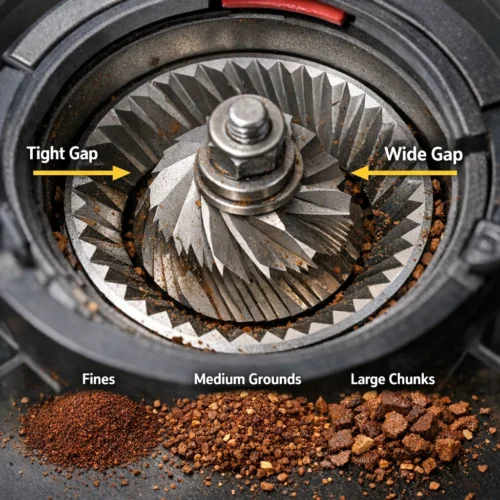
Uneven grounds are frustrating because they directly affect how your coffee tastes — a mix of fine dust and large chunks can lead to a confusing combination of over- and under-extraction in the same cup.
What’s actually happening
Burrs need to sit at a precisely even gap all the way around their circular path. If something has shifted — the adjustment collar has loosened slightly, a washer has worked its way out of position, or the central axle has developed minor play — the gap is no longer the same on all sides. The result is that grounds come out in several different sizes in the same batch, even though you only set the dial once.
Worn burrs cause a similar effect over a much longer timeline. As burr edges wear down from years of use, they lose their sharp, defined cutting surfaces and start to crush rather than shear the beans cleanly, which produces more fine dust mixed in with your intended grind size.
How to fix it:
- Disassemble the grinder fully and check that every component — washers, the central nut, the burr holder — is correctly seated and tightened.
- Re-set your grind size from scratch rather than assuming the dial is accurate; small drifts in adjustment collars happen gradually and aren’t always obvious.
- Inspect the burrs themselves for visible wear, shiny worn patches, or chips along the cutting edges.
- If everything is tightened and clean but unevenness persists, the burrs themselves may have reached the end of their useful life.
A look at our guide on why coffee grinders produce uneven grounds goes deeper into diagnosing this specific issue.
3. The Grinder Isn’t Grinding at All
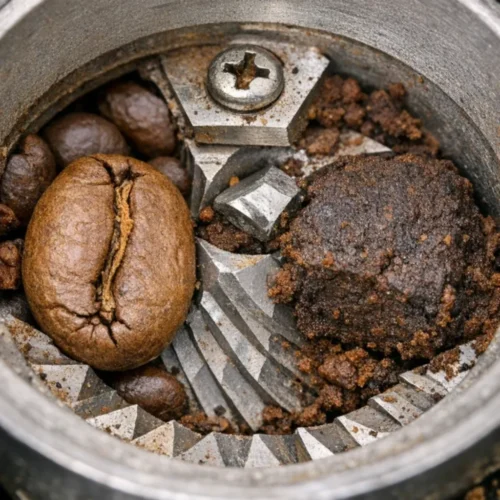
This is the most alarming-feeling problem, but it’s almost never a true mechanical failure.
What’s actually happening: In nearly every case, this comes down to one of two things: the burrs have been adjusted to a gap so tight that beans simply can’t pass through, or something is physically blocking the chamber — usually a foreign object, a swollen or oversized bean, or a dense clump of old coffee residue that’s hardened into a small block.
Less commonly, a component has come loose internally to the point that the rotating burr is spinning freely without actually engaging with the fixed burr — meaning the handle turns, but no real grinding force is being applied.
How to fix it:
- Open the adjustment all the way to your coarsest setting and try again. If beans suddenly start moving through, your gap was simply closed too tight.
- Fully disassemble the grinder and visually check the chamber for blockages, paying particular attention to the area directly around the burrs where buildup tends to harden over time.
- Reassemble carefully, making sure the rotating burr is properly seated against the drive shaft and that nothing is spinning loose.
- If beans go in but nothing comes out even at the widest setting, check that the burrs are actually making contact at all — a fully disengaged burr will turn the handle with almost no resistance whatsoever, which is itself a useful diagnostic clue.
4. Grinding Feels Painfully Slow
Slow grinding is less about something being “wrong” and more about working against the grinder’s design.
What’s actually happening: Finer grind settings naturally take longer because more crushing work is happening per rotation. Overfilling the hopper compounds this — too many beans at once means the top layer adds weight and resistance without actually being processed any faster, since only the beans nearest the burrs are doing anything.
How to fix it:
- Grind in smaller batches rather than filling the hopper to capacity. Most hand grinders are noticeably faster and easier with half-size batches.
- Double-check your grind setting against what your brew method actually requires — espresso-fine settings on a hand grinder will always be slow, almost regardless of grinder quality.
- If grinding has become gradually slower over weeks, treat it as a buildup issue and clean the burr chamber.
5. The Handle Feels Loose or Slips During Use
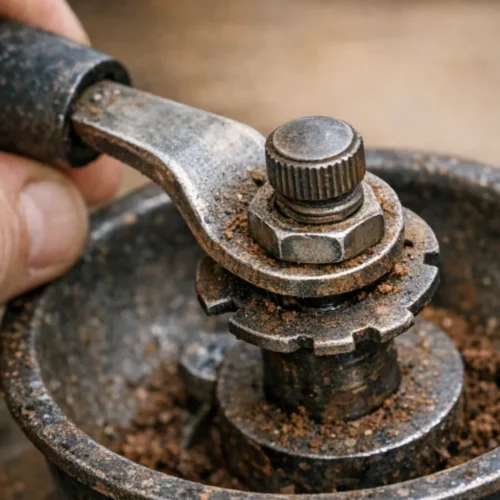
A loose or slipping handle is a purely assembly issue rather than a grinding mechanism problem, but it’s worth addressing since it affects both comfort and grind consistency.
What’s actually happening:
The handle connects to the central shaft through a screw, nut, or pin mechanism, depending on the grinder model. Repeated cranking puts cyclical stress on this connection, and over months of regular use, it’s normal for it to gradually loosen.
How to fix it:
- Check the screw or nut connecting the handle to the shaft and tighten it by hand (avoid overtightening with tools, which can damage threads on smaller hardware).
- If the handle slips rather than simply feeling loose, inspect for worn-down flat edges or rounded corners on the connection point, which can happen after extended heavy use.
- A small drop of food-safe mechanical grease on metal-to-metal contact points (never on the burrs themselves) can help reduce wear-related slipping in older grinders.
How to Adjust Your Manual Grinder Properly
A surprising number of “malfunctions” are really just confusion about adjustments. A few habits make this far more reliable:
- Turn the adjustment dial in small increments and test-grind a small amount after each change rather than guessing at a final setting.
- Match your grind size to your actual brew method rather than a remembered “usual” setting — ratios and ideal grind size vary depending on whether you’re brewing French press, pour-over, or espresso.
- If your grinder uses click-stop adjustments, count clicks from a known reference point (such as fully closed) rather than relying on memory, since this makes it far easier to return to a known-good setting later.
For a full breakdown of which grind size suits which brew method, our coffee grind size chart is a useful reference to keep nearby.
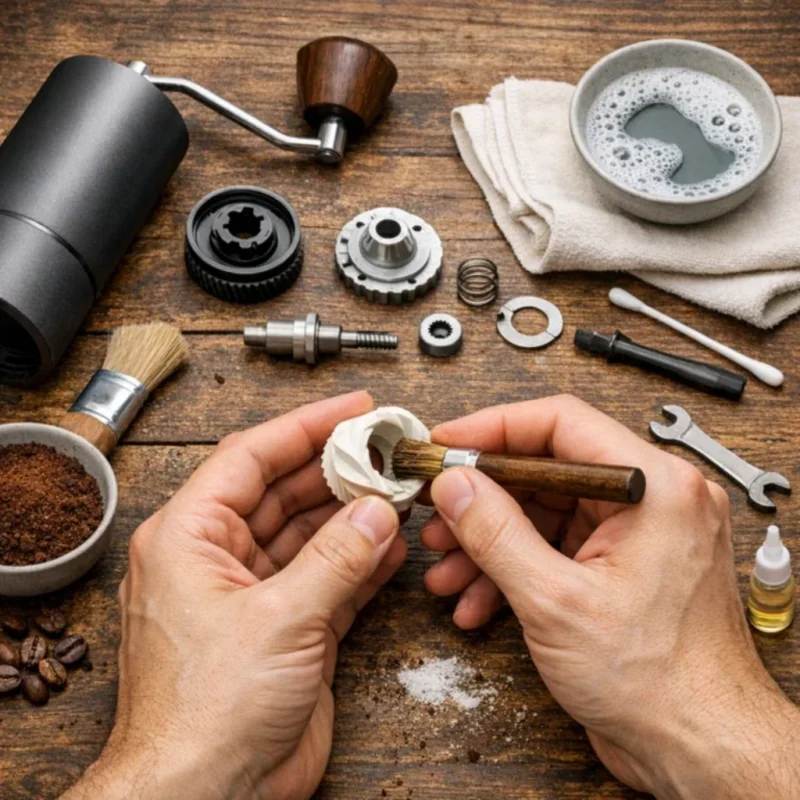
When to Clean Your Grinder
Cleaning solves more manual grinder problems than any other single fix, which makes it worth treating as routine maintenance rather than a last resort.
Signs it’s time to clean:
- The handle feels noticeably stiffer than it used to at the same setting
- Grounds have started coming out inconsistent in size
- Your coffee has developed a stale or slightly rancid edge, even with fresh beans
- You can see visible buildup or dust clumping near the burr chamber when you look inside
For most home users who grind once or twice daily, cleaning every 1 to 2 weeks keeps a manual grinder performing like new. Heavy daily use or consistently oily dark-roast beans may require weekly cleaning. Our guide to properly cleaning a coffee grinder walks through the full process step by step.
When It’s Time to Replace Your Grinder
Most manual grinders are built to last for years, and true end-of-life failure is uncommon. That said, a few signs suggest a grinder has genuinely reached its limit rather than simply needing maintenance:
- Burrs show visible wear, chipping, or smooth shiny patches where sharp edges used to be
- Grind consistency remains poor even immediately after a full cleaning and reassembly
- Plastic components have cracked or internal metal parts have visibly bent or warped
- The grinder requires constant re-tightening even after a thorough fix
If you’re seeing these signs consistently rather than occasionally, it may be worth looking at our manual coffee grinder buying guide to compare what an upgrade would offer.
Tips to Prevent Manual Grinder Problems Before They Start
A little routine care goes a long way with manual grinders, since their simplicity rewards consistency:
- Clean the burr chamber on a regular schedule rather than waiting for problems to appear
- Match grind settings deliberately to your brew method instead of leaving the dial wherever it last ended up
- Avoid overfilling the hopper, even when you’re in a hurry
- Store the grinder fully assembled in a dry spot, away from humidity that can encourage residue to harden
- Periodically check that the handle connection and adjustment collar are still snug
Frequently Asked Questions
Why is my manual grinder suddenly hard to turn?
It’s most often one of two things: a finer grind setting than you’re used to, or coffee oil and fines buildup inside the burr chamber. Try a coarser setting first, then clean the grinder if resistance still feels gritty rather than smoothly heavy.
Why is my grinder producing such uneven grounds?
Uneven grounds usually indicate a loose adjustment collar, a slightly shifted internal component, or burrs that have begun to wear down. Disassembling, re-tightening, and resetting the grind size from scratch resolves most cases.
Can I actually fix a manual grinder myself, or does it need a professional?
Nearly all common manual grinder issues are fixable at home with no tools other than those that came with the grinder. Disassembly, cleaning, and reassembly cover the large majority of problems people run into.
How often should I clean my manual grinder?
Every one to two weeks for typical daily use is a reasonable baseline. Heavier daily grinding or oily dark-roast beans may call for weekly cleaning to prevent buildup-related issues.
Is it normal for a manual grinder to need more effort at fine settings?
Yes, completely normal. Finer grind settings require more crushing force per rotation, so extra effort at espresso-fine or fine pour-over settings isn’t a sign of a problem.
Recommended Reading
Bottom Line
A manual grinder that’s acting up is almost never a grinder that’s dying. The mechanism is simple enough that nearly every issue — stiffness, unevenness, slow grinding, a loose handle — comes down to grind setting, buildup, or a component that’s worked itself slightly loose.
A few minutes of disassembly, cleaning, and re-adjustment restore the vast majority of manual grinders to full performance, often making them feel brand new again. Genuine replacement-worthy wear is the exception, not the rule.