
Quick Answer Box
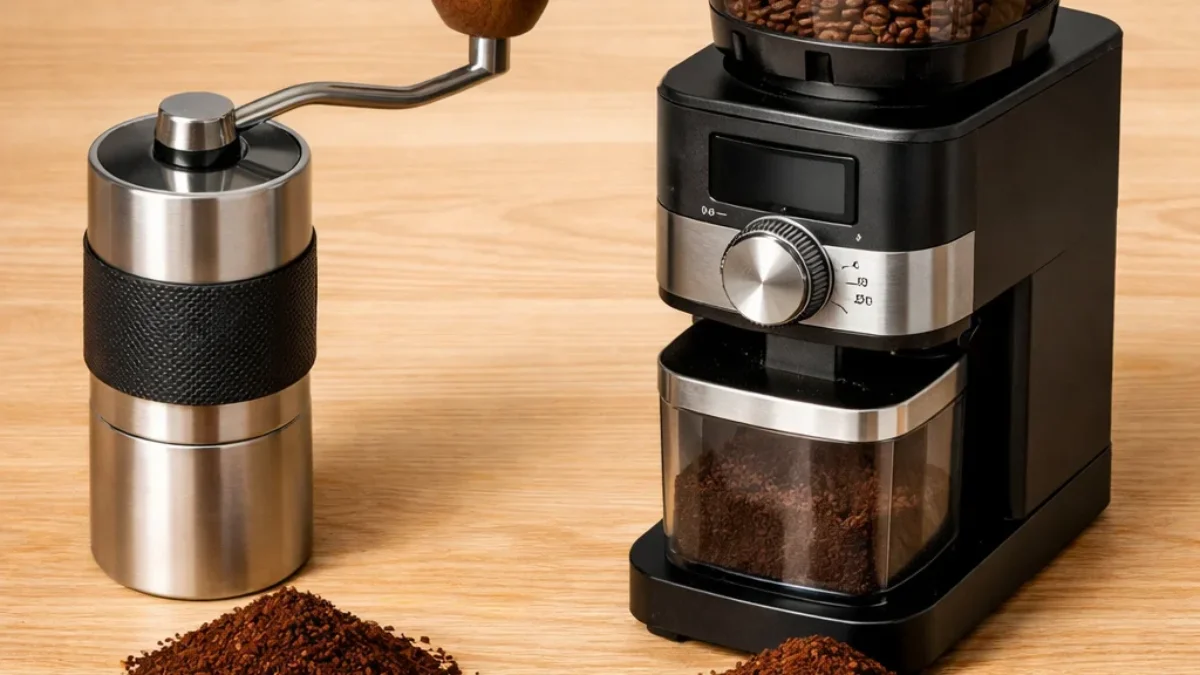
Conical burr grinders are the better practical choice for most home brewers. They are more affordable, quieter, widely available in manual formats, and produce excellent results across all brewing methods.
Flat burr grinders offer more precise particle separation and a cleaner flavor profile, but they come at a higher cost and are mainly found in electric grinders. For beginners and everyday home brewing, conical burrs are the clear starting point.
Introduction
If you’ve been researching coffee grinders, you’ve probably come across both terms — conical burr and flat burr — and found conflicting opinions about which is better.
Here’s the honest answer up front: both are far better than blade grinders for producing consistent coffee. The difference between them matters more as your skills and preferences develop. For most people starting out, a good conical burr grinder is all they need.
This guide explains how each type works, how they compare across the variables that actually affect your coffee, and how to decide which makes sense for where you are right now.
Related: Read our guide on the best manual coffee grinders
What Is a Burr Coffee Grinder?
A burr grinder crushes coffee beans between two abrasive surfaces — called burrs — rather than chopping them with a spinning blade. This produces a much more consistent particle size, which is fundamental to even extraction.
Blade grinders chop randomly. Some pieces end up fine, some coarse, some in between — all in the same batch. The result is a mix of over-extracted fine particles and under-extracted coarse ones in every cup.
Burr grinders, regardless of burr shape, eliminate most of that inconsistency. That’s the single most important upgrade any home brewer can make to their grinding setup.
- For a full comparison of burr and blade grinders, see Burr vs Blade Coffee Grinders.
- Electric grinders worth buying
What Are Conical Burr Grinders?
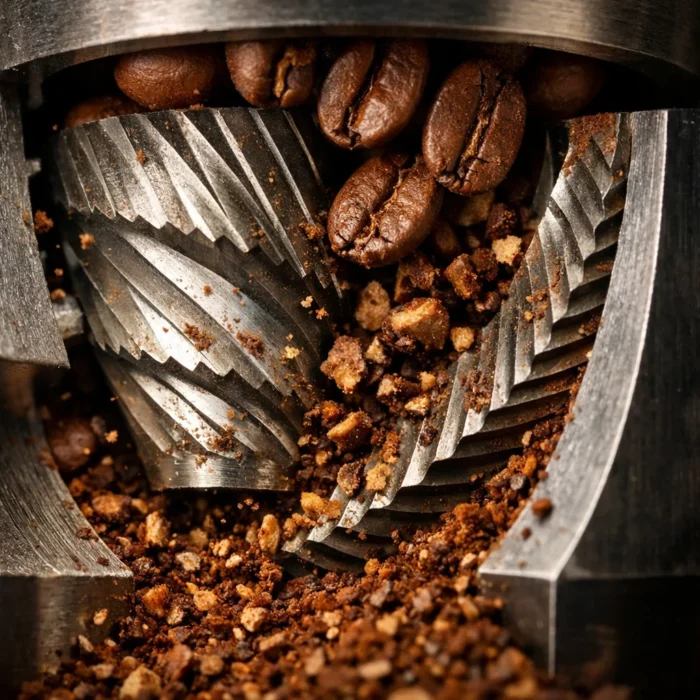
A conical burr grinder uses two burrs — a cone-shaped inner burr that fits inside a ring-shaped outer burr. Coffee beans feed into the gap between them from the top and are crushed as they travel downward through the narrowing space.
Key characteristics of conical burr grinders:
- Lower retention: Grounds travel through the burrs quickly by gravity. Less coffee gets stuck inside the grinder between uses.
- Quieter operation: The cone-and-ring design operates at lower RPM than many flat burr designs, producing less noise.
- Wide grind range: Conical burrs handle everything from espresso-fine to cold-brew-coarse with reliable results.
- Common in manual grinders: Almost all use conical burrs. This makes them the natural entry point for budget-conscious home brewers.
- Slightly more body in the cup: Conical burrs tend to produce a slightly wider range of particle sizes, which some brewers feel adds body and roundness to the final flavor.
What Are Flat Burr Grinders?
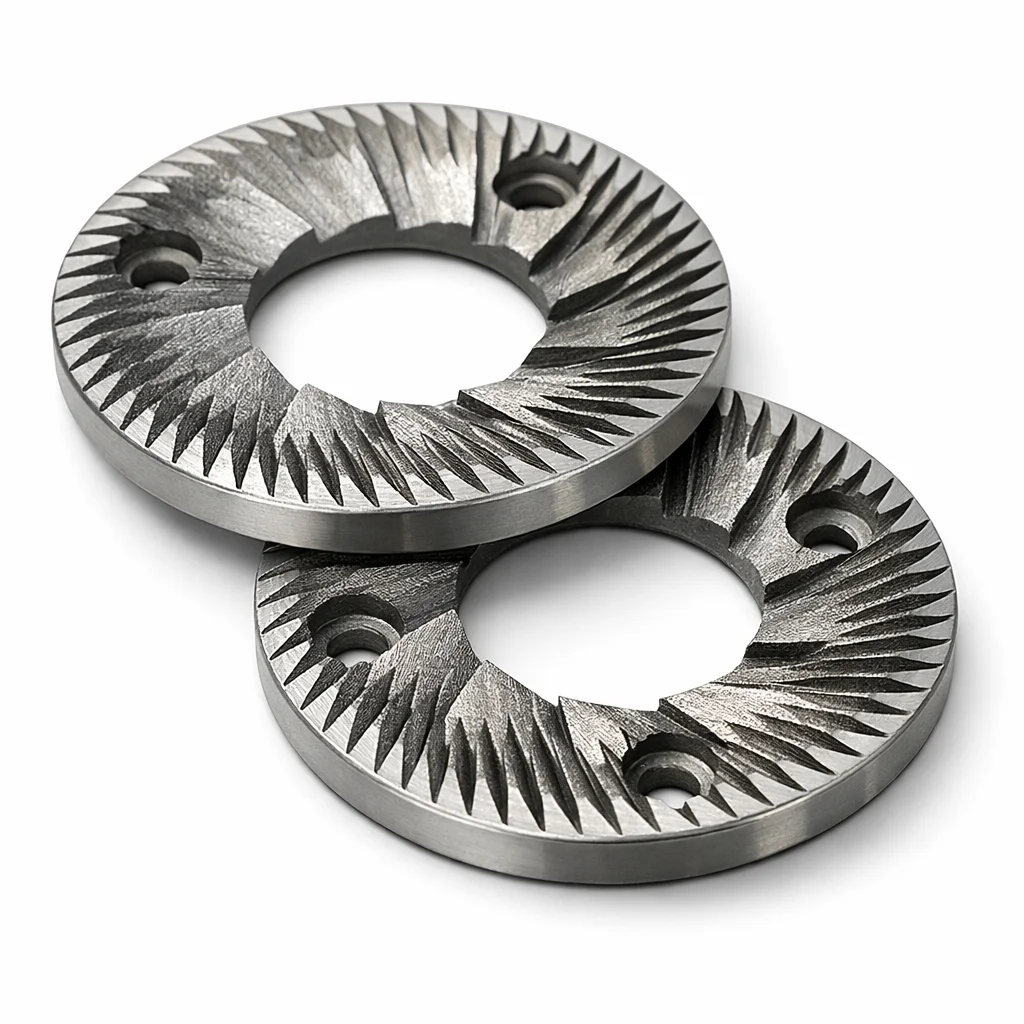
A flat burr grinder uses two parallel disc-shaped burrs facing each other. Coffee beans feed in from the center and are ground as they move outward through the gap between the two discs.
Key characteristics of flat burr grinders:
- More even particle distribution: Flat burrs tend to produce a narrower range of particle sizes per setting, meaning more grounds are closer to the same size.
- Clearer flavor separation: The more uniform grind is often associated with a brighter, more precise flavor profile — individual tasting notes come through with more definition.
- Higher retention: Flat burrs can retain more ground coffee between uses, which matters more for espresso than for filter coffee.
- Louder operation: Most flat burr grinders run at higher speeds than conical models.
- Mainly electric: High-quality flat burr grinders are almost exclusively electric, and they tend to be more expensive than comparable conical options.
Conical vs Flat Burr Grinders: Quick Comparison
| Feature | Conical Burrs | Flat Burrs |
|---|---|---|
| Price | Often more affordable | Often more expensive |
| Noise | Usually quieter | Often louder |
| Grind retention | Usually lower | Can be higher |
| Flavour style | Fuller, more rounded | Cleaner, more defined |
| Best for | Beginners and all-purpose brewing | Enthusiasts and precision-focused brewing |
| Common format | Manual and electric | Mainly electric |
| Availability | Very wide | More limited at lower price points |
Which Burr Type Produces Better-Tasting Coffee?
This is where most of the debate lives — and it’s worth being honest about: for most home brewers, the difference is small and often not the most important factor.
The flavor difference between conical and flat burrs is real, but it exists at the margins. A conical burr grinder tends to produce a fuller, slightly rounder cup — some describe it as having more body. A flat burr grinder tends to produce a cleaner, more separated cup — individual flavor notes feel more distinct.
Neither is universally better. “Body” versus “clarity” is a preference, not a ranking. Many experienced brewers genuinely prefer the rounded quality of a good conical burr result.
More importantly, bean freshness, grind setting, water temperature, and brewing technique have a larger impact on your final cup than burr shape alone. A quality conical burr grinder used well will consistently outperform a flat burr grinder used carelessly.
Which Burr Type Is Better for Pour Over?
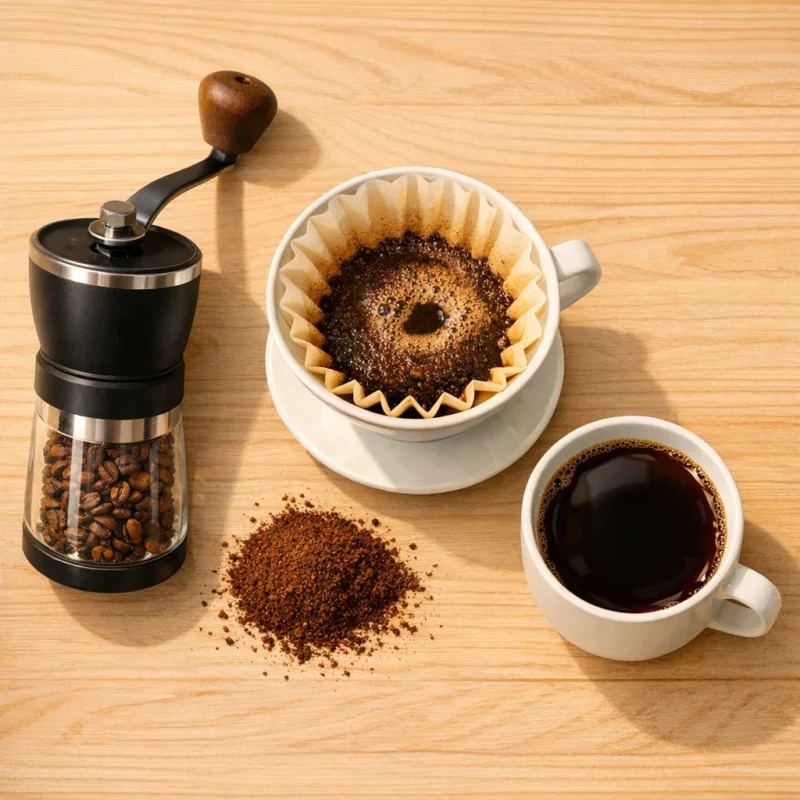
Pour-over rewards grind consistency. Clean, even particle sizes produce predictable water flow through the coffee bed and even extraction across the whole dose.
Flat burr grinders have a reputation in specialty coffee circles for producing cleaner, brighter pour-over results — and that reputation is well-founded. Enthusiasts who enjoy tasting subtle differences between single-origin beans often prefer flat burrs for this reason.
That said, a quality conical burr grinder is more than capable of producing excellent pour-over coffee. Many well-regarded manual grinders use conical burrs, and the pour-over they produce is genuinely impressive.
For most beginners and intermediate home brewers, a good conical burr grinder paired with proper technique will produce a noticeably better pour-over than the method alone would suggest is possible.
See the Pour Over Coffee Guide for technique, and the Manual Coffee Grinder Buying Guide for grinder recommendations across budget levels.
Which Burr Type Is Better for French Press?
French press is more forgiving of slight grind inconsistencies than pour-over. The long immersion steep and metal filter mean that small variations in particle size matter less than they would in a paper-filtered method.
A good conical burr grinder is entirely sufficient for French press. The key requirement is simply a coarse, relatively consistent grind that minimizes fines — which both burr types deliver far better than blade grinders.
Reducing fine particles is the most important grind-related consideration for French press, since fines pass through the metal mesh filter and add muddy, bitter sediment to the cup. Both conical and flat burr grinders significantly reduce this problem compared to blade grinding.
See French Press Coffee Guide for the full method.
Which Burr Type Is Better for Cold Brew?
Cold brew is the most forgiving brewing method when it comes to grinder performance. It uses a very coarse grind, a long steep time, and cold water — a combination that is naturally tolerant of some grind inconsistency.
Both conical and flat burr grinders perform well for cold brew. Even a basic conical burr grinder set to its coarsest setting will produce consistent enough results for excellent cold brew concentrate.
If your primary brewing method is cold brew, burr shape should be one of the last factors influencing your grinder choice. Budget, build quality, and ease of use matter more here.
See Cold Brew Coffee Guide for technique.
Conical vs Flat Burr Grinders for Beginners
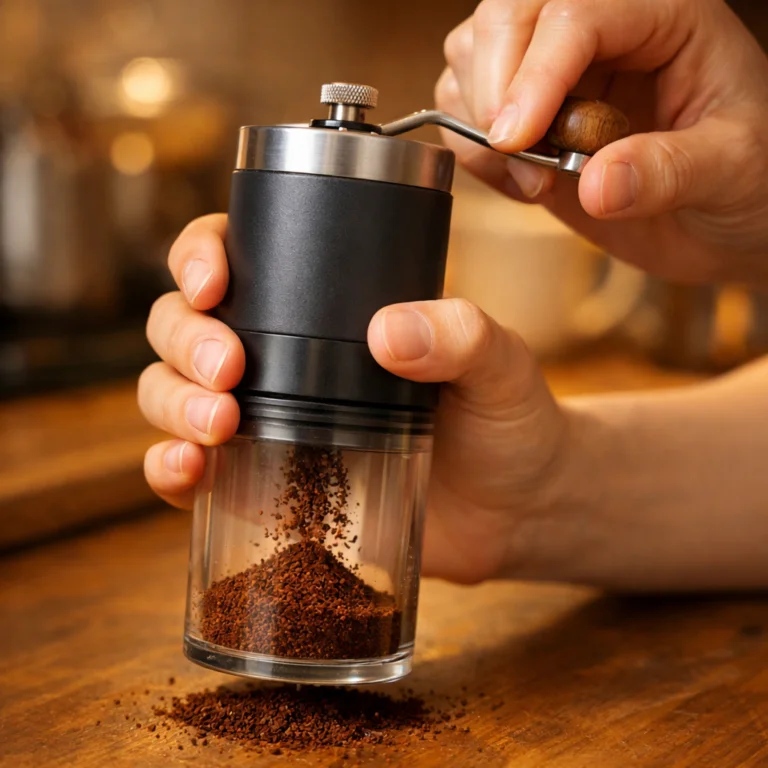
For most people starting out with home coffee brewing, conical burr grinders are the right choice. Here’s why:
- They are available at a much wider range of price points, including excellent manual options under $50.
- Manual conical burr grinders require no power, are portable, and are easy to clean.
- They produce great results across every common home-brewing method — pour-over, French press, AeroPress, cold brew, and drip.
- The performance gap between conical and flat burrs only becomes meaningful at a level of refinement that most beginners haven’t yet reached.
Starting with a quality conical burr grinder lets you develop your brewing skills without overspending on equipment precision you can’t yet take full advantage of.
See Manual Coffee Grinder Buying Guide and Best Manual Coffee Grinders for specific options.
When a Flat Burr Grinder May Be Worth the Extra Cost
Flat burr grinders start making more sense in specific situations:
You brew pour over daily and enjoy comparing subtle differences between single-origin beans. The improved clarity flat burrs offer is most noticeable when you’re actively exploring bean character rather than just making a satisfying morning cup.
You have a stable brewing routine and want to push results further. Once technique is consistent and grind setting is dialed in, a flat burr upgrade can provide a noticeable improvement in cup definition.
Your budget supports it comfortably. Quality flat burr electric grinders typically start at $150–$200 and go significantly higher. That’s a meaningful investment, and it makes the most sense once you’ve confirmed that manual brewing is a long-term habit rather than an experiment.
FAQs
Are flat burr grinders always better?
No. Flat burrs produce a cleaner, more defined flavour profile that some brewers prefer. Conical burrs produce a fuller, more rounded cup that others prefer. The difference is a style preference, not a quality ranking.
Are conical burr grinders good enough for pour over?
Yes. Many excellent pour over setups use conical burr grinders. The best manual grinders on the market — including popular options from 1Zpresso and Timemore — use conical burrs and produce outstanding pour over results.
Which burr type is best for beginners? Conical burr grinders. They offer a wider range of affordable options, excellent all-purpose performance, and are available in manual formats that don’t require a power outlet.
Are manual grinders usually conical burr grinders?
Yes. Almost all manual hand grinders use conical burrs. The design works naturally with the hand-cranking mechanism and suits the portability and lower-retention priorities that manual grinder users typically have.
Do flat burr grinders make less bitter coffee?
Not directly. Bitterness in coffee is primarily caused by over-extraction — from grind size that’s too fine, water that’s too hot, or brew time that’s too long. Flat burrs can produce a cleaner cup, but they don’t specifically reduce bitterness. Grind setting and brewing technique matter much more.
Key Takeaways
Both conical and flat burr grinders are a major improvement over blade grinders — the burr vs blade choice matters more than conical vs flat for most beginners.
- Conical burrs are more affordable, quieter, and widely available in manual format — they’re the right starting point for most home brewers.
- Flat burrs offer cleaner particle separation and a more defined flavor profile — the advantage is most noticeable for daily pour-over enthusiasts exploring single-origin beans.
- For French press and cold brew, conical burrs are entirely sufficient — the extra cost of flat burrs offers diminishing returns for immersion methods.
- Start with a quality conical burr grinder and invest in technique first — the grinder upgrade can come later once you’ve developed a consistent routine.
Recommended Reading
- Manual Coffee Grinder Buying Guide
- Burr vs Blade Coffee Grinders
- Best Manual Coffee Grinders
- Coffee Grind Size Chart
- Manual vs Electric Coffee Grinder
- Pour Over Coffee Guide