
Quick Answer Box
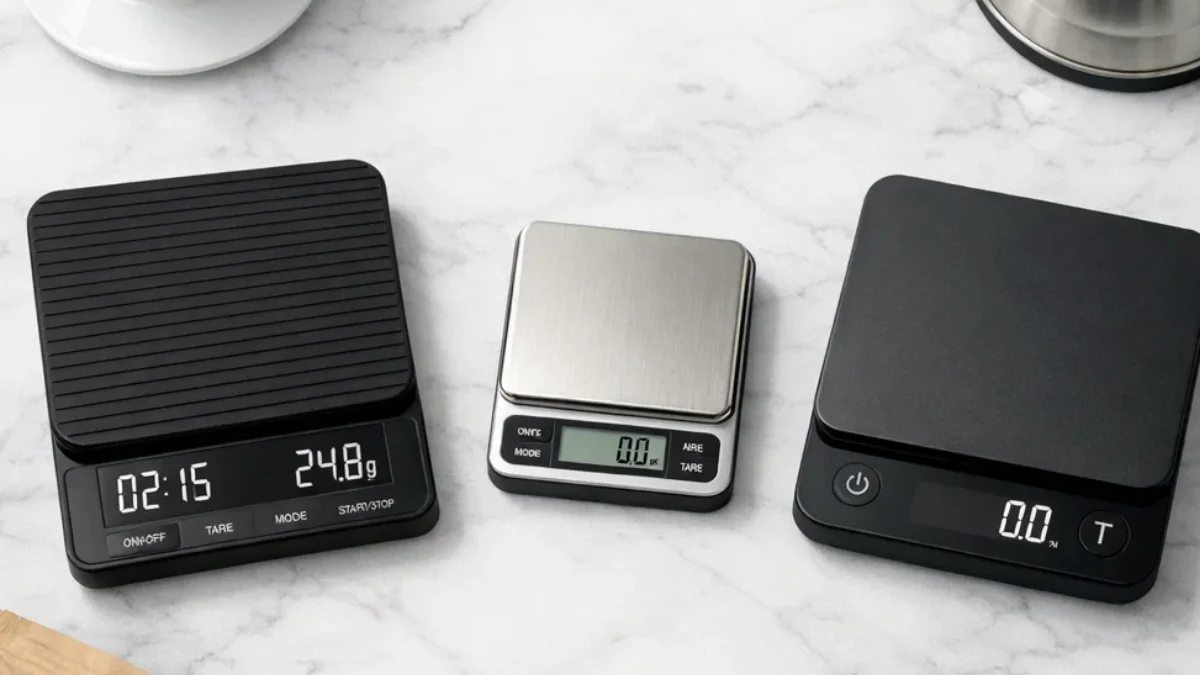
The best coffee scale for most home brewers is accurate to at least 1g, has a built-in timer, fits your brewer on the platform, and is water-resistant. You don’t need to spend much to get a scale that meaningfully improves your brewing. Budget options work well for French press and cold brew. For pour-over, a scale with 0.1g accuracy and a responsive timer make the most difference.
Introduction
A coffee scale is one of the most practical upgrades a home brewer can make. It costs less than most brewing equipment, takes up minimal counter space, and immediately improves the consistency of every cup you make — regardless of whether you brew pour-over, French press, or cold brew.
The challenge is choosing between the many options available. Not all coffee scales are equally useful, and some features that sound impressive on a product page matter much less in daily brewing than others.
This guide covers what to look for, which features are genuinely useful versus marketing noise, and how to match a scale to how you actually brew.
Quick Picks: Best Coffee Scales for Home Brewing
| Best For | Why It Stands Out |
|---|---|
| Best overall | Accurate, timer-equipped, water-resistant, practical platform size for most brewers |
| Best budget scale | Greater Goods Coffee Scale — reliable accuracy, simple interface, strong value |
| Best compact scale | Maestri House Mini Coffee Scale — small footprint, portable, suited to small setups |
| Best for pour over | Responsive 0.1g accuracy, clear display, built-in timer, wide platform |
| Best for travel | Compact, USB-rechargeable, lightweight with protective cover |
Why a Coffee Scale Makes Better Coffee
Consistency is the core benefit. A scale makes precise two things that volume measurement cannot: how much coffee you use and how much water you add.
Without a scale, small variations in scoop size, grind density, and water volume compound across every brew. With a scale, those variables are locked in. Once you find a ratio that produces a cup you enjoy, you can reproduce it exactly.
A scale also makes troubleshooting straightforward. When something tastes off, you have a reliable record of exactly what you did — dose and water weight — which tells you which variable to change next.
See How to Use a Coffee Scale for a full beginner walkthrough, and Coffee Brewing Ratio Explained for guidance on ratios.
What to Look for in a Coffee Scale
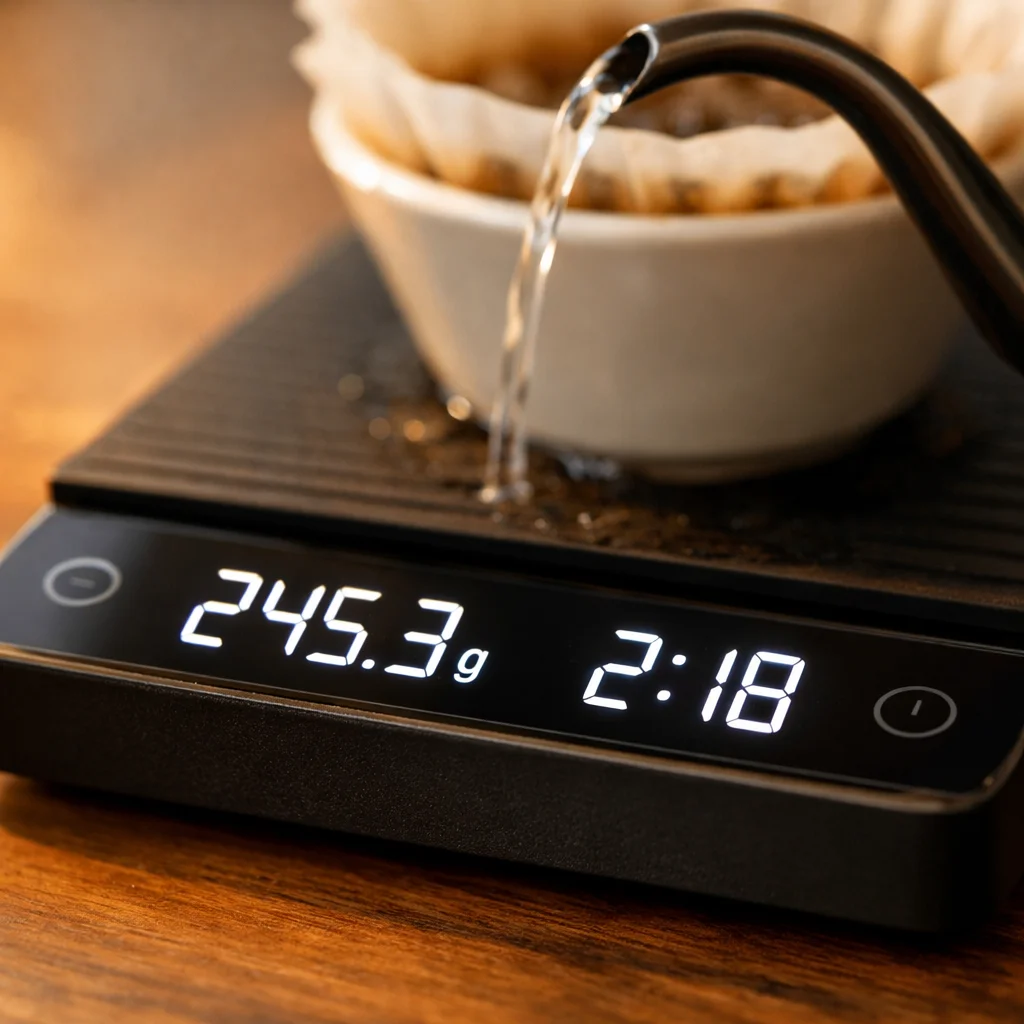
Accuracy: 0.1g increments are useful for pour-over, where small dose variations noticeably affect extraction. For French press and cold brew, 1g accuracy is sufficient and more affordable.
Capacity: Most home setups need at least 2kg capacity. Larger batches — Chemex for multiple people, cold brew pitchers — may need 3kg or more.
Built-in timer: Convenient for pour-over, where bloom timing and total brew time run simultaneously with water weight. A separate phone timer works equally well for French press and cold brew.
Response speed: A scale that updates slowly lags behind fast pours. For pour over especially, a scale that responds quickly to weight changes makes pouring to a target much easier.
Water resistance: Splashes and steam are part of manual brewing. IPX ratings indicate water resistance level — even basic splash resistance is worth having.
Platform size: The scale platform needs to fit your brewer comfortably. A V60 on a server fits most standard platforms. A Chemex or large French press needs a wider base.
Battery: Rechargeable (USB) scales avoid the frustration of dead batteries. Replaceable battery scales are more common at lower price points — keep a spare set if you go this route.
Display visibility: A clear, backlit display is much easier to read in typical kitchen lighting than a small, dim one, especially when pouring with one hand.
Coffee Scale vs Kitchen Scale: Which Should You Buy?
A standard kitchen scale works adequately for French press and cold brew. Both methods use larger quantities and are forgiving of small measurement variations.
For pour over, the case for a coffee-specific scale is stronger. Coffee scales tend to offer:
- Faster response speed for real-time pour tracking
- Built-in timers
- Smaller, more stable platforms suited to single-server setups
- Lower profile that fits more easily under low-clearance drippers
If you already own a reliable kitchen scale that reads to 1g, try using it for coffee before buying a dedicated scale. You may find it’s perfectly adequate for your brewing style.
Best Overall Coffee Scale
Best for: Daily home brewers who want a single scale that works well for pour-over, French press, and cold brew.
A strong all-around coffee scale combines 0.1g accuracy with a built-in timer, a water-resistant platform, and a display clear enough to read mid-pour. The platform should be large enough for a standard single-serve server, with the dripper not overhanging the edges.
What to look for:
- Dual-unit display showing weight and timer simultaneously
- Response time of less than 0.5 seconds
- At least splash resistance (IPX3 or above)
- USB-C or Micro-USB charging
Limitations to expect at this category: Most scales in the mid-range aren’t fully waterproof — spills directly onto the scale can cause damage over time. Handle with care during active pouring.
Who should buy it: Any home brewer who wants a single, reliable scale that works well across multiple methods without paying a premium.
Best Budget Coffee Scale
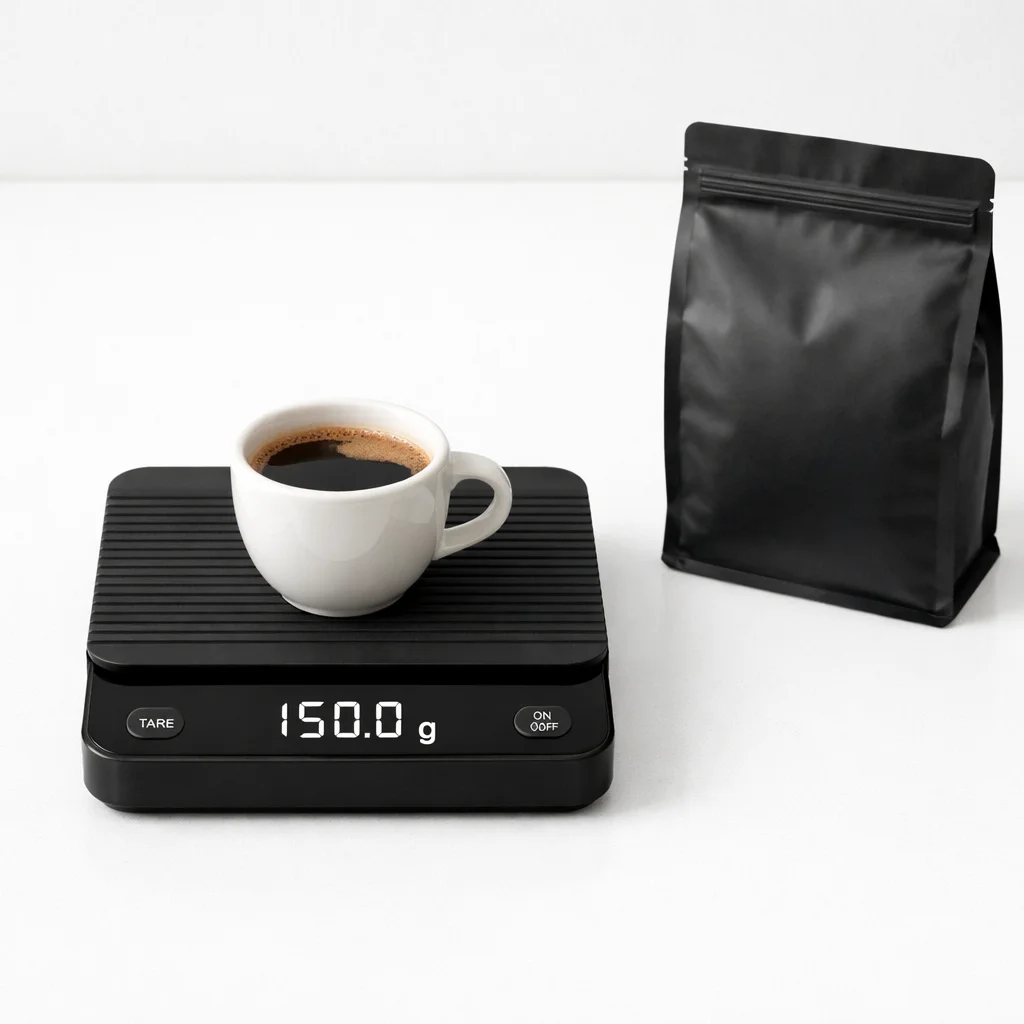
The Greater Goods Coffee Scale remains one of the most recommended entry-level options for home coffee brewing. It offers reliable accuracy, a clean interface, and practical features for everyday use without unnecessary complexity.
Best for: Beginners and casual brewers who want accurate measurements without spending on features they may not use.
What it does well: Consistent accuracy, straightforward tare function, and a stable platform. Its simplicity is a genuine advantage — there’s very little to learn and very little to go wrong.
Limitations: No built-in timer on some versions. Response speed is adequate but slower than that of higher-end models. Not water-resistant.
Who should buy it: Beginners starting out with French press or pour-over who want to build good-ratio habits without a significant equipment investment.
See the full Greater Goods Coffee Scale Review for detailed performance testing.
Best Compact Coffee Scale
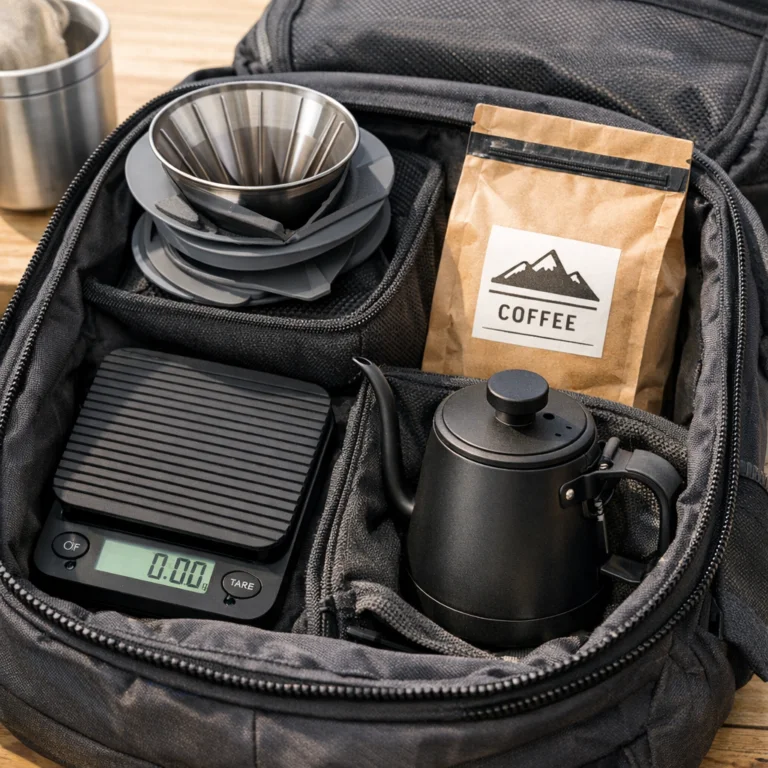
The Maestri House Mini Coffee Scale is built specifically for small spaces, travel, and compact brewing setups where a full-size scale platform would be impractical.
Best for: Small kitchen setups, travel brewing kits, and brewers who want portability without sacrificing accuracy.
What it does well: Small footprint, lightweight, and accurate enough for everyday home brewing. Fits easily in a travel bag alongside a compact pour over kit.
Limitations: Smaller platform means some larger brewers overhang the edges. Lower capacity than full-size scales. Not suitable for large batch cold brew.
Who should buy it: Frequent travelers, small-apartment brewers, and anyone building a compact pour-over kit where portability matters.
See the full Maestri House Mini Coffee Scale Review for more detail.
Best Coffee Scale for Pour Over
Pour-over places the greatest demands on a coffee scale. You’re tracking weight and time simultaneously, often with one hand occupied by a kettle. The scale needs to respond quickly, display clearly, and time the bloom alongside water weight without requiring you to look away from the pour.
Key features for pour over:
- 0.1g accuracy — small dose changes matter more at pour over’s shorter contact times
- Fast response — ideally updating every 100–200 milliseconds so you can track pour rate in real time
- Clear simultaneous display of both weight and elapsed time
- Wide, stable platform — a server plus dripper sits more securely on a wider base
- Auto-off delay — pour over takes 3–4 minutes; a scale that auto-offs after 2 minutes mid-brew is frustrating
A scale that meets these criteria may cost slightly more than a basic model, but the improvement in pour-over control is genuinely worth it.
See “Pour Over Coffee Ratio Explained” for the complete pour-over measurement method.
Best Coffee Scale for Travel and Small Kitchens
Travel and compact kitchen scales prioritize three things: small footprint, lightweight, and USB charging.
What matters most:
- Dimensions: Should fit in a bag alongside brewing gear without adding significant bulk
- USB charging: Proprietary charging cables are inconvenient for travel; USB-C is the most practical standard
- Protective cover: Some compact scales include a flip-cover that protects the display and doubles as a platform stabilizer
- Trade-offs to accept: Smaller platform, lower maximum capacity, sometimes slower response
Travel scales are not ideal as your primary home scale if you brew Chemex or large French press batches. They’re best for single-serve pour over setups where portability is the priority.
Are Expensive Coffee Scales Worth It?
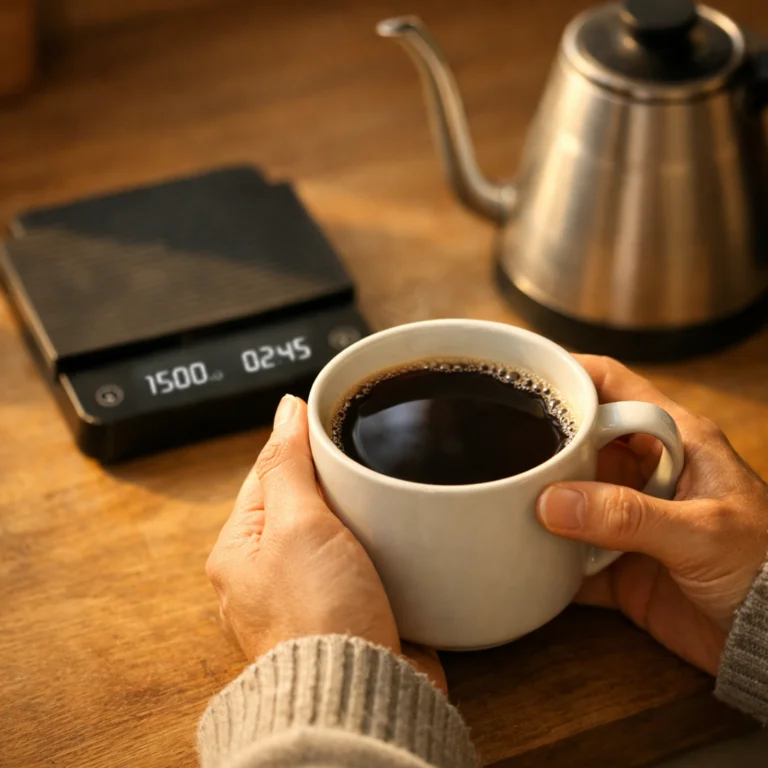
For most home brewers, the answer is no — at least not at the beginning.
The difference between a $25 budget scale and a $100 premium scale is real, but it’s primarily in response speed, build quality, and advanced features (like automatic tare at the start of a pour, or Bluetooth app connectivity). These features improve the experience for experienced brewers who have already optimized their technique.
For beginners, the ratio consistency of a $25 scale is identical to that of a $150 scale. The brewing improvement comes from using a scale consistently, not from which scale you use.
Upgrade when you’ve developed a consistent pour over routine and notice that scale response speed or precision is the limiting factor — not before.
Common Coffee Scale Problems and How to Avoid Them
Inaccurate readings: Usually caused by an uneven surface, low battery, or accumulated residue on the platform. Keep the scale on a flat surface, charge or replace batteries regularly, and wipe the platform clean after each use.
Slow response: A slow-updating scale makes real-time pour tracking difficult. This is primarily a hardware characteristic — if your current scale is frustratingly slow for pour over, it’s a reason to consider an upgrade.
Water damage: The most common cause of scale failure. Keep the scale away from direct water exposure, dry the platform after spills, and choose a water-resistant model if you brew manually every day.
Low battery at inconvenient moments:Keep a spare set of AAA or AA batteries if your scale uses replaceable batteries. Rechargeable scales avoid this entirely.
Uneven surface: Placing the scale on a slightly curved or textured countertop causes inconsistent readings. A small cutting board as a base solves this problem completely.
See Coffee Scale Not Accurate? for a full troubleshooting guide.
FAQs
Do I need a coffee scale for pour over?
It’s the single most useful addition to a pour over setup after the grinder and kettle. Without a scale, ratio and water volume vary cup to cup in ways that are hard to diagnose or fix systematically.
Is 0.1g accuracy necessary?
For pour over, it’s helpful but not essential when starting out. For French press and cold brew, 1g accuracy is entirely sufficient. Start with whatever accuracy level you can access, and upgrade if and when precision becomes the limiting factor.
Can I use a kitchen scale for coffee?
Yes — a kitchen scale that reads to 1g works well for French press and cold brew. For pour-over, a coffee-specific scale with a built-in timer and faster response time is more convenient but not strictly necessary.
What is the best coffee scale for beginners?
The Greater Goods Coffee Scale is a well-regarded entry-level option that balances accuracy, simplicity, and value. The Maestri House Mini is a strong alternative for anyone prioritizing a compact footprint.
Are rechargeable coffee scales better?
For convenience, yes. USB-rechargeable scales eliminate the need for replacement batteries and are more practical for daily brewing. The trade-off is that some rechargeable models are slightly more expensive than comparable battery-powered options.
Key Takeaways
- Accuracy, timer, platform size, and water resistance are the four features that matter most for daily coffee use.
- 0.1g accuracy helps pour over; 1g accuracy is sufficient for French press and cold brew.
- The Greater Goods and Maestri House Mini scales are well-established options at the budget and compact ends of the market.
- Expensive scales aren’t necessary for beginners — consistent use of a basic scale improves brewing far more than the scale’s price point.
- Response speed matters for pour over — a scale that updates slowly makes real-time water tracking frustrating.
Recommended Reading
- How to Use a Coffee Scale
- Essential Coffee Brewing Tools
- Coffee Scale Not Accurate?
- Greater Goods Coffee Scale Review
- Maestri House Mini Coffee Scale Review
- Pour Over Coffee Ratio Explained
- Coffee Brewing Ratio Explained