
Quick Answer Box
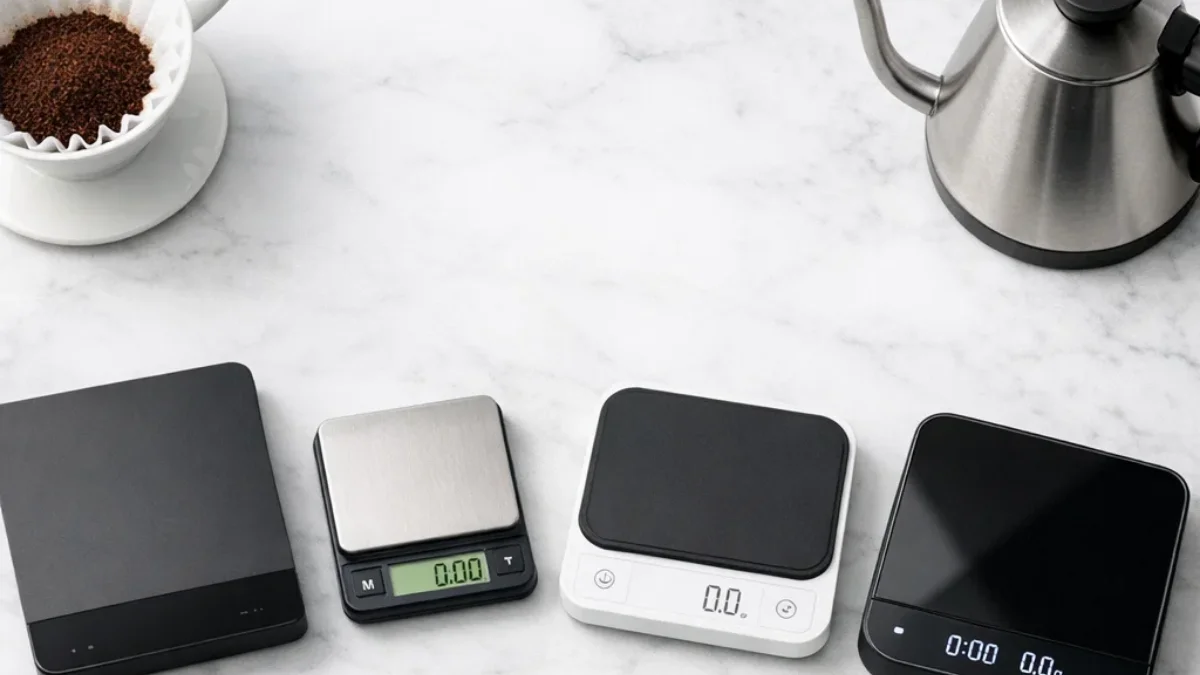
The best coffee scale for most home brewers is the Timemore Black Mirror Basic 2 — accurate to 0.1g, USB-C rechargeable, with a built-in timer and real-time flow rate display, all at a mid-range price.
For a budget pick, the Greater Goods Coffee Scale remains reliable and fuss-free. For a premium pour-over experience, the Fellow Tally Pro stands out for its Brew Assist mode and OLED display.
Introduction
A coffee scale does one fundamental thing: it removes guesswork from ratios. That single improvement — knowing exactly how much coffee and water you’re using — makes every other brewing variable easier to control and adjust.
This guide is for home brewers, not professional baristas. The scales here are chosen for daily home use: pour over setups, compact brewing spaces, and manual methods like French press and cold brew. When we mention “espresso-style brewing,” we mean compact setups and small-space brewing — not pulling shots on a dedicated espresso machine with a pressure gauge. A coffee scale doesn’t replace an espresso machine.
The guide covers a range of budgets and priorities — from reliable budget options to feature-rich premium picks — so you can find the right scale for how you actually brew.
Quick Picks: Best Coffee Scales for Home Brewing (2026)
| Best For | Product | Why It Stands Out |
|---|---|---|
| Best overall | Timemore Black Mirror Basic 2 | 0.1g accuracy, flow rate display, USB-C, reliable and affordable |
| Best budget scale | Greater Goods Coffee Scale | Fuss-free, 3kg capacity, dishwasher-safe cover, AA batteries |
| Best compact scale | Maestri House Mini Coffee Scale | Small footprint, portable, accurate for everyday use |
| Best for pour over | Fellow Tally Pro | Brew Assist mode, OLED display, premium build, 2,500g capacity |
| Best for travel | Timemore Black Mirror Basic 2 | Compact at 152×130mm, lightweight at 380g, USB-C rechargeable |
Why a Coffee Scale Makes Better Coffee
Consistent ratios
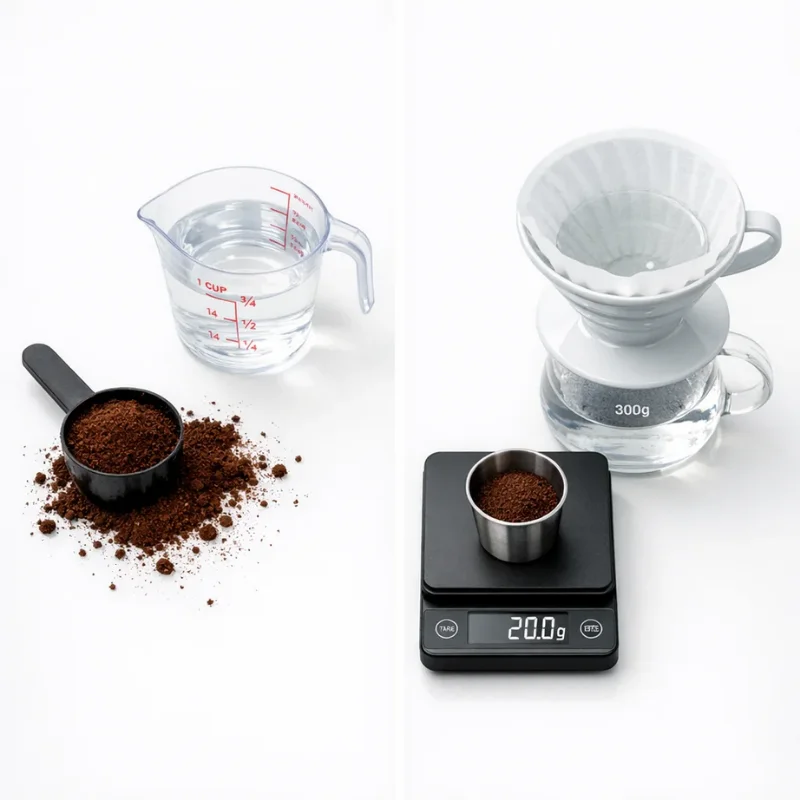
The coffee-to-water ratio is the biggest single factor in brew strength. A scale measures both precisely, so your recipe stays the same from cup to cup — regardless of grind density, bean type, or how tightly you packed the scoop.
Easier recipe repeatability
When you make a great cup, a scale lets you reproduce it exactly. Without measurement, you’re relying on muscle memory that varies more than you’d expect.
Better troubleshooting
When something tastes off, a scale gives you a reliable baseline. If you know you used 20g of coffee and 300g of water, you can change one variable and observe a clear result. Without that baseline, diagnosis is guesswork.
Less waste
Precise dosing means you use exactly what the recipe calls for — no more, no less. With specialty coffee especially, consistent dosing adds up to real savings over time.
See How to Use a Coffee Scale for a full beginner walkthrough, and Coffee Brewing Ratio Explained for ratio guidance by method.
What to Look for in a Coffee Scale
Accuracy
0.1g resolution is the standard for coffee-specific scales and is genuinely useful for pour-over, where small dose changes noticeably affect extraction. For French press and cold brew, 1g accuracy is sufficient.
Capacity
Most single-serve and two-cup setups stay comfortably within 2kg. If you regularly brew large Chemex batches or cold brew pitchers, aim for 3kg or more. The Greater Goods scale’s 3kg capacity is one of its underrated advantages.
Built-in timer
Standard on quality coffee scales and genuinely useful for pour-over, where bloom time and total brew time run simultaneously alongside water weight.
Response speed
A scale that updates slowly lags behind real-time pouring. For pour-over, a scale that responds within half a second keeps you in control of your technique. The Timemore Basic 2 responds fast enough for active pour tracking.
Water resistance
Coffee brewing involves steam, splashes, and occasional spills. At minimum, look for splash resistance. The Greater Goods’ silicone cover is dishwasher-safe — a practical advantage for daily brewing.
Battery type
Rechargeable (USB-C) scales are more convenient for daily use — charge once every few weeks and forget about it. Battery-powered scales (Greater Goods uses AA batteries) offer the opposite advantage: no charging, no dead scale mid-brew.
Platform size
The scale platform needs to support your brewer without tipping. A V60 on a small server fits most platforms. A Chemex or large French press needs a wider, stable base.
Display visibility
A clear, readable display matters when you’re pouring with one hand and need a quick glance. The Fellow Tally’s OLED display is the clearest here.
Coffee Scale vs Kitchen Scale: Which Should You Buy?
A standard kitchen scale accurate to 1g works adequately for French press and cold brew, where small measurement variations matter less.
For pour over, coffee-specific scales offer practical advantages that a typical kitchen scale doesn’t:
- Faster response speed for real-time pour tracking
- Built-in timer for simultaneous weight and time management
- More compact footprint that fits comfortably under a V60 or Kalita Wave
- Lower profile that doesn’t create clearance problems under drippers
If you already own a reliable kitchen scale, try it for coffee before buying a dedicated one. You may find it works well for French press and cold brew. For daily pour over, the upgrade to a coffee-specific scale is noticeable.
Best Overall Coffee Scale: Timemore Black Mirror Basic 2
Best for
Daily home brewers who want a versatile, feature-rich scale without paying a premium price.
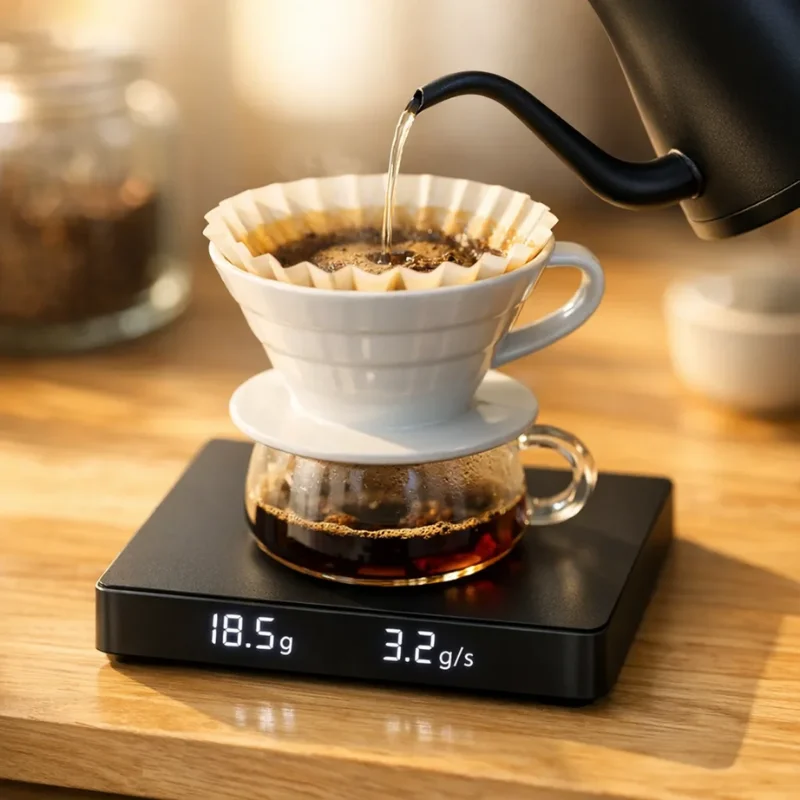
The Timemore Black Mirror Basic 2 offers 0.1g precision across a 2kg range, a flow-rate measurement function that runs independently of the built-in timer, and a 1,600mAh battery charged via USB-C that lasts up to 24 hours per charge.
Key features:
- 0.1g accuracy across full 2kg range
- Real-time flow rate display (ml/s) for pour technique feedback
- Auto-timing function that starts when it detects weight changes
- USB-C rechargeable, 1,600mAh battery (~24 hours use per charge)
- Compact dimensions: 152 × 130 × 26mm, 380g
- Removable silicone mat (heat-resistant, wipe-clean)
- Physical on/off switch to prevent accidental activation
What it does well:
The flow rate display shows pour speed in ml/s as you brew — a genuinely useful feature for V60 technique, not a gimmick. The scale refreshes approximately twice per second and stabilizes readings in under one second during a controlled pour, which is fast enough to guide technique in real time.
Limitations:
At around $56, it’s one of the pricier options in the mid-range category. The 2kg capacity is sufficient for most single and double-serve setups but can feel limiting for Chemex or large French press brewing. Not fully waterproof — splash-resistant only.
Who should buy it: Any home brewer who wants genuine pour-over feedback, reliable accuracy, and USB-C convenience at a mid-range price. It’s the strongest all-around choice in this guide.
Best Budget Coffee Scale: Greater Goods Coffee Scale
Best for: Beginners and home brewers who want reliable accuracy without complexity or charging requirements.
Greater Goods removes most of the daily friction around using a coffee scale. AA batteries mean you never have to charge it — swap them once a year and forget about it. The silicone spill cover is dishwasher-safe, which is a genuinely practical feature. At 3,000g capacity, it’s the only scale in this category that won’t hesitate when you put a heavy Chemex or a large glass server on top.
Key features:
- 0.1g accuracy
- 3kg maximum capacity (highest in this guide)
- AA battery-powered — no charging required
- Dishwasher-safe silicone cover
- Built-in timer
- Simple interface, low learning curve
What it does well: Consistency, simplicity, and zero charging friction. The 3kg capacity is a real-world advantage for large batch brewing. Made by a small US-based brand known for responsive customer support.
Limitations: Response speed is adequate for pour-over but not as fast as the Timemore. No flow rate display. Some users find the auto-off function activates too quickly.
Who should buy it: Beginners, casual home brewers, and anyone who resists adding another USB-C device to their rotation. Also the best option for large-format brewing where capacity matters.
See the Greater Goods Coffee Scale Review for detailed testing notes.
Best Compact Coffee Scale: Maestri House Mini Coffee Scale
Best for: Small kitchen setups, compact brewing stations, and travel.
The Maestri House Mini is built around one priority: taking up as little space as possible without sacrificing the accuracy needed for daily home brewing. Its small footprint makes it practical for setups where a full-size scale platform would overhang the counter or clutter the workspace.
Key features:
- 0.1g accuracy
- Compact platform ideal for single-serve setups
- Rechargeable battery
- Built-in timer
- Lightweight and portable
What it does well: Fits neatly into compact brewing setups and travel bags alongside a V60 and compact gooseneck kettle. Accurate and reliable for everyday use.
Limitations: Smaller platform means larger brewers (Chemex, French press) may overhang. Lower capacity than full-size scales. Not suited to large batch cold brew.
Who should buy it: Brewers with limited counter space, frequent travelers who bring brewing gear, and minimalist setups where portability matters as much as performance.
See the Maestri House Mini Coffee Scale Review for full details.
Best Coffee Scale for Pour Over: Fellow Tally Pro
Best for: Dedicated pour over brewers who want a premium, guided brewing experience and don’t mind paying for it.
The Fellow Tally Pro is the most thoughtfully designed pour over scale available for home use. It doesn’t just measure — it guides.
<cite index=”26-1″>The Tally Pro offers 0.1g readability, a 2,500g maximum capacity, and a rechargeable lithium-ion battery lasting 13 hours of continuous use. Dimensions are 177mm × 150mm × 33mm, and it charges via USB-C.
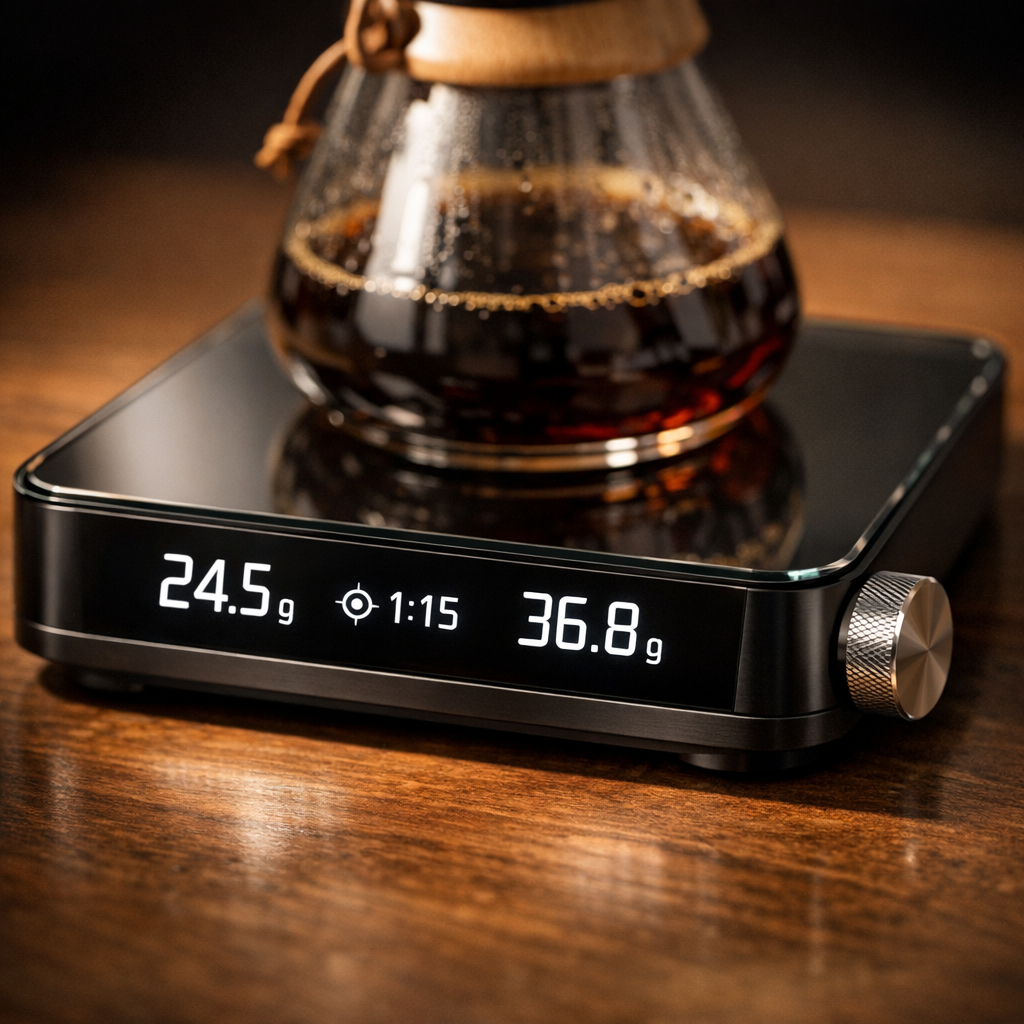
Its unique Brew Assist Mode lets you choose your preferred coffee-to-water ratio and guides you until you hit your target — plus two additional modes for kitchen versatility. The OLED display is stunningly clear, and the build uses premium materials including a glass base and metal touchpoints.</cite>
Key features:
- 0.1g accuracy, 2,500g capacity
- Brew Assist Mode — set your ratio, the scale guides you to the target water weight automatically
- OLED display — the clearest, most readable screen in this guide
- Three modes: Weight, Timer, and Brew Assist
- Removable weigh pan for easy cleaning
- USB-C rechargeable, 13 hours battery life
- Water resistant (not waterproof)
What it does well:
The Brew Assist mode is a genuine coffee-making tool that makes this scale worth serious consideration for pour over enthusiasts. A bright OLED screen and premium, tangible controls round out an experience that feels premium and purposeful.
Limitations:
At $199.95, the price is considerably higher than mid-range alternatives.
The footprint is too large for most espresso machine drip trays — this is a dedicated pour-over and manual-brewing scale, not a compact espresso scale. No flow rate display.
Who should buy it: Experienced pour-over brewers who want the best guided brewing experience available at home and already have a strong brewing routine they want to refine further.
Best Coffee Scale for Travel and Small Kitchens
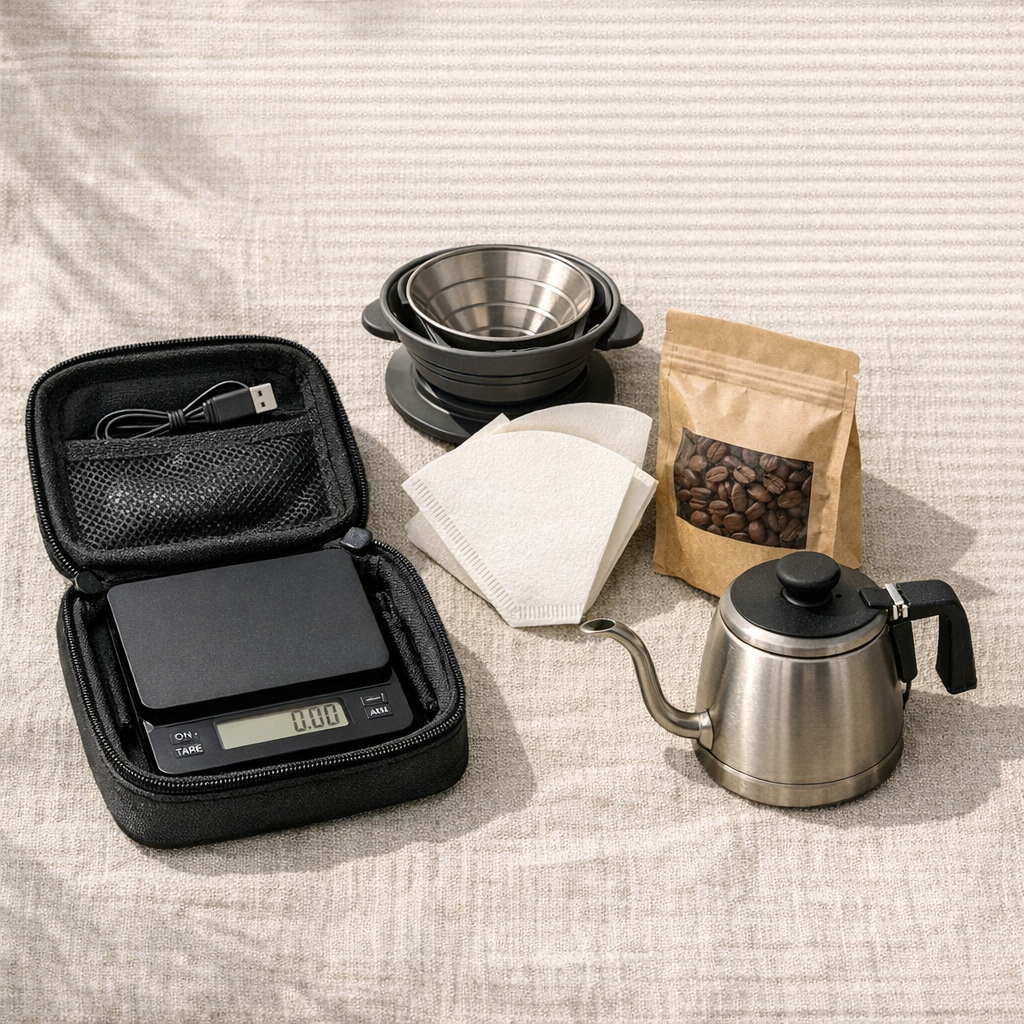
For travel, the Timemore Black Mirror Basic 2 is the best travel-friendly option on this list. Measuring 142 × 142 × 12mm and weighing just 220g, it’s compact enough to tuck into a drawer or travel bag yet large enough to accommodate most drip brewers and mugs. Its slim profile means it won’t interfere with your kettle spout during pours. USB-C charging means one less cable type in your bag.
For an even more compact dedicated travel option, the Maestri House Mini is worth considering — smaller footprint with a slightly more limited platform size.
What to prioritize for travel:
- USB-C charging (universal, no adapter needed)
- Sub-200g weight
- Dimensions that fit in a brewing kit bag alongside a compact dripper
- Protective silicone cover if available
- Accept the trade-off of a smaller platform and lower capacity
Are Expensive Coffee Scales Worth It?
For most beginners, no. The brewing improvement comes from using a scale consistently — not from which scale you use. A $35 Greater Goods scale and a $200 Fellow Tally Pro both measure 20g of coffee and 300g of water, yielding the same result for a basic pour-over recipe.
The higher cost becomes more justified in specific situations:
Better response speed. Premium scales update faster, which matters most for espresso-style timing and for brewers actively monitoring pour rate during V60 technique. For French press and cold brew, response speed is irrelevant.
Brew Assist features. The Fellow Tally’s guided ratio mode genuinely reduces mental load during pour over. Worth it if you brew daily and want to focus on the pour itself rather than tracking target weights mentally.
Build quality and durability. Premium materials (glass, anodized aluminum, metal touchpoints) hold up to daily use longer than budget plastic constructions. If the scale is on your counter every day for five years, build quality matters.
Start with a budget or mid-range option. Confirm that you want to brew manually every day, develop your technique, then upgrade if response speed or guided features become the limiting factor.
Common Coffee Scale Problems and How to Avoid Them
Inaccurate readings. Usually caused by an uneven surface, accumulated residue on the platform, or low battery. Keep the scale on a flat, stable surface, clean the platform after each use, and maintain charge or replace batteries regularly.
Slow response. A hardware characteristic more than a maintenance issue. If your current scale feels too slow for the active pour-over technique, it’s a reason to consider a model with a faster refresh rate — like the Timemore Basic 2.
Water damage. The most common cause of scale failure for home brewers. Keep the scale away from direct water streams, promptly dry the platform after spills, and choose a water-resistant model if you brew daily.
Low battery mid-brew. Rechargeable scales: charge after every few sessions rather than waiting for low battery warnings. Battery-powered scales: keep a spare set of AA or AAA batteries in your brewing drawer.
Uneven surface. A countertop with slight texture or curvature causes inconsistent readings. A thin cutting board as a stable base solves this immediately.
See Coffee Scale Not Accurate? for a full troubleshooting walkthrough.
FAQs
Do I need a coffee scale for pour over?
It’s the single most useful addition to a pour-over setup after the grinder and kettle. Without a scale, ratio and water volume vary cup to cup in ways that make systematic improvement difficult. Start with any scale that reads to 1g and build from there.
Is 0.1g accuracy necessary?
For pour-over, it’s helpful for fine-tuning the dose. For French press and cold brew, 1g accuracy is entirely sufficient. Don’t let the absence of 0.1g accuracy stop you from using a scale — the consistency benefit applies at any resolution.
Can I use a kitchen scale for coffee?
Yes — a kitchen scale accurate to 1g works well for French press and cold brew. For daily pour-over, a coffee-specific scale with a timer and a faster response time makes the process smoother.
What is the best coffee scale for beginners?
The Greater Goods Coffee Scale for anyone who wants simplicity and no charging friction. The Timemore Black Mirror Basic 2 for anyone who wants mid-range features and USB-C convenience from day one.
Are rechargeable coffee scales better?
For daily convenience, yes. USB-C scales charge in under an hour and hold a charge for weeks of typical use. Battery-powered scales offer the opposite advantage — no charging at all, just a set of batteries once or twice a year. Choose based on your existing device habits.
How We Chose These Coffee Scales
Accuracy and consistency. 0.1g resolution is the baseline for this guide. We prioritized scales with consistent readings across their full capacity range, not just at low weights.
Timer function. Built-in timer is standard in this category. We paid attention to how intuitively the timer integrates with weighing — simultaneous display of both values is a meaningful convenience.
Ease of use. Button layouts, display clarity, and auto-tare behaviour all affect daily friction. Scales that are fiddly or confusing in the morning routine get penalised.
Durability. Build quality, water resistance rating, and long-term ownership reports from the coffee community informed our assessments. Scales with known failure points at common contact with steam and splashes were noted.
Value. We assessed performance relative to price at each tier — not just absolute performance. The Greater Goods earns its budget recommendation because it delivers what matters at its price point, not because it competes with the Tally Pro.
Suitability for home brewing. These picks are optimized for daily home use across pour over, French press, and cold brew. Professional café scales (Acaia Lunar, for example) are excellent, but outside the scope and budget of most home brewers this guide serves.
Key Takeaways
- The Timemore Black Mirror Basic 2 is the best all-around choice for most home brewers — accurate, rechargeable, with flow rate display at a mid-range price.
- The Greater Goods Coffee Scale is the most practical budget option — 3kg capacity, no charging, dishwasher-safe cover.
- The Fellow Tally Pro is the best pour-over scale if the budget allows — its Brew Assist mode and OLED display justify the premium for dedicated pour-over enthusiasts.
- 0.1g accuracy matters most for pour over — for French press and cold brew, 1g resolution is sufficient.
- Response speed and battery type are the two most practical differentiators between mid-range options.
Recommended Reading
- How to Use a Coffee Scale
- Essential Coffee Brewing Tools
- Coffee Scale Not Accurate?
- Greater Goods Coffee Scale Review
- Maestri House Mini Coffee Scale Review
- Pour Over Coffee Ratio Explained
- Coffee Brewing Ratio Explained