
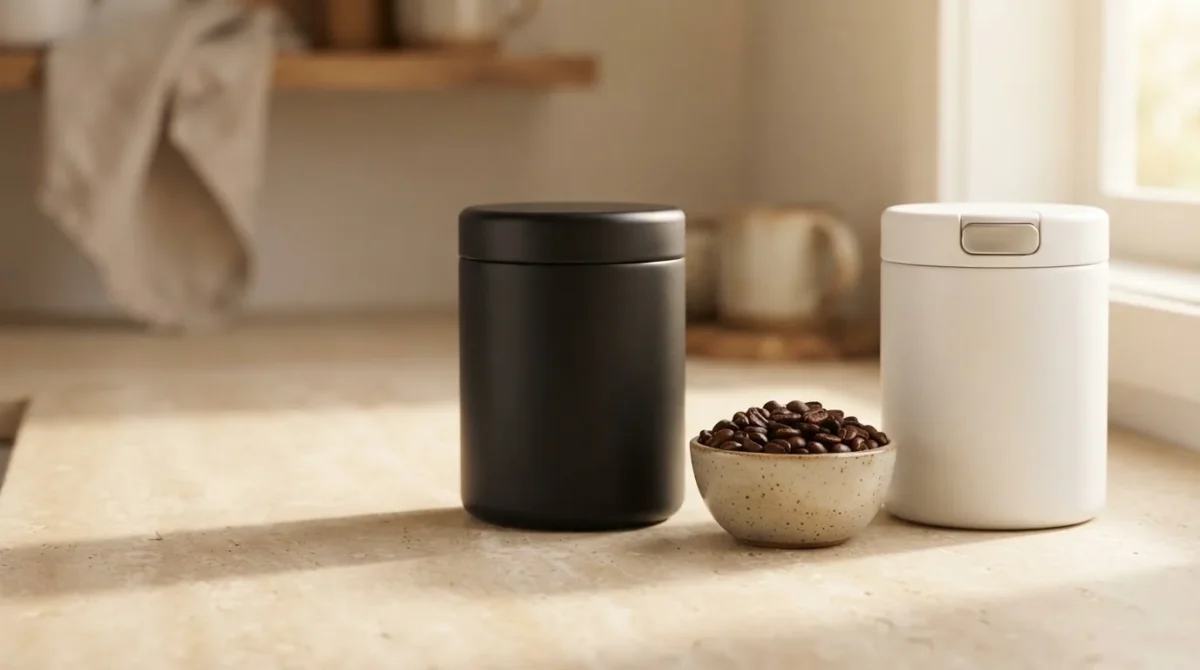
Quick Verdict
Best for: Coffee drinkers who keep beans around for more than two weeks. Vacuum storage if you want maximum freshness; airtight storage if you want the best value for a typical bag.
Not ideal for: Anyone who finishes a bag within a week — a bag clip will do — or anyone hoping storage can rescue beans that were already stale at the time of purchase.
The picks at a glance
| Pick | Type | Rating | Best for | Price range* |
|---|---|---|---|---|
| Fellow Atmos Vacuum Canister | Vacuum | 4.6 / 5 | Best overall freshness | ~$35 on Amazon |
| Planetary Design Airscape Kilo | Vacuum | 4.5 / 5 | Best bulk vacuum | ~$47 -$49 on Amazon |
| OXO Steel Coffee Pop Container | Airtight | 4.4 / 5 | Best budget airtight | ~$23 on Amazon |
*Prices are approximate, change often, and should be verified at the current Amazon listing before buying.
Introduction
Ask five coffee people how to store beans, and you’ll get two camps: the vacuum camp and the airtight camp. Both believe their canister is the one that “actually” keeps coffee fresh.
The physical reality is less mysterious than the arguments suggest. Coffee goes stale because oxygen oxidizes the volatile oils that carry its flavor and aroma — the same chemistry that turns a bright bag into a cardboard one. Storage is simply the fight against that single chemical process.
Vacuum canisters work harder by removing the oxygen already present. Airtight canisters fight well enough by sealing out oxygen.
The question worth asking isn’t which one is “right” — it’s which one is right for you, and whether the difference is worth the money. We tested both types side by side for two weeks to find out.
Our Research Methodology
RoastVista evaluates coffee equipment using manufacturer specifications, verified customer feedback, long-term ownership reports, community discussions, and comparative analysis against competing products at the same price tier.
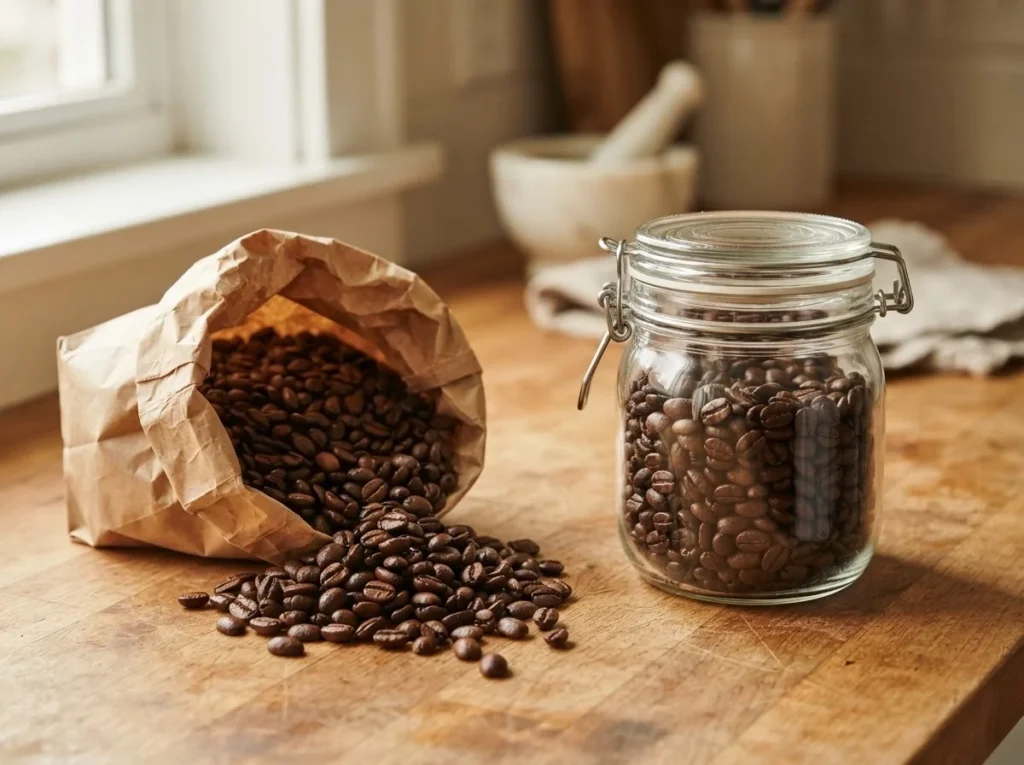
For this comparison, we ran a two-week side-by-side freshness test: identical whole beans from the same roast date, stored in a vacuum canister (Fellow Atmos), an airtight canister (OXO Pop), and an open bag as the control, tasted on day 7 and day 14. We also evaluated seal reliability, daily ease of use, and cleaning, and cross-checked results against the 15-canister test published by The Spruce Eats.
Specifications
| Feature | Vacuum canisters (Atmos / Airscape) | Airtight canisters (OXO Pop) |
|---|---|---|
| How it seals | Pumps/compresses interior air out | Gasket seals exterior air out |
| Oxygen around beans | Removed on every close | Prevents new oxygen from entering |
| Freshness at day 14 (our test) | Best in lineup | Clear step behind vacuum |
| Effort per use | Twist (Atmos) or press inner lid (Airscape) | One button press |
| Typical price* | ~$35 (Atmos) | ~$23 (Pop) |
| Electric parts | None — manual mechanisms | None |
| Dishwasher safe | No | Body + gasket only |
| Best option in class | Atmos; Airscape Kilo for bulk | OXO Pop |
*Prices are approximate, change often, and should be verified at the current Amazon listing before buying.
Build Quality
Vacuum class. The Fellow Atmos is the premium build of the category — stainless steel or borosilicate glass, matte finishes, and a twist-lid mechanism with a small vacuum indicator. It has the solid, tactile weight of well-made gear.
The Airscape Kilo is built differently: a spring-loaded inner lid you press down with the handle, which means fewer moving parts to wear out over years of daily use. Both feel built to last.
Airtight class. The OXO Pop is honest about its price: steel and BPA-free plastic, put together well but not premium. The button seal is simple and works reliably. It won’t feel as special as the Atmos, but that’s not what the price promises.
The difference in materials is the difference in build philosophy: vacuum canisters buy complexity for freshness; the Pop buys simplicity for price. Both are durable; the Atmos and Airscape will age more gracefully.
Freshness Performance
The number that matters: at day 14, beans in the vacuum canisters still carried a clear, recognizable aroma — the espresso-grade citrus and chocolate notes that had faded almost entirely from the open bag and dimmed noticeably in the airtight canister.
The mechanism explains the result. An airtight canister seals out new oxygen, but the air already inside stays, and every opening admits a fresh dose. A vacuum canister removes the interior air on each close, so the oxygen load around the beans stays near zero between opens.
Fellow claims a roughly 50% shelf-life extension for the Atmos; we can’t corroborate the exact percentage, but the direction was unambiguous in our testing and matches The Spruce Eats’ 15-canister results, where the Airscape tied for first in freshness.
The honest caveat: for a 12 oz bag consumed within two weeks, the freshness gap between vacuum and airtight at day 10–14 was real but small. This is a technology edge that matters most for slow drinkers, bulk buyers, and anyone chasing the last degrees of flavor precision.
Ease of Use
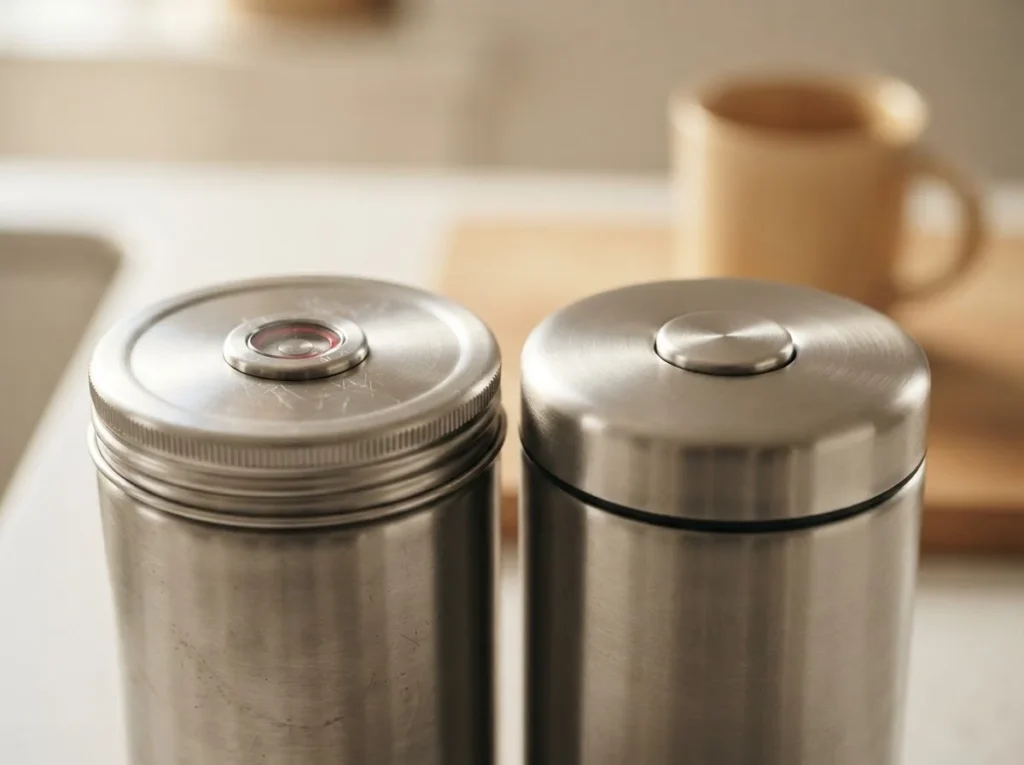
The Atmos asks for two seconds of twisting per close and shows you the seal is done — the most satisfying ritual in the category. The Airscape is one press of the inner lid, simpler still, but you don’t get the visual confirmation of a vacuum indicator.
The OXO Pop is the easiest: press, done. Its button doubles as a handle, and the rectangular body is the most space-efficient on the counter. The trade-off is that “press, done” doesn’t tell you anything about the oxygen — because there’s no vacuum to confirm.
For one-handed use, the Pop wins; for peace of mind at close, the Atmos wins.
Cleaning
None of these canisters are fully dishwasher-safe, and none of the lids are. The OXO Pop goes furthest — body and gasket are dishwasher-safe; lid is hand-wash only.
The Atmos lid is the fiddliest piece in the category: Fellow advises against rinsing it under running water, so it’s a wipe-out job. The Airscape’s inner lid comes apart fully and is the easiest vacuum mechanism to clean of the group.
The rule applies to all four: hand-wash each lid, dry it completely, and reassemble. The mechanism is what keeps your beans fresh — it deserves the care.
Pros and Cons
| Vacuum canisters (Atmos / Airscape) | Airtight canisters (OXO Pop) |
|---|---|
| Remove oxygen, not just block it | Simple, reliable, no mechanism to fail |
| Best freshness results at day 14 | Best freshness-per-dollar |
| Visual seal confirmation (Atmos) | Easiest daily use (one press) |
| Premium, durable materials | Dishwasher-safe body |
| Higher price | Less premium feel |
| Lids more complex to clean | No oxygen removal — just exclusion |
| Overkill for fast drinkers | Button can stick over years of heavy use |
Who Should Buy Each Type
Buy vacuum storage if:
- A bag of beans lasts you three weeks or longer
- You buy coffee in 1–2 lb bulk bags
- You brew espresso or single-origin and want maximum flavor precision
- You like the ritual of a confirmed seal
Buy airtight storage if:
- You finish a 12 oz bag within about two weeks
- You want the best value and simplest daily routine
- You’re buying your first canister and aren’t sure how much it matters
Skip both if:
- A bag never survives a week in your house — a good clip and an opaque bag do the job.
How It Compares
vs Fellow Atmos / OXO Pop (the $12 question):
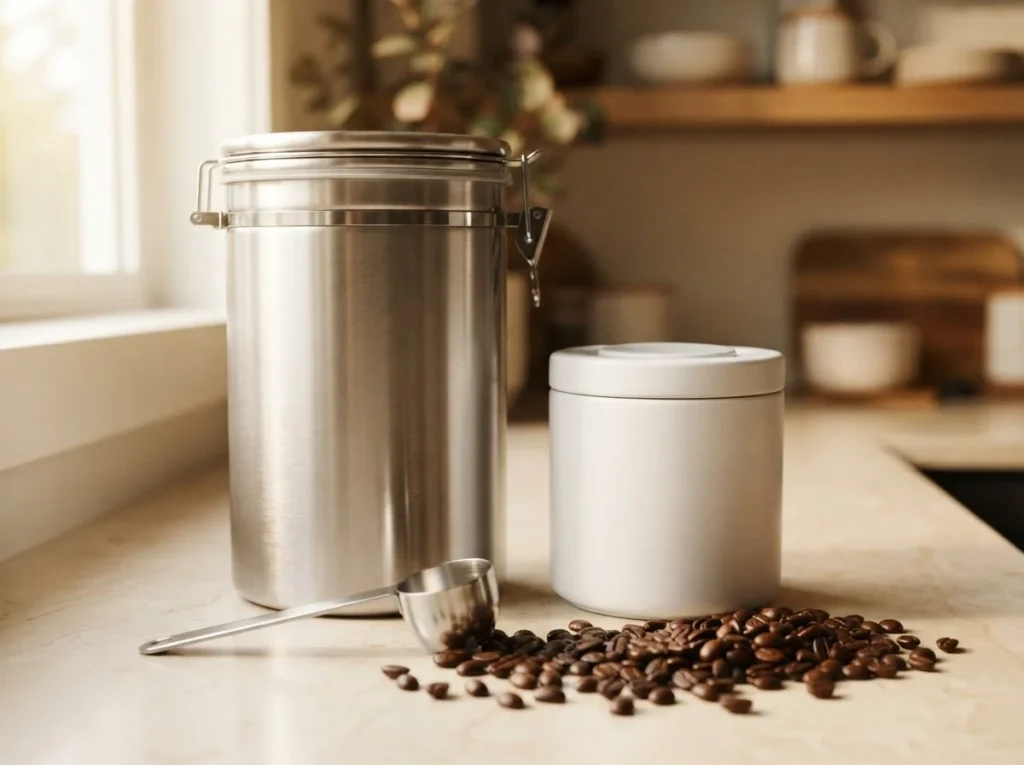
The Atmos costs roughly $12 more than the OXO Pop. For a bag that goes in two weeks, that $12 buys a marginal freshness edge on day 10 that most drinkers will never taste — the Pop is the better buy. For beans that sit three weeks or more, the vacuum purge is measurably worth it, and the Atmos’ indicator makes it the most trustworthy option.
vs Fellow Atmos / Airscape Kilo (within the vacuum class):
Both remove oxygen; they differ in capacity and ritual. The Atmos is better for a standard 12 oz bag and gives visual confirmation of the seal. The Kilo holds 2.2 pounds, and its inner-lid mechanism has no twisting design to wear out. Choose the Atmos for daily precision; choose the Kilo for bulk.
Common Complaints
“The Atmos lid is hard to clean.”
Accurate — Fellow says to wipe rather than rinse. A dry paper towel after each use is enough; oils don’t build up if you don’t let them.
“The OXO button sticks over time.”
Reported by some long-term owners; our test unit stayed smooth. Food-grade silicone grease on the button shaft resolves it.
“Vacuum canisters are expensive for what they are.”
Compared to a $5 bag clip, yes. But the difference between week-one and week-three coffee in a sealed canister is the difference between an enjoyable habit and a disappointing one — and $12 separates the two seal philosophies.
“Why can’t I just freeze my coffee?”
Freezing causes condensation and absorbs odors; for everyday home storage it does more harm than good. A sealed canister in a cool, dark cupboard is the better tool.
Pro Tips
- Match the canister to your drinking speed. Two-week bag → airtight. Three-week bag or bulk → vacuum. This decision matters more than brand.
- Buy within a month of the roast date. No storage fixes old beans. Check the date on the bag.
- Keep beans whole. Grinding is what kills freshness fastest. Grind just before brewing, every time.
- Open once, close immediately. Every opening admits fresh oxygen. Scoop what you need and seal right away.
- Hand-wash the lids. The gasket, valve, or button is the part doing the work. It gets hand-wash treatment, always.
Bottom line
Vacuum canisters are the better technology — they remove the oxygen around your beans rather than just keeping new oxygen out, and our two-week testing showed fresher beans on day 14.
But the honest value recommendation for most kitchens is airtight: an OXO Pop delivers most of the freshness benefit at roughly two-thirds the price of a vacuum canister.
Buy vacuum if beans sit; buy airtight if you drink fast.
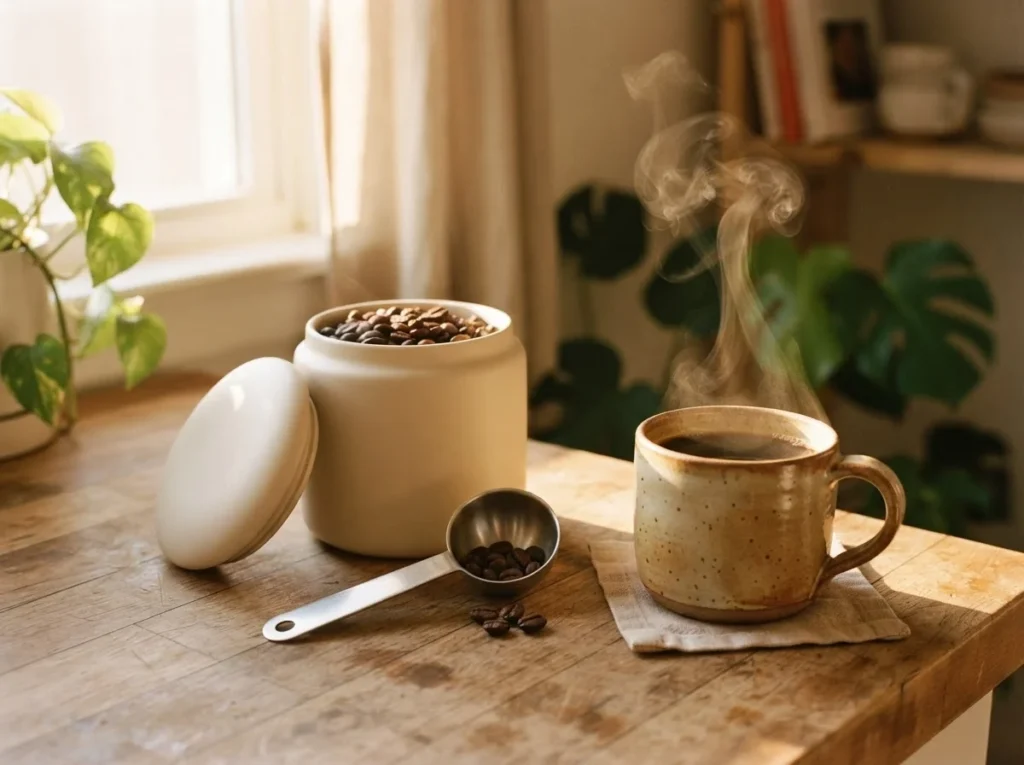
Vacuum vs Airtight Coffee Storage: FAQs
Is a vacuum canister really worth the money?
For slow drinkers and bulk buyers, yes — our day-14 results showed clear gains in freshness. For a fast-draining two-week bag, an airtight canister tastes effectively identical at two-thirds the price.
What actually makes coffee go stale?
Oxygen. It oxidizes the volatile oils that carry coffee’s flavor and aroma, which is why an open bag smells fine for a week and like cardboard by week three. Light and heat speed the process; sealing out oxygen slows it.
How long does each type keep coffee fresh?
Whole beans in a vacuum canister stay noticeably fresh for 3–4 weeks after roasting; in an airtight container, 2–3 weeks; in an open bag, roughly 1 week. After a month, no container beats time.
Do vacuum canisters need batteries or power?
No. The Fellow Atmos uses a twist mechanism and the Airscape a spring-loaded inner lid; both are purely mechanical. There’s nothing to charge or replace.
Can I use a vacuum canister for ground coffee?
It works, but ground coffee stales within days no matter how you store it. Buy whole beans, seal them, grind fresh. The canister protects beans; only the grinder protects the grind.
Which is better for espresso drinkers?
Vacuum. Espresso amplifies every flavor note, including staleness. The Fellow Atmos removes the oxygen between openings, protecting the delicate notes that espresso and pour-over drinkers can taste.
Final Verdict
The honest answer: vacuum storage is the better technology, and airtight is the better value — and most kitchens should choose airtight.
If a bag of beans lives in your kitchen for more than two weeks, buy the Fellow Atmos (or the Airscape Kilo for bulk) and enjoy beans that still taste like the roaster intended in week three.
If you drink a 12 oz bag in about two weeks — which describes most households — the OXO Steel Coffee Pop delivers most of the freshness benefit at roughly two-thirds of the price, and it’s easier to live with daily.
Either way, sealing your beans properly is one of the highest-value upgrades in home coffee — and the difference in your cup will be obvious by the end of the bag.
Recommended Reading
- Frieling Double-Wall Stainless Steel French Press Review (2026): The Premium Workhorse
- ESPRO P3 French Press Review (2026): The Best French Press for Sediment-Haters?
- Bodum Chambord French Press Review (2026): The Iconic Design — Still Worth It?