
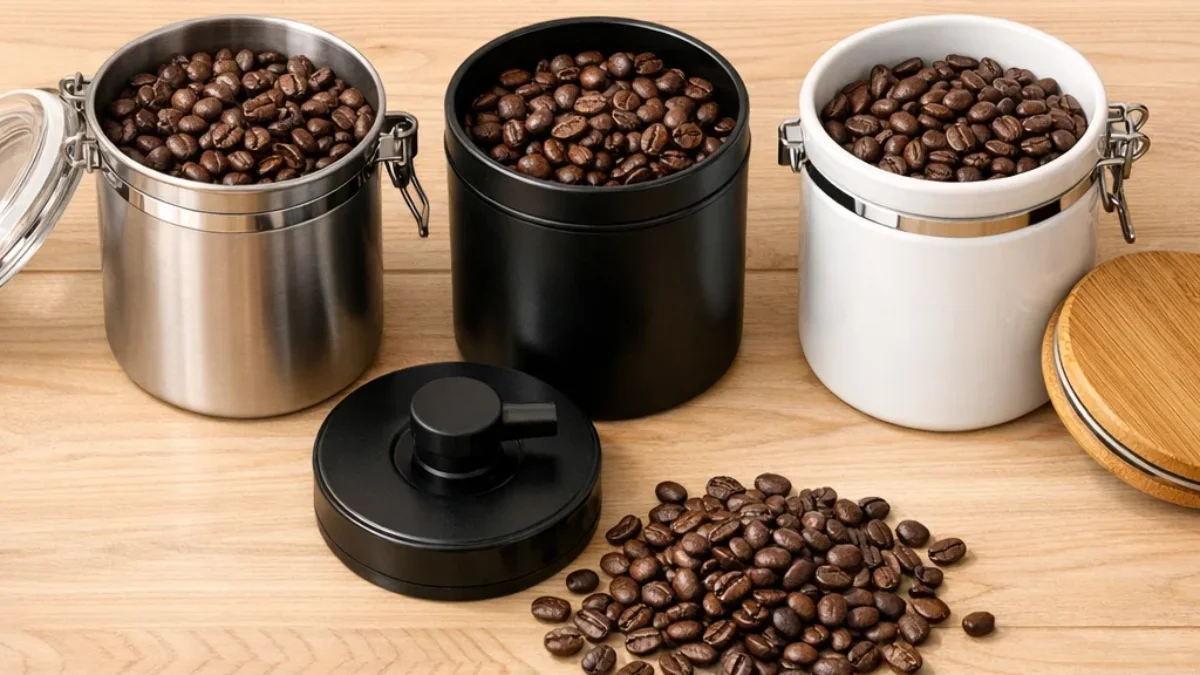
Quick Answer Box
The best coffee storage container is opaque, airtight, and sized to hold 2–4 weeks of beans. For most people, that’s a vacuum canister like the Fellow Atmos (best overall) or a push-button airtight canister like the OXO POP (best budget).
Vacuum containers actively remove oxygen; airtight containers keep it out. Avoid glass on open shelves, never refrigerate unsealed coffee, and keep beans away from heat, light, and strong odors.
Introduction
Fresh coffee is one of the most important variables in home brewing — and one of the easiest to protect. The difference between beans stored correctly and beans left in an open bag on a sunny countertop is noticeable in every cup.
Coffee’s enemies are straightforward: oxygen, light, heat, and moisture. All four degrade the aromatic compounds that give coffee its brightness, sweetness, and complexity. Once those compounds are gone, no technique or equipment can bring them back.
A good storage container slows that degradation. It won’t make old beans fresh again, but it will preserve quality beans for noticeably longer than a poorly sealed bag or an open container. This guide covers the containers that actually work, how we tested them, and how to choose the right one for your kitchen.
Best Drip Coffee Makers (2026): 6 Picks for an Easy Morning Cup
Our Review & Research Disclaimer
At RoastVista, our product reviews are based on detailed research and analysis rather than hands-on physical testing. We study manufacturer information, product specifications, independent sources, and feedback from real users to understand a product’s performance, quality, features, strengths, and limitations. We also compare products with similar alternatives to provide a broader perspective.
Our goal is to give prospective buyers a clear, balanced, and well-researched picture of each product so they can make a more informed purchasing decision.
Quick Picks: Best Coffee Storage Containers
| Best For | Container Type | Why It Stands Out |
|---|---|---|
| Best overall | Opaque airtight stainless-steel canister | Excellent light and air protection, durable, long-lasting |
| Best budget option | Opaque airtight ceramic or BPA-free plastic canister | Simple, affordable, effective for countertop storage |
| Best vacuum-style option | Vacuum-sealed coffee canister with pump | Actively removes air, extends freshness beyond a standard airtight seal |
| Best for large bags | Large-capacity (64oz+) stainless-steel canister | Fits a full 1lb bag; practical for daily coffee drinkers |
| Best for ground coffee | Small airtight canister (8–12oz capacity) | Easy daily access, right size for ground coffee quantities |
Comparison Table
| Product | Type | Material | Capacity | Holds 1 lb? | Price Range | Best For |
|---|---|---|---|---|---|---|
| CoffeeVac 1 lb | Vacuum | Airtight body + vacuum lid | 1.85 L | Yes | ~$18 | Best Vacuum |
| Veken 22 oz | Airtight + CO₂ valve | Stainless + window | 22 oz | Yes | ~$25 | Best budget; beans or ground |
| Airscape (Kilo) | Displacement | Stainless steel | 2+ lb | Yes (and more) | ~$49 | Large households, big bags |
| Coffee Gator | Airtight + valve | Stainless steel | ~1 lb | Yes | ~$24 | Degassing fresh beans |
| OXO POP small | Airtight | BPA-free plastic | ~10 oz | No | ~$8–14 | Ground coffee daily access |
1. CoffeeVac 1 lb Airtight Vacuum Canister — Best Vacuum Canister (replaces Fellow Atmos)

Description
The CoffeeVac is the closest current alternative to the Fellow Atmos’s core trick: it actively removes excess air from the container before sealing. Press the button on the lid as you push down; it pumps a small amount of air out as the lid descends, creating a vacuum that locks out external oxygen. It’s built for coffee beans and grounds, with a smell-proof, airtight seal that keeps aromatics in and kitchen odors out.
Where the Atmos is unavailable or out of budget, the CoffeeVac delivers the same class of preservation — true vacuum sealing, not just an airtight gasket — at a notably lower price. Serious Eats tested it alongside the Atmos in 2026 and described it as a hybrid “between a vacuum-sealed canister and an airtight one.”
Key specs
- Capacity: 1 lb of beans (~1.85 L)
- Material: airtight body with patented vacuum-seal lid (push-button pump)
- Seal type: vacuum — pushes air out, locks the seal
- Suitable for: whole beans and ground coffee
- Cleaning: hand-wash; keep the lid mechanism dry
Pros
- True vacuum sealing — removes excess air, not just keeps it out
- Noticeably fresher beans than standard airtight containers (Serious Eats: stored coffee “okay but a little flat” vs. Atmos — honest note: it leaves some oxygen, so slightly behind a full vacuum pump)
- Affordable — sits well below the Atmos’s price
- Smell-proof and airtight — good for countertops near cooking
- Holds a full 1 lb bag
Cons
- Leaves a little oxygen inside (a hybrid, not a full pump-out vacuum) — the Atmos preserves slightly better
- Hand-wash only; the button mechanism needs care
- Handling/cleaning is fussier than a simple twist-lid airtight canister
Who it’s for
Home brewers who want vacuum-level freshness for beans that sit 2–4+ weeks, at a friendlier price than the Fellow Atmos. Skip it if you only store ground coffee (use the OXO small card below) or want the deepest possible vacuum (the Atmos-class canisters still edge it out).
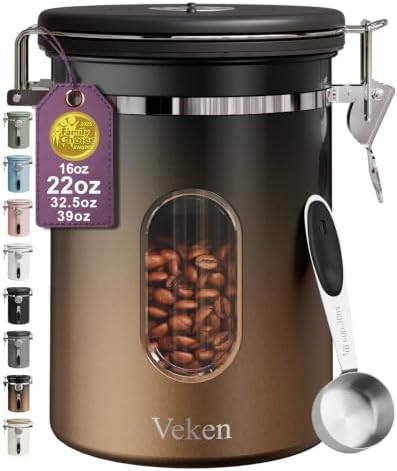
2. Veken Coffee Canister with Window, 22 oz — Best Budget Airtight (replaces OXO POP)
Description
The Veken Coffee Canister with Window is a straightforward, well-made airtight canister that’s earned a place on Amazon’s cold-brew/coffee canister best-seller lists. It pairs a stainless steel body with a see-through window, a date tracker on the lid, a CO₂ valve, and an included scoop. The airtight seal and one-way valve let freshly roasted beans degas without letting oxygen in — the same principle as specialty coffee bags and the Coffee Gator.
It’s the natural budget replacement for the OXO POP: same push-to-seal simplicity, same “holds a pound of beans” utility, plus the visual convenience of seeing how much coffee you have left without opening it.
Key specs
- Capacity: 22 oz (~620 g) — roughly a standard 1 lb bag
- Material: stainless steel body with a tinted plastic window
- Seal type: airtight lid with CO₂ valve + date tracker + scoop
- Suitable for: whole beans and ground coffee
- Cleaning: hand-wash recommended for the lid
Pros
- Airtight with a CO₂ valve — beans degas without oxygen ingress
- Window — see your coffee level at a glance (keep it out of direct light; the body is mostly stainless)
- Date tracker helps you know when the batch was opened
- Affordable, solid build for the price
- Includes a scoop; stainless body resists odor transfer
Cons
- The window means some light exposure — store away from direct sunlight
- Airtight (not vacuum) — for beans that sit 4+ weeks, a vacuum canister preserves better
- Smaller capacity than the 1.7 qt OXO it replaces — fine for a 1 lb bag, snug for bulk
Who it’s for
Budget-conscious daily brewers who want an honest airtight seal and don’t need vacuum tech. The ground-coffee version of this lineup (smaller 16 oz size) is available in the same Veken store — grab that if you want a dedicated ground container.
3. Planetary Design Airscape — Best Large Capacity

Price: [VERIFY] (~$50–60 for Kilo) · Type: Displacement · Capacity: up to 2+ lb (Kilo size)
Why it stands out: The Airscape uses a plunger to push air out of the container before you seal the silicone-ringed lid — a clever “displacement” design that removes most of the oxygen without a pump. The Kilo size holds over two pounds, making it the best choice for households that buy big bags or store multiple roasts.
Pros:
- Removes air without a vacuum pump
- Large sizes for heavy drinkers and big bags
- Stainless steel, opaque, durable
Cons:
- Plunger can be awkward to pull up when near the bottom
- Large sizes take up significant counter space
- Serious Eats found its stored coffee “harsh and ashy” vs. the Atmos — it’s a capacity play, not a freshness leader
Who it’s for: large households and anyone who buys 2 lb+ bags. Skip it if counter space is tight.
4. Coffee Gator Canister — Best with CO₂ Valve
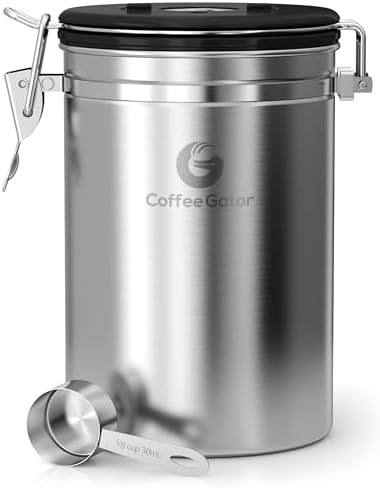
Why it stands out: the Coffee Gator pairs an airtight stainless-steel body with a one-way CO₂ valve in the lid — the same principle used in specialty coffee bags. Freshly roasted beans degas CO₂ for the first week or two; the valve lets that gas escape without letting oxygen in, so very fresh beans don’t build pressure or go stale prematurely.
Pros:
- One-way valve ideal for freshly roasted beans
- Stainless steel, opaque, good value
- Serious Eats noted “toastiness and cocoa flavors” in stored coffee
Cons:
- Filter in the lid can’t get wet — finicky to wash
- Filters need periodic replacement
Who it’s for: anyone who buys beans within days of the roast date and wants them to degas safely.
5. OXO Good Grips POP Small Square Container, 0.3 qt — Best for Ground Coffee (new card)

Description
Ground coffee goes stale in days, not weeks — so the right container for it is small (less headspace = less oxygen in contact with the grounds) and easy to open daily. The OXO Good Grips POP Small Square nails both. It’s the little sibling of the OXO POP family: same one-push lid with a silicone seal that snaps airtight with a satisfying click, same stackable square design, but sized for everyday ground-coffee use.
Because it’s deliberately small, you’re forced to buy pre-ground in smaller quantities — which is exactly the right instinct for freshness.
Key specs
- Capacity: 0.3 qt (~10 oz) — ideal for a small bag of grounds
- Material: BPA-free plastic body (clear, so store out of direct light), silicone-sealed push-button lid
- Seal type: airtight, one-push
- Suitable for: ground coffee, single-origin batches, small dry-goods portions
- Cleaning: container dishwasher-safe; lid hand-wash
Pros
- Right size for ground coffee — minimal headspace keeps grounds fresher
- One-push lid, effortless daily open/close
- Airtight silicone seal locks out oxygen and odors
- Stackable with the rest of the OXO POP family
- Dishwasher-safe container, very affordable
Cons
- Small capacity — you’ll want a separate container for a whole 1 lb bag of beans
- Clear body needs a dark cabinet/shelf (light degrades coffee)
- Same “frequently returned” family as the 1.7 qt OXO — check in SiteStripe before linking (see note below)
Who it’s for
Daily ground-coffee users who buy in small quantities and want an effortless, airtight daily-access container. Skip it if you grind whole beans at home — you’ll want a bean-sized canister instead.
Airtight vs. Vacuum vs. Displacement — What Actually Matters
There are three ways a canister can fight oxygen, and they’re not equal:
- Airtight canisters (OXO POP, Coffee Gator) keep outside air out with a silicone-gasket seal. Simple, cheap, and effective for beans used within 2–4 weeks.
- Vacuum canisters (Fellow Atmos) pump oxygen out after sealing. The strongest protection — and the only design that won a blind taste test against the original bag.
- Displacement canisters (Airscape, MiiR) expel air using a plunger. Clever in theory; in Serious Eats’ testing, displacement models finished at the bottom of the tasting rankings.
The practical takeaway: if you use a bag within 2–4 weeks, a quality airtight canister is plenty. If beans sit longer — or you want maximum freshness — a vacuum canister is worth the money. For a deeper comparison, see our guide to vacuum vs. airtight coffee storage.
What Makes a Good Coffee Storage Container?
Not all “airtight” containers are equal for coffee. Here’s what actually matters:
- Airtight seal. The lid should close firmly with a substantial silicone gasket — thin or loose gaskets leak.
- Opaque or stainless body. Light penetrates glass continuously, even diffuse indoor light. Stainless steel and ceramic block it entirely. If you use a clear container, keep it in a dark cabinet.
- Right capacity. Match the container to 2–4 weeks of consumption. A half-empty container means more headspace and more oxygen in contact with the beans.
- Easy to clean. Wide openings and smooth interiors. Narrow-necked containers accumulate stale oil residue.
- Food-safe materials. Stainless steel, ceramic, and BPA-free food-grade plastic are all fine. Avoid containers with strong plastic odors.
Stainless Steel vs. Glass
| Feature | Stainless Steel | Glass |
|---|---|---|
| Light protection | Excellent — fully opaque | Poor unless stored in a dark cupboard |
| Durability | High | Breakage risk |
| Visibility | Can’t see beans | Easy to see contents |
| Best use | Countertop or open shelves | Dark cupboard storage only |
Glass isn’t bad for coffee — it’s just a poor choice for an open countertop. In a dark, cool cupboard, glass is perfectly adequate.
How Big Should a Coffee Storage Container Be?
Size should match how quickly you use coffee, not the largest bag available. The more headspace, the more oxygen in contact with the beans.
- 1–2 cups/day: 250–350 g capacity (~12 oz)
- 3–4 cups/day or two people: 500 g capacity (~16–20 oz)
- A full pound per week: 1 kg+ canister (or the Airscape Kilo)
If you buy larger quantities, store the portion you won’t use for two weeks separately — in the original sealed bag, clipped shut, or a secondary container.
Whole Beans vs. Ground Coffee
Whole beans stay fresh significantly longer than ground coffee — grinding dramatically increases surface area exposed to air. For whole beans, prioritize an opaque body, a secure silicone-gasketed lid, a capacity suited to 2–4 weeks, and a wide opening. A one-way valve is a useful addition for very freshly roasted beans.
Ground coffee goes stale within days. Buy smaller quantities, use a small easy-access airtight container (8–12 oz), and grind fresh whenever possible. No storage container fully compensates for the freshness lost at the moment of grinding — if you have a burr grinder, grinding just before brewing is the single most effective way to preserve freshness.
Should You Freeze Coffee Beans?
Freezing works — when done correctly. Freeze beans you won’t use within 3–4 weeks of roasting, in single-use portions, each in a separate airtight bag or container. Never repeatedly open and refreeze the same container — condensation from freeze-thaw cycles damages beans. Take out only what you’ll use in the next few days.
Coffee Storage Mistakes to Avoid
- Leaving beans in the original bag with the top folded over — the #1 habit that stales coffee fast.
- Storing near heat — oven, stove, or a warm cabinet accelerates oxidation.
- Clear containers on open shelves — light continuously degrades aromatics.
- Oversized containers — excess headspace means excess oxygen.
- Refrigerating unsealed coffee — the fridge is humid and full of odors; beans absorb both.
- Storing ground coffee in bulk — it stales in days; buy small and grind fresh.
FAQs
Do coffee canisters actually keep coffee fresh?
Yes. In Serious Eats’ 10-day blind taste test, coffee stored in a vacuum canister tasted nearly as fresh as the day it was roasted, while coffee in a non-resealable bag tasted “thin, stale, and papery.”
Is the original coffee bag good enough?
A resealable bag with a one-way valve does a decent job for a few weeks. A non-resealable bag doesn’t — transfer to a canister.
Can I store ground coffee in a vacuum canister?
No — not in the Fellow Atmos. Fines clog the vacuum mechanism. Use an airtight canister for ground coffee.
How long do beans stay fresh in a canister?
Airtight: 2–4 weeks of good flavor. Vacuum: longer — the Atmos kept beans tasting fresh well past the 10-day test window.
Should I store coffee in the fridge?
No. The fridge is humid and full of odors; unsealed beans absorb both. Freeze only in single-use portions.
Key Takeaways
- Fellow Atmos is the best overall — it’s the only canister that won a blind taste test.
- OXO POP is the best value and the right choice for ground coffee.
- Airscape wins on capacity; Coffee Gator wins for freshly roasted beans.
- Match container size to your consumption, keep it opaque, and never refrigerate unsealed coffee.
From brewing equipment to accessories, these gifts for coffee lovers suit a range of tastes and budgets