
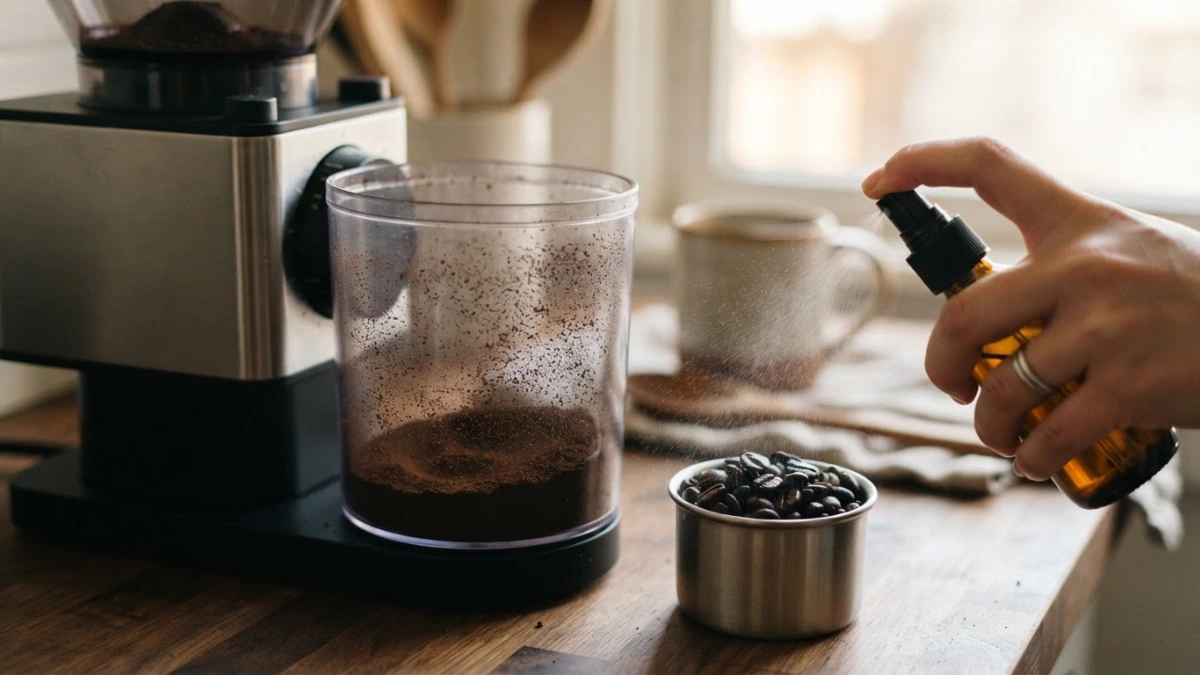
The short answer: static comes from friction between dry grounds and a plastic bin or chute. Add a small amount of water to your beans before grinding (the “RDT” method), let the grounds rest for a minute, and wipe the bin with a barely damp cloth. That solves it for most home grinders.
It is also a bigger effect than most people assume. On a commercial grinder, ground coffee can carry tens of nanocoulombs per gram—a level of electrification comparable to what researchers measure inside thunderclouds and volcanic ash plumes [1].
Static isn’t dangerous, and it doesn’t change coffee flavor by itself. What it does change is your dose. Grounds that cling to the chute and bin never reach your brewer, so the coffee you think you weighed isn’t the coffee you are brewing.
On a dark winter morning in a dry kitchen, a grinder can retain two or three grams — enough to shift a 15 g dose by 20%.
This guide explains the physics, what the peer-reviewed research actually measured, how much retention is normal, and which fixes are worth doing. Every technical claim is sourced at the end.
What Causes Static in a Coffee Grinder?
Coffee grounds pick up a static charge through the triboelectric effect: when two dissimilar materials touch and separate, electrons transfer from one surface to the other, and both are left charged [2].
Grinding multiplies the effect because it does two things at once — it fractures beans (creating fresh, highly reactive surfaces) and it forces thousands of those fragments to rub against each other and the burrs. The coffee study below calls this combination fracto- and triboelectrification [1].
The phenomenon itself has been documented for over a century; NIST’s classic circular on static electricity remains a useful plain-language reference for how charge accumulates and dissipates [3]. What is newer is measuring it in coffee specifically.
Oppositely charged surfaces — usually the plastic catch cup — then attract the grounds.
Four conditions make it worse:
Low humidity
Moisture on a surface lets charge bleed away, so dry air keeps it in place. Harvard’s physics demonstration lab puts it bluntly: “humidity is the worst enemy of any electrostatic experiment” [4]. This is why static is a winter problem in heated homes and rare in humid climates. The widely quoted 40% relative humidity figure is a rule of thumb from industrial ESD practice, not a threshold published in coffee research — treat it as a guide, not a limit.
Plastic bins and chutes
Plastic is an insulator and holds charge right where the grounds land. Metal helps at the surfaces it touches, but it isn’t a cure: coffee particles are insulators, so charge on particles away from the metal cannot drain away, and grounded surfaces can even attract charged grounds and increase retention [1]. Material affects how much sticks to the cup; water is what removes the charge.
Fine grinds
Espresso settings produce more surface area and more friction, so static and clumping increase as you grind finer. How much fine material a grinder produces is partly a design question — our comparison of conical vs flat burr grinders explains why the two geometries produce different particle distributions, and therefore different amounts of dust available to pick up charge.
Roast level — but not the way most guides claim
Much coffee writing gets this backward. Light roasts tend to charge positively and dark roasts negatively, but darker, drier roasts produce more total charge and throw far more fine particles at the same grinder setting [1]. If your dark-roast espresso is the messiest thing you grind, that is expected. Internal bean moisture predicts charge far better than roast color does.
Is Static Actually a Problem?
Mostly it is a dosing and mess problem, but there are two real consequences:
- Inconsistent doses. If 1.5 g stays in the grinder, every recipe is off by 1.5 g. That is enough to change extraction in a 15 g espresso basket.
- Stale carryover. Old grounds stuck in the chute get pushed into the next dose. If you switch beans, the first shot or cup is a blend.
- Uneven extraction. This is the consequence most people miss. Electrostatic clumping changes how water moves through the coffee bed, so charge indirectly affects both flavor and shot-to-shot repeatability — especially in espresso [1].
Static does not make coffee bitter, sour, or unsafe on its own. If your coffee tastes off, check grind size, ratio, and water first.
What the Research Actually Shows
Most advice about static in coffee circles is anecdotal. A 2024 study in Matter, led by a volcanologist and a computational materials chemist and supported by the U.S. Department of Energy and the National Science Foundation, measured the charge on ground coffee directly and produced the clearest picture available [1].
| Finding | What it means at home |
| Ground coffee can carry tens of nanocoulombs per gram | Comparable to charge measured in thunderclouds and volcanic plumes — not a trivial effect |
| Charge rises sharply as the grind gets finer | Espresso is the worst case; filter brewing has less of a problem |
| Internal bean moisture predicts charge exponentially, with a transition around 2% water content | Drier beans cling; the roast date on the bag tells you nothing about this |
| Dark roasts charge negatively and produce more total charge; light roasts charge positively and less | The roast effect is real but weaker than the moisture effect |
| Dark roasts also produce far more fines at the same setting | Fines plus charge is why dark-roast espresso is messy |
| Adding 20 μL of water per gram of beans halved the charge-to-mass ratio | RDT works, and the dose can be measured rather than guessed |
| 10 μL/g cut retention on a dark roast from over 10% to about 2.5% | The mess is coffee you paid for, not just cleanup |
| 10 μL/g made espresso shots run almost 50% longer and raised TDS from 8.2% to 8.7% | Less clumping means a denser, more uniform bed and better extraction |
The practical takeaway is that RDT isn’t folklore—it has a measured mechanism and measurable effects on retention, flow, and concentration [1]. The Specialty Coffee Association’s own write-up describes it as adding credibility to a technique that had circulated among baristas for years [5].
How Much Retention Is Normal?
| Grinder type | Typical retention | What to expect |
| Blade grinder | 0.5–2 g | Static clings to the lid and walls |
| Entry-level conical burr | 0.5–1.5 g | Some chute retention, worse at espresso settings |
| Single-dose flat burr | 0.2–0.8 g | Better, but static still appears in dry rooms |
| Hand grinder | 0.1–0.5 g | Mostly in the catch cup and burr chamber |
A gram of retention is normal. Three grams on a grinder that usually retains one is a sign that something changed — humidity, bean type, or grind setting.
For scale: the Matter study measured retention above 10% of the dose for a dark roast ground dry, falling to roughly 2.5% once 10 μL/g of water was added [1]. On a 20 g dose, that is the difference between losing over 2 g and losing about half a gram.
The 7 Fixes That Work
1. Use the RDT (a single spray of water)
The Ross Droplet Technique is the most effective fix and what most specialty cafes use. Add a tiny amount of water to the beans before grinding — not to the grounds.
How to do it:
- Put your dose of beans in a small cup.
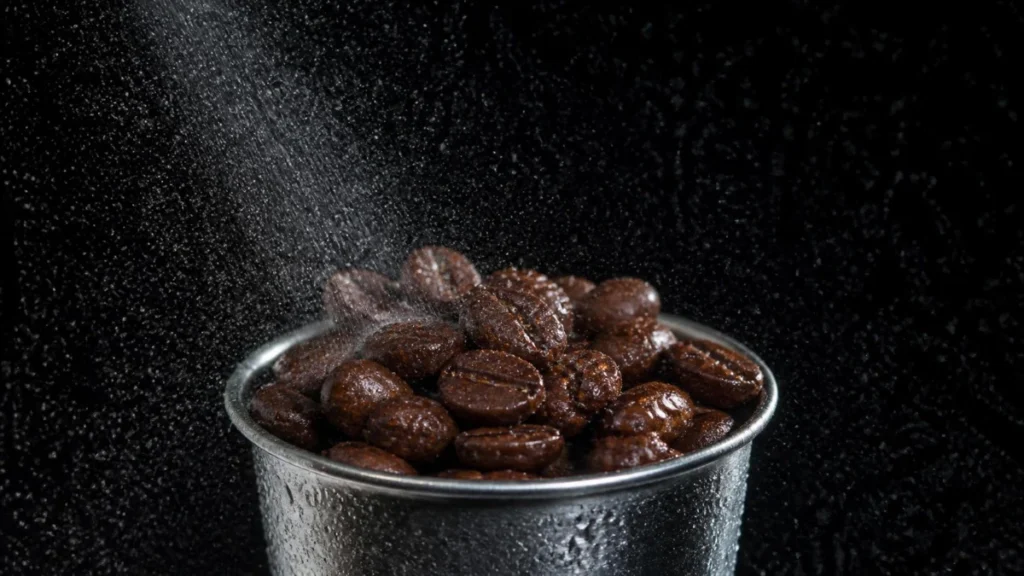
- Spray two to four times with a fine mist bottle from 15–20 cm away. For a 20 g dose, aim for roughly 0.1–0.2 g of water — about 5–10 μL per gram of coffee, the range the published research tested [1].
- Stir or shake for a few seconds to distribute the moisture.
- Grind immediately.
The water dissipates static without wetting the grounds. The beans should still look dry to the eye — if you can see droplets, you have overdone it.
Do not run water over the beans, add a spoonful of water, or spray the burrs directly. The study authors note that too much water may promote caking or corrosion inside the grinder [1], and excess moisture also encourages rust on carbon-steel burrs.
If you don’t own a spray bottle, dip a spoon handle in water, flick off the excess, and stir the beans with it. Two or three drops are enough for a 20 g dose.
2. Let the grounds rest before you open the bin
Static is strongest immediately after grinding. Wait 30–60 seconds, then tap the bin once on the counter before opening. Much of the charge dissipates, and the grounds fall away from the walls.
This is free and works on every grinder. It is especially useful for espresso, where you are dosing straight into a basket.
3. Switch to a metal dosing cup
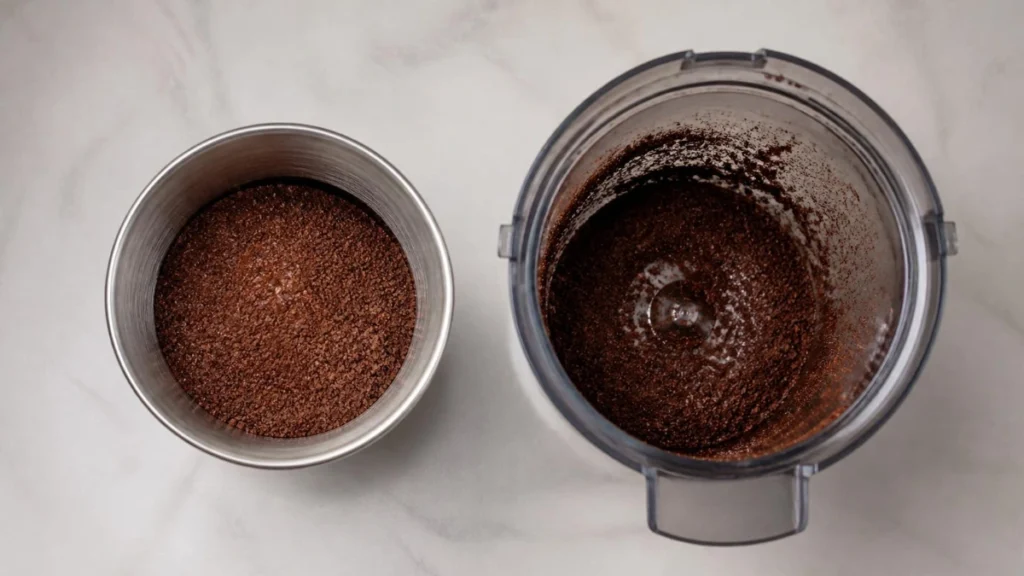
A stainless dosing cup or metal basket noticeably reduces cling on grinders that accept one, because less charge builds on the surface the grounds land on. Many mid-range grinders now ship with a metal cup, which sidesteps the plastic problem right where the grounds land. The Baratza Encore ESP is one of them, and our review covers how its 54/58 mm dosing cup performs in daily use alongside its measured retention—roughly 1.1 g—which is worth knowing before you buy.
Keep the mechanism in perspective, though. Grounding does not neutralize charge held on insulating coffee particles, and grounded metal can attract charged grounds and raise retention rather than lower it [1]. A metal cup helps at the cup; it does not fix the physics.
4. Wipe the bin with a barely damp cloth
A faintly damp paper towel wiped around the inside of the catch bin neutralizes surface charge and removes the oil film that gives grounds something to stick to. Dry it immediately — do not leave moisture in the bin.
Do this weekly, not after every grind. Over-wetting plastic can leave residue that clumps the next dose.
5. Grind slightly coarser
Finer grounds have more surface area, more friction, and more static. If you are at the extreme fine end for espresso and fighting clumps, you may be grinding finer than the basket needs. Our coffee grind size chart maps settings to brewing methods across the common grinders, so you can move one or two clicks at a time instead of guessing at the dial.
This is not a fix for filter brewing — do not coarsen a pour-over grind just to avoid static. Use RDT instead.
6. Clean the burrs and chute
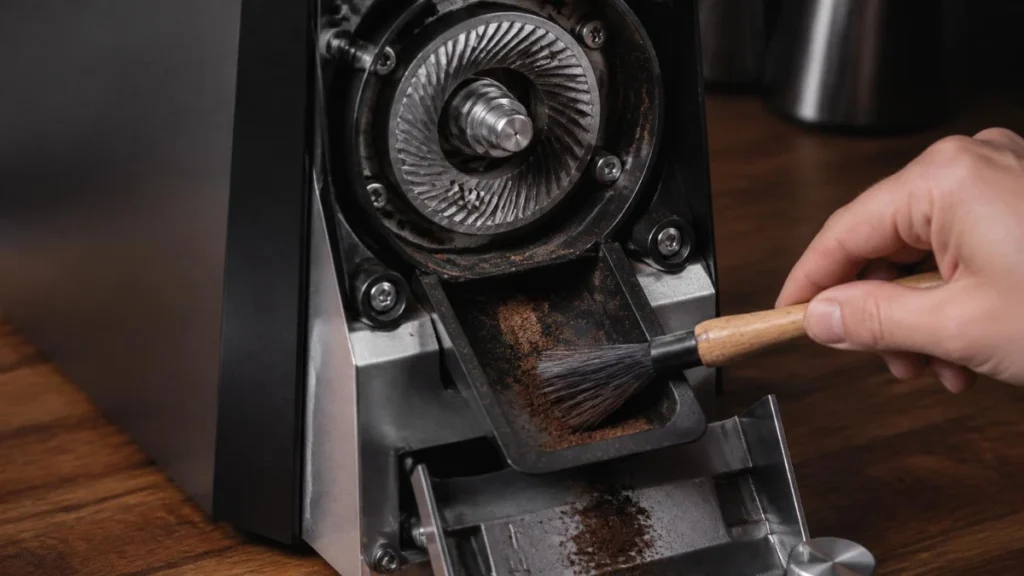
Oil and compacted fines in the chute hold moisture and grounds. A monthly clean with a brush and a grinder cleaning tablet restores flow and reduces retention. Our step-by-step guide to cleaning a coffee grinder covers disassembly and brushing, including how to reach the chute without taking apart more of the machine than you need to.
If you have never opened your grinder, start with the chute and burr chamber—that is where most retention lives.
7. Raise the humidity (last resort)
A small humidifier near the grinder, or simply brewing in a room above 40% relative humidity, reduces static. This is a house-level fix, not a grinder-level one, and it is usually unnecessary if you use RDT.
Do not store beans in a humid environment to compensate. Store coffee in an airtight container, away from moisture.
Fixes by Grinder Type
| Grinder | Best fix | Avoid |
| Blade grinder | RDT + rest + wipe lid | Adding water directly to the chamber |
| Entry-level conical burr (Baratza Encore, OXO) | RDT, metal cup, tap and rest | Over-spraying; water in the chute |
| Single-dose flat burr (DF64, Ode) | RDT, ionizer if fitted, dosing cup | Wet beans in a grinder with an ionizer |
| Hand grinder | RDT, metal catch cup, brush after use | Washing the burr set with water |
| Espresso grinder | RDT, WDT in the basket, purge after switching beans | Grinding finer to compensate for a stale dose |
Hand grinders deserve their own note. They tend to retain less simply because the grounds fall straight from the burr into a small cup, with no chute or impeller to hold them. The trade-offs are real, though, and our roundup of the best manual coffee grinders compares burr sets, catch-cup materials, and which models are worth the daily effort.
Static vs Clumping: How to Tell the Difference
Static makes grounds cling to surfaces. Clumping makes grounds stick to each other in the basket or bin.
| Symptom | Likely cause | Fix |
| Grounds coat the bin walls | Static | RDT, metal cup, rest |
| Grounds form hard clumps | Humidity or over-spraying | Reduce water; stir grounds; check storage |
| Grounds stuck in the chute | Retention + oil buildup | Clean the chute; purge with a few beans |
| Fine dust everywhere | Static plus a dark, dry roast | RDT; wipe the counter with a damp cloth |
| Clumps only at espresso settings | Normal for fine grinding | WDT in the basket |
A little clumping at espresso fineness is normal. Stir the grounds with a needle tool (WDT) before tamping. That is a distribution step, not a static problem.
Does RDT Ruin Your Grinder?
Not if you use the right amount. In published experiments, meaningful charge reduction came from adding 5–20 μL of water per gram of beans to whole beans immediately before grinding [1]. At that level, the beans look dry, and the moisture is distributed across the dose rather than pooling.
The technique has been used in specialty coffee for years and is discussed approvingly in SCA coverage of the research [5], but it is worth being precise about the risk: the study authors explicitly note that too much water may promote caking or corrosion inside the grinder [1].
The risks appear with over-application:
- Visible wet spots on beans
- Grounds that clump into paste
- Rust on carbon-steel burrs (stainless is more forgiving)
- Caked grounds in the chute
If your grinder has a built-in ionizer or anti-static system, you probably don’t need RDT at all.
Frequently Asked Questions
Why does my coffee grinder have so much static?
Dry air, fine grinding, low internal bean moisture, and darker roasts all increase static. Research shows internal bean moisture is the strongest single predictor of how much charge a coffee generates [1].
Does putting water on coffee beans ruin them?
A small amount does not. A spray of 5–10 μL per gram reduces static without affecting the beans. Do not soak them or add spoonfuls of water.
Is static making my coffee taste bad?
Not directly. Static affects dose consistency and makes a mess. Bitterness or sourness is more likely due to grind size, ratio, or water temperature.
Do expensive grinders have less static?
Usually less mess, but not because grounding “drains” the charge. Coffee is an insulator, so metal surfaces only neutralize the particles they touch, and grounded parts can even attract charged grounds [1]. Better grinders tend to have tighter chutes, metal cups, and sometimes ionizers, which is why they feel cleaner.
How do I stop grounds sticking to a plastic bin?
RDT before grinding, let the grounds rest for a minute, tap the bin, and wipe it with a barely damp cloth once a week.
Can static damage the grinder?
No. It is a nuisance, not a mechanical fault. The bigger long-term risk is oil and fine buildup in the chute, which cleaning solves.
Scientific References
- Méndez Harper, J., McDonald, C.S., Rheingold, E.J., Wehn, L.C., Bumbaugh, R.E., Cope, E.J., Lindberg, L.E., Pham, J., Kim, Y.-H., Dufek, J., & Hendon, C.H. (2024). “Moisture-controlled triboelectrification during coffee grinding.” Matter, 7(1). DOI: 10.1016/j.matt.2023.11.005. Open record via the NSF Public Access Repository: par.nsf.gov/biblio/10508770. Supported by the U.S. Department of Energy, the National Science Foundation, the Camille and Henry Dreyfus Foundation, and the Coffee Science Foundation.
- Zou, H., Zhang, Y., Guo, L., Wang, P., He, X., Dai, G., Zheng, H., Chen, C., Wang, A.C., Xu, C., & Wang, Z.L. (2019). “Quantifying the triboelectric series.” Nature Communications, 10, 1427. doi.org/10.1038/s41467-019-09685-x (open access via PubMed Central, PMC6441076).
- National Institute of Standards and Technology. Circular of the Bureau of Standards No. 438: Static Electricity. nvlpubs.nist.gov/nistpubs/Legacy/circ/nbscircular438.pdf
- Harvard University, Science Demonstration Lab. “Triboelectric Effects.” sciencedemonstrations.fas.harvard.edu
- Specialty Coffee Association. “It’s Electric: Understanding—and Reducing—Static Electricity During Grinding.” SCA News, Issue 21 — a practitioner explainer written by the study’s authors. sca.coffee
Citation note: claims about the magnitude of charge in coffee, the effect of moisture, roast polarity, retention, and espresso flow all come from reference 1, whose authors also wrote reference 5. Reference 2 covers the general triboelectric mechanism, reference 3 the fundamentals of static charge, and reference 4 the humidity effect.
Final Thoughts
Static is one of the few grinder problems you can fix in ten seconds with a spray bottle. If you do nothing else, try RDT with two or three sprays on your dose, let the grounds rest before opening the bin, and see whether retention drops — most people notice the difference on the first grind.
If static persists after that, clean the chute and check the humidity. And if you are shopping rather than fixing, our roundup of the best electric coffee grinders compares models on retention, cup material, and chute design—the three things that decide how much static you end up living with.