

Quick Verdict
Best for: Beginners, daily home brewers, anyone who wants a reliable, beautiful French press at a fair price.
Not ideal for: Anyone who needs maximum heat retention, dislikes any sediment, or tends to be rough on glassware.
Rating: 4.3 / 5
Bottom line: The Bodum Chambord has earned its status as the world’s most recognizable French press. The borosilicate glass, chrome frame, and three-part stainless mesh filter have barely changed since the 1970s — and they still work. It makes a rich, full-bodied cup, parts are easy to replace, and the price is genuinely reasonable. It’s not the most technically advanced French press on the market. It doesn’t need to be.
Introduction
Some products earn their reputation through clever marketing. The Bodum Chambord earned its reputation through decades of reliable performance in millions of kitchens.
The Chambord is a true original — the classic French press coffee maker designed in the 1950s to honor the iconic Château de Chambord in France, still produced with the same painstaking craftsmanship as when it launched. It is proudly made in Europe, just as it has always been.
Today it sits at around $35–$50 for the 34oz version on Amazon, and it’s still the French press most coffee educators reach for when recommending an entry-level brewer. That’s not nostalgia. That’s a real track record.
But the question worth asking in 2026 is: does it hold up against better-filtered, better-insulated competitors at similar or slightly higher prices?
This review covers build quality, brewing performance, cleaning, ease of use, and an honest comparison against the alternatives — so you can decide whether the Chambord is right for your setup.
Our Review & Research Disclaimer
At RoastVista, our product reviews are based on detailed research and analysis rather than hands-on physical testing. We study manufacturer information, product specifications, independent sources, and feedback from real users to understand a product’s performance, quality, features, strengths, and limitations. We also compare products with similar alternatives to provide a broader perspective.
Our goal is to give prospective buyers a clear, balanced, and well-researched picture of each product so they can make a more informed purchasing decision.

Specifications
| Feature | Details |
|---|---|
| Sizes available | 12oz, 17oz, 34oz, 51oz |
| Material | Borosilicate glass beaker, polished stainless steel frame |
| Filter type | Three-part stainless steel mesh + spiral plate |
| Dishwasher safe | Beaker, plunger, and filter — yes. Frame — hand wash recommended |
| Made in | Portugal |
| Colours available | Chrome, black, white, copper, cork, and others |
| Price range (34oz) | ~$35–$50 on Amazon |
| Replacement glass | Available separately (~$15–$25) |
Build Quality
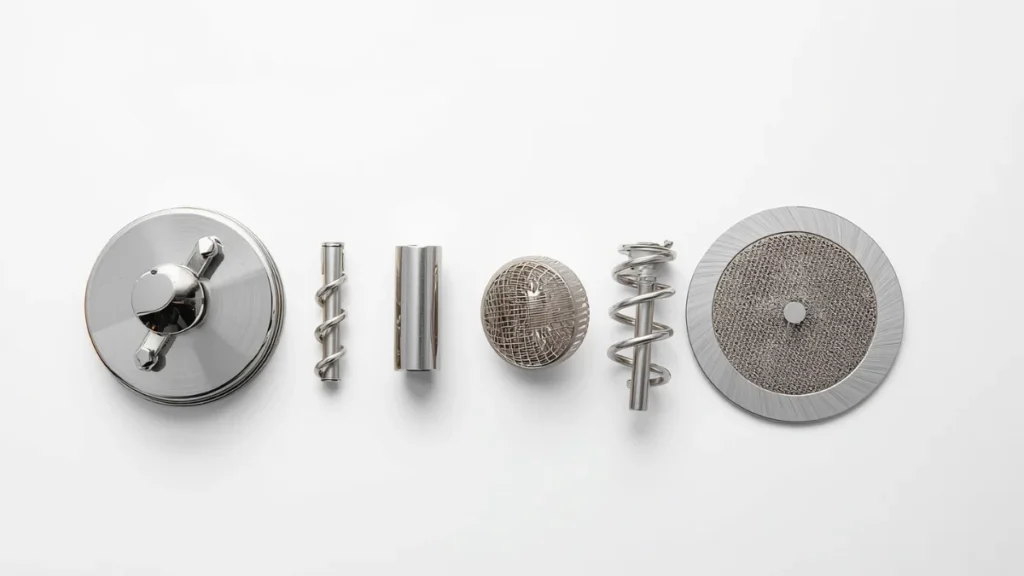
The Chambord’s build is a study in deliberate simplicity. The borosilicate glass is ultra-light and strong, with excellent heat resistance. The stainless steel spiral plate keeps the filter mesh in place and ensures that water flows through without coffee grounds passing through.
The flexible spiral provides a universal fit that accounts for the manufacturing tolerances of glass jugs.
The borosilicate glass deserves particular attention. Unlike ordinary glass, borosilicate handles thermal shock — the rapid temperature change between cold and very hot — without cracking. This is the same type of glass used in laboratory equipment and quality bakeware.
It’s also odor-neutral, meaning it won’t absorb old coffee odors or transfer them to your next brew, as some plastics can.
The polished stainless steel frame is solid and stable. It holds the beaker firmly and gives the Chambord its characteristic elegant profile. The handle is plastic — not stainless — which is the most common point of criticism for this press.
It feels noticeably lighter than the rest of the construction. Functionally, it does the job; aesthetically, it’s the one element that doesn’t quite match the quality of the frame and glass.
Where it’s durable
The chrome frame survived 15 dishwasher cycles without peeling, and the glass beaker showed zero clouding after repeated use. The filter components hold up well over extended daily use.
Where it’s fragile
The glass beaker. The glass carafe is fragile — this is the most consistent long-term ownership complaint across thousands of reviews. Drop it on a hard floor, knock it against a tap, or put it away wet where it can shift and collide with other items, and the glass will break.
The saving grace: replacement glass and filters are easy to find at modest cost, which means a broken beaker doesn’t end the life of the press.
Brewing Performance
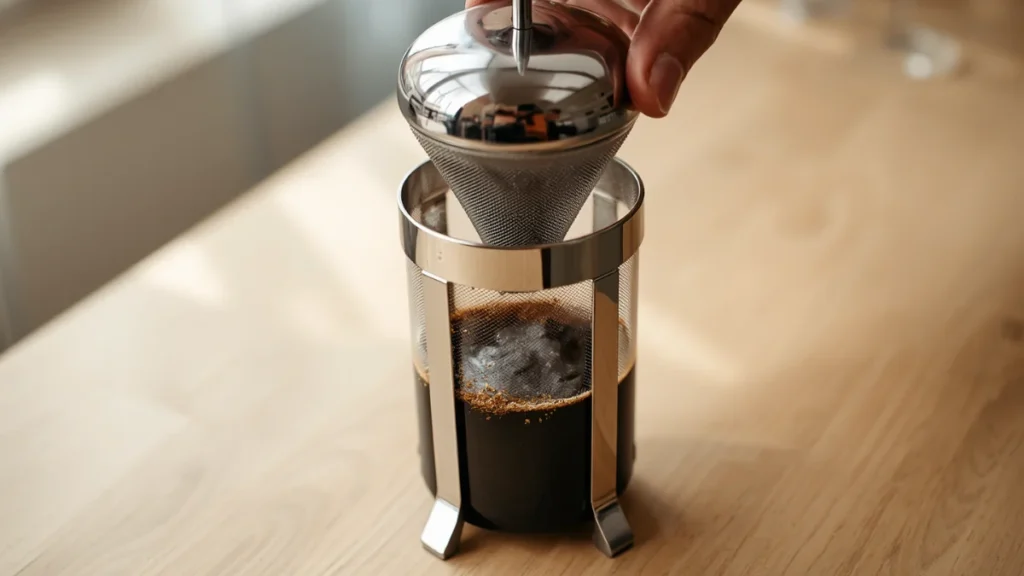
The Chambord brews exactly what a French press is supposed to produce: a rich, full-bodied, oil-forward cup of coffee. Paper-filtered methods like pour-over strip out the coffee oils that give French press its characteristic weight and texture. The Chambord’s metal mesh keeps those oils in — which is precisely the point.
The standard recipe: use a coarse grind, add hot water at 92–96°C (197–205°F), bloom briefly, steep for 4 minutes, press slowly and evenly, serve immediately.For most beginners, sediment is not an issue, and the coffee you get from the Chambord is genuinely enjoyable — full-bodied, rich, and smooth when brewed correctly. The key variables, as always, are grind size and brew time.
On sediment
Every French press produces some sediment — this is a characteristic of the brewing method, not a flaw of the Chambord. Bodum’s filter design is single-mesh, meaning you’ll get noticeably more sediment in your cup than from double-filter brands like ESPRO or Frieling.
Using a burr grinder set to a genuinely coarse setting significantly minimizes this. Using pre-ground supermarket coffee (which is ground fine for drip machines) produces noticeable sediment— this is a grind problem, not a press problem.
Heat retention
Glass loses heat faster than stainless steel. The Chambord keeps coffee reasonably warm for 20–30 minutes after brewing, after which the temperature drops noticeably. If you brew and serve immediately — as you should with a French press — this isn’t a problem.
If you brew and leave it on the counter for an hour before pouring, the coffee will be lukewarm and, more importantly, increasingly bitter from continued extraction.
The fix is simple: pour your brewed coffee into a preheated carafe or thermos immediately after pressing. Don’t leave coffee sitting in contact with the grounds.
Ease of Use
The Chambord is one of the most beginner-friendly brewing methods available. There’s no pour technique to master, no gooseneck kettle required, no bloom timing to manage with precision.
The steps are straightforward: add coarse grounds, add hot water, wait 4 minutes, press, pour. That's it. A total beginner can make a genuinely good cup of French press coffee on their first attempt with the Chambord in a way that simply isn't true of pour over.Bodum recommends 2 rounded tablespoons of coarse-ground coffee per 8 ounces of water as a starting point— though we’d encourage moving to a weight-based ratio of 1:15 (grams of coffee to grams of water) once you have a scale, since weight is more consistent than volume for dosing.
The plunger presses smoothly when the grind is correct. If it feels very stiff or very easy, that’s diagnostic information — too fine or too coarse, respectively. The dome-shaped lid fits securely, and the pouring spout is clean and drip-free under normal use.
Cleaning
Both the glass beaker and the filter and plunger are dishwasher safe and will not get cloudy in the dishwasher. With the exception of items with a Chrome or Matte Chrome finish, only the beaker, filter, and plunger are dishwasher-safe. The frame and lid should be hand-washed with a non-abrasive sponge.
For daily maintenance, the most effective routine is:
- After pressing and pouring, allow the press to cool slightly.
- Add warm water to the beaker, swirl to loosen grounds, and pour out.
- Disassemble the plunger and rinse the mesh screen separately — coffee oils accumulate quickly on the mesh and affect flavor if left to build up.
- Either run the beaker through the dishwasher (top rack) or hand-wash it with a soft brush.
The mesh filter is the component that benefits most from careful regular cleaning. A quick rinse is usually sufficient for daily use, but a more thorough disassembly and soak every week or two keep the filter performing properly and prevent stale oil buildup from affecting taste.
Pros and Cons
| Pros | Cons |
|---|---|
| Iconic, beautiful design | Glass beaker is fragile |
| Rich, full-bodied brew | Average heat retention |
| Genuine borosilicate glass | Single-mesh filter — more sediment than double-filter competitors |
| Made in Portugal | Plastic handle feels lightweight |
| Replacement parts widely available | Chrome frame should be hand-washed |
| Dishwasher-safe beaker and filter | — |
| Available in 4 sizes and multiple colors | — |
| Beginner-friendly | — |
| Strong value at ~$35–$50 | — |
Who Should Buy the Bodum Chambord
Buy it if:
- You’re new to French press and want a reliable, easy-to-use starting point
- You want a French press that looks genuinely good on a kitchen counter
- You’re comfortable with normal French press sediment and understand it’s a method characteristic
- You want a brewer where replacement parts are easy to source and inexpensive
- You’re working with a budget of ~$35–$50 for a 34oz press
Skip it if:
- You need maximum heat retention for extended table service — a stainless steel double-wall press will keep coffee hot significantly longer
- Sediment bothers you — the ESPRO P3’s double micro-filter reduces sediment substantially
- Your kitchen or workspace is hard on glassware
- You want all-stainless construction with no glass components
How It Compares to Alternatives
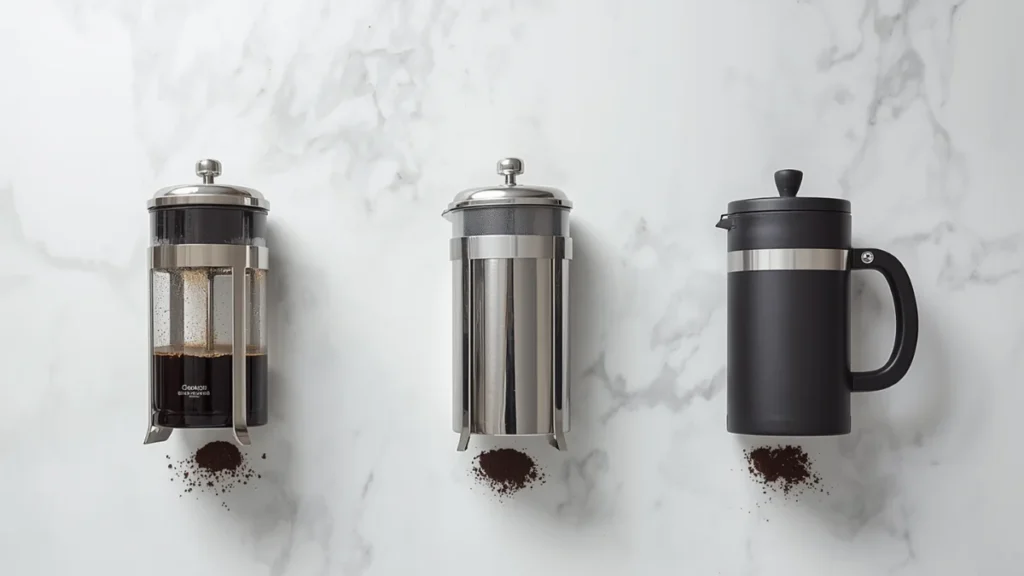
Bodum Chambord vs ESPRO P3 (~$40)
Both are priced similarly. The ESPRO P3 has a double micro-filter that produces a noticeably cleaner, less gritty cup. If sediment is your main concern, the ESPRO is worth the same price. If you’re fine with normal French press sediment, the Chambord is the more reliable long-term buy with better parts availability.
Bodum Chambord vs Frieling Double-Wall Stainless (~$90+)
The Frieling is a significant step up in two areas: heat retention (hours, not minutes) and durability (no glass to break). The trade-off is price — roughly twice the Chambord — and aesthetics (you can’t see the brew).
For serious daily brewers who want their press to last a decade without concerns about fragility, the Frieling is worth the investment. For everyone else, the Chambord delivers the same cup quality at a fraction of the price.
Bodum Chambord vs Bodum Brazil (~$20)
The Brazil is Bodum’s budget sibling — same borosilicate glass, same four-minute steep method, but with a plastic frame instead of stainless steel. The Chambord’s design feels more refined, and the stainless frame is more durable long-term.
The brewing result is effectively identical. If budget is the priority, the Brazil is a legitimate option. If you want the full Chambord experience, the extra cost is visible and felt every time you pick it up.
Value Analysis
At $35–$50 for the 34oz model, the Bodum Chambord offers strong value for what it delivers. You get a press made in Portugal from borosilicate glass and stainless steel, with dishwasher-safe components, replacement parts that cost a fraction of the original price, and a brewing result that competes with equipment costing significantly more.
The only circumstance in which value feels questionable is if the glass breaks shortly after purchase due to accidental damage — at which point replacement glass at $15–$25 makes economic sense rather than replacing the whole press.
For a first French press, or a reliable daily driver that doesn’t need to be precious about, the Chambord is difficult to beat at this price.
Common Complaints (And What’s Actually True)
“The glass breaks easily.”
Partly true. Borosilicate glass is more durable than regular glass, but it will break if dropped or knocked hard against a hard surface. It’s glass — handle it accordingly.
“There’s too much sediment.”
This is almost always a grind size issue rather than a Chambord issue. Fine or medium-ground coffee produces significant sediment in any French press. A burr grinder set to a genuinely coarse setting reduces sediment to a minimal, barely noticeable level.
“The plastic handle feels cheap.”
Fair. It’s a functional but uninspiring component on an otherwise quality product.
“The chrome frame rusts.”
The chrome plating on the stand can pit and rust over years of dishwashing. Hand-washing the frame avoids this entirely — it takes 30 seconds and significantly extends the frame’s lifespan.
Pro Tips for Getting the Best From the Chambord
Grind coarser than you think you need
The most common Chambord mistake is using a grind that’s too fine. If your plunger pushes down very easily, your grind is too coarse. If it feels very stiff, it’s too fine. The sweet spot has moderate, consistent resistance throughout the press.
Preheat the carafe
Fill the beaker with hot water for a minute before adding the coffee, then discard the water. A preheated beaker maintains brew temperature better during the steep and produces a noticeably hotter final cup.
Don’t leave coffee in the press after steeping
Once you press the plunger, pour all the coffee out immediately. Coffee left in contact with the grounds continues to extract — bitterness increases quickly after the 5-minute mark.
Use a scale
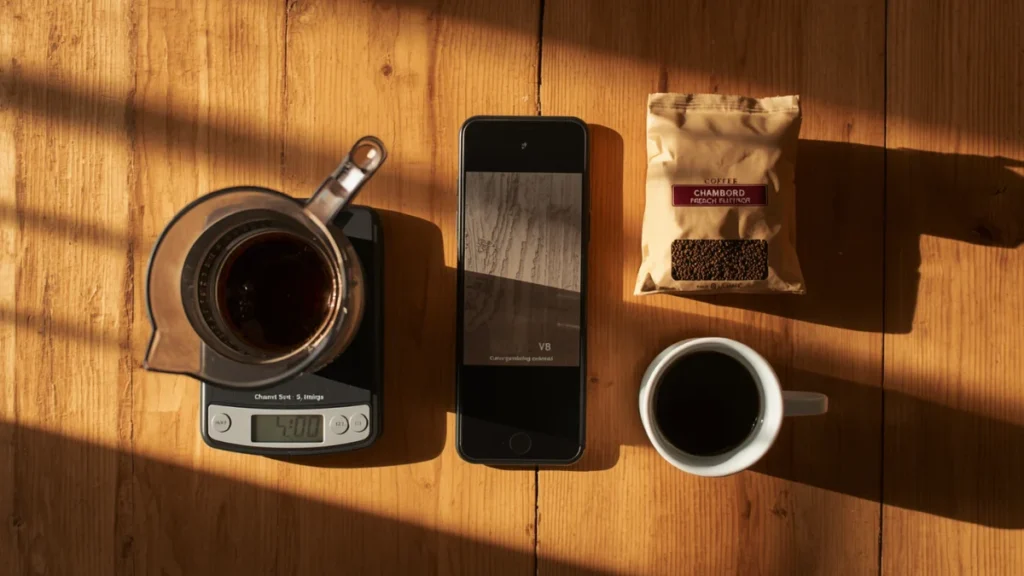
A 1:15 ratio by weight — 30 grams of coffee to 450 grams of water for the 34oz press — is a reliable starting point. See French Press Coffee Ratio Explained for a full ratio guide.
Clean the mesh after every use. A quick disassembly and rinse of the three-part filter takes two minutes and keeps old coffee oils from building up and making fresh coffee taste stale.
Bodum Chambord French Press review: FAQs
Is the Bodum Chambord worth buying?
For most home brewers, yes. It brews excellent French press coffee, looks great on a counter, and is priced so that replacement parts are practical rather than an afterthought. If you specifically need extended heat retention or minimal sediment, there are better-suited alternatives at higher prices.
How do you clean the Bodum Chambord?
The beaker, plunger, and filter are dishwasher-safe (top rack). The frame and lid should be hand-washed with a soft, non-abrasive sponge. For daily maintenance, a quick disassembly and rinse of the mesh filter is sufficient. A more thorough weekly soak removes coffee oil buildup that affects flavor over time.
What size Chambord should I buy?
For a single daily brewer, the 17oz (2-cup) or 34oz (4-cup) models suit most home routines. The 34oz is the most popular size and the best value per ounce. If you regularly make coffee for two or more people, the 34oz or 51oz is the practical choice.
Does the Bodum Chambord produce sediment?
Yes — a small amount of sediment at the bottom of the cup is normal for all French press brewing. It’s a characteristic of the method, not a flaw of the press. Using a burr grinder set to a coarse setting significantly reduces sediment. If sediment is a primary concern, the ESPRO P3’s double micro-filter addresses this more directly.
See How to Reduce Sediment in French Press Coffee for practical fixes.
How long should the Bodum Chambord steep?
4 minutes is the standard and most reliable starting point. Start your timer when you add the water. Press and serve immediately at 4 minutes—don’t leave it steeping longer, or the coffee will continue extracting, and bitterness will increase.
Final Verdict
The Bodum Chambord isn’t the most technically advanced French press of 2026. It doesn’t have double micro-filtration, double-wall insulation, or an all-stainless body. What it has is a decades-long track record of producing genuinely good French press coffee in a well-made, beautiful package at a fair price.
It makes a rich, full-bodied cup heavy with coffee oils — not the brightest cup, but arguably the coziest. Replacement parts are readily available. The brewing process is simple enough for a complete beginner and reliable enough for a daily driver that experienced brewers keep coming back to.
If you want a French press that delivers on the fundamentals, handles daily use gracefully, and looks good doing it — the Chambord remains an easy recommendation in 2026.
Check the current price on Amazon →
Recommended Reading
- French Press Coffee Guide
- How to Reduce Sediment in French Press Coffee
- French Press Coffee Ratio Explained
- Best Coffee Beans for French Press
- Coffee Grind Size Chart
- Burr vs Blade Coffee Grinders
- ESPRO P3 French Press Review (2026): The Best French Press for Sediment-Haters?