
Quick Answer
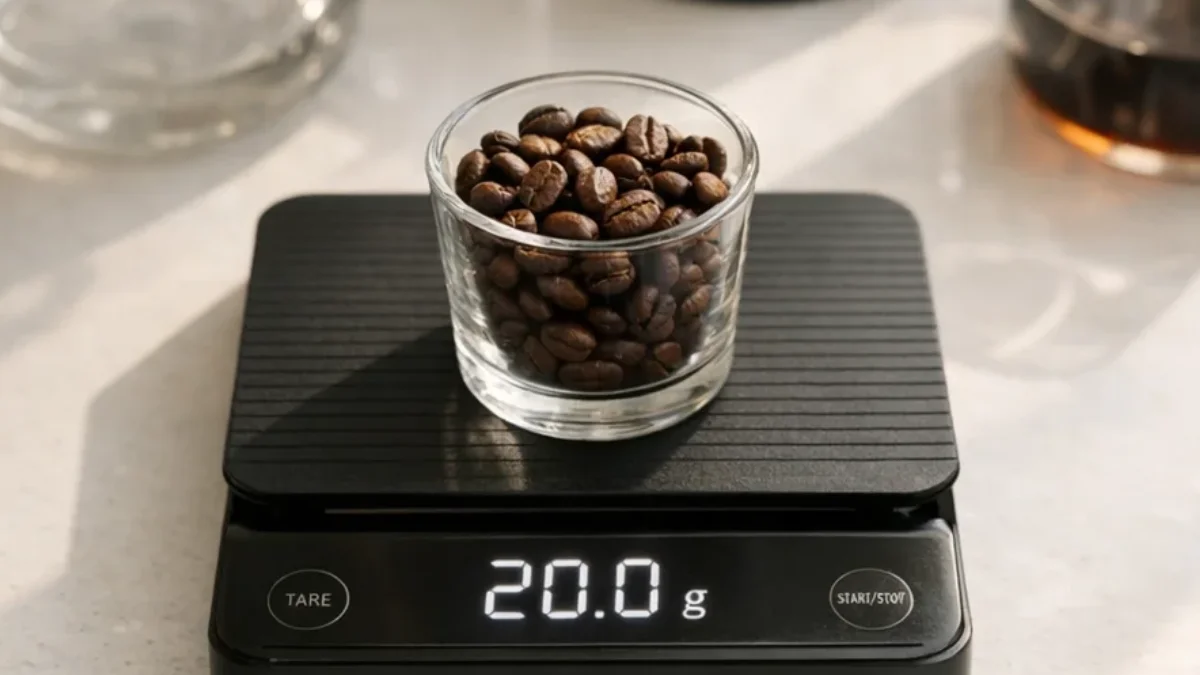
Place your brewer on the scale, press tare to zero it, add your coffee dose by weight, tare again, then add water until you hit your target weight. For most brewing methods, start with a 1:15 ratio — 1 gram of coffee for every 15 grams of water. A scale removes guesswork from ratio and makes every brew repeatable.
Introduction
A coffee scale sounds like something only serious enthusiasts need. The reality is different. A scale is one of the simplest and most practical tools a home brewer can add — and it works just as well for a basic French press as it does for a carefully dialed-in pour over.
The reason is straightforward. Without a scale, you’re measuring coffee by volume — a scoop here, a rough estimate there. Volume measurements are inconsistent. A heaped scoop of finely ground coffee weighs significantly more than the same volume of coarsely ground coffee. Humidity, bean density, and how firmly you pack the scoop all affect the result.
A scale removes all of that variability. Once you have a ratio that produces a cup you enjoy, you can reproduce it exactly — every time, with any bean, at any grind size.
This guide walks you through everything you need to know to start using a coffee scale confidently.
Why Use a Coffee Scale for Brewing Coffee?
Consistent coffee-to-water ratio
Ratio is the single biggest factor in determining how strong your coffee tastes. A scale measures both coffee and water precisely, so your ratio stays the same from cup to cup.
Easier troubleshooting
When something tastes off, a scale gives you a reliable baseline to adjust from. If you know you used exactly 20g of coffee and 300g of water, you can change one variable at a time and track the result. Without a scale, every brew is a slightly different experiment.
Less wasted coffee
Weighing your dose means you use exactly the coffee you intend to use — not slightly more, not slightly less. Over weeks and months, consistent dosing adds up to meaningful savings, especially with specialty coffee.
Better repeatability
A great cup of coffee is only useful if you can make it again. A scale is what makes that possible.
For more on the importance of ratio, see Coffee Brewing Ratio Explained.
What Kind of Scale Do You Need for Coffee?
You don’t need an expensive, coffee-specific scale to start. Here’s what actually matters:
Accuracy
A scale that reads in 0.1g increments is useful for pour over, where small dose changes can affect extraction. For French press and cold brew, 1g accuracy is plenty.
Capacity
Most brewing setups need a scale that can handle 1–2kg. Larger batches (cold-brew pitchers, Chemex for multiple people) may need a 3kg capacity.
Built-in timer
Not essential, but convenient for pour over. A scale with a timer means you measure weight and track bloom time without needing a separate device.
Water resistance
Coffee brewing involves water, steam, and occasional spills. A scale with some water resistance survives kitchen use much better than one without it.
Platform size
The scale platform needs to fit your brewer comfortably. A V60 on a small server fits most platforms. A large French press or a Chemex may need a wider base.
Battery type
Rechargeable (USB) scales avoid the frustration of dead batteries mid-brew. Replaceable battery scales are more common at budget price points.
See Essential Coffee Brewing Tools for a broader overview of equipment.
How to Set Up a Coffee Scale Before Brewing
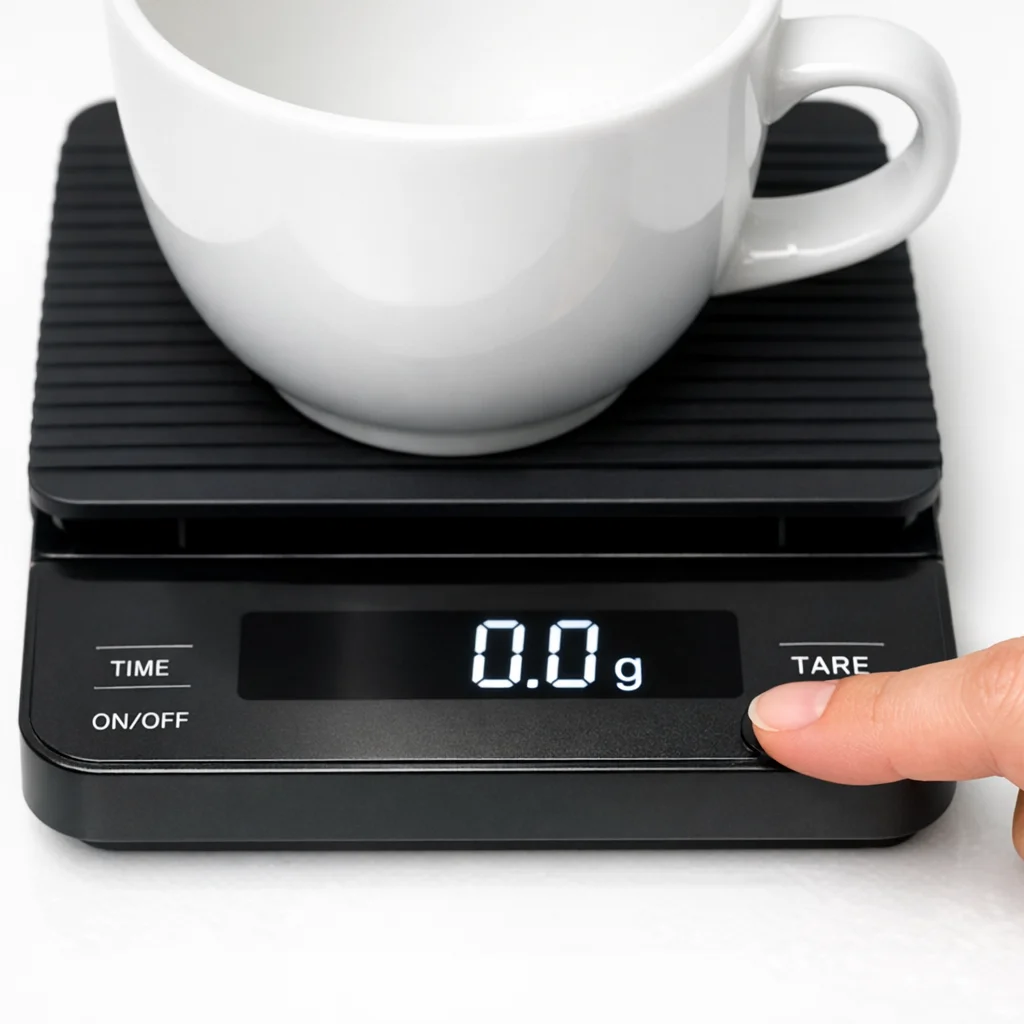
Setup takes about ten seconds:
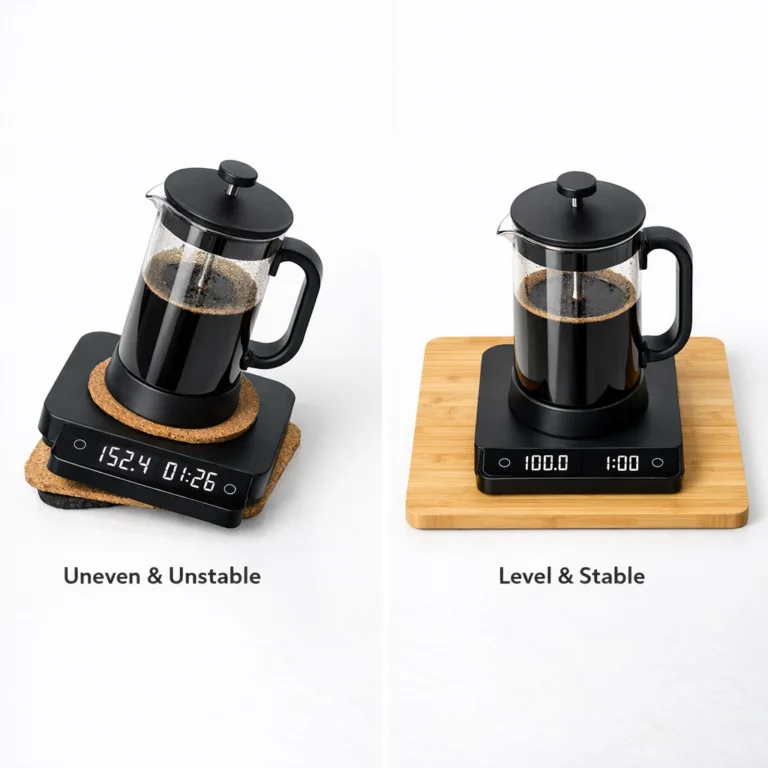
- Place the scale on a flat, stable surface. An uneven surface causes inaccurate readings.
- Turn the scale on and wait for it to stabilize at zero.
- Place your brewer or container on the scale platform.
- Press the tare button to reset the display to zero. This subtracts the brewer’s weight, so you’re only measuring coffee and water.
- Confirm the unit is set to grams, not ounces. Grams are the standard for coffee brewing and offer finer resolution.
That’s the complete setup. Everything else is just adding coffee and water while watching the numbers.
How to Weigh Coffee Beans
- Place your dosing container, portafilter, or grinder catch cup on the scale.
- Press tare to zero it.
- Add whole beans until the display shows your target dose.
- Grind and proceed with brewing.
Simple dose examples to get started:
- One small cup: 15g coffee → 225g water (1:15 ratio)
- Standard single serving: 20g coffee → 300g water
- Two cups: 30g coffee → 450g water
- Large French press: 35g coffee → 525g water
These are starting points. Adjust to taste once you have your baseline.
For ratio guidance by method, see Coffee Brewing Ratio Explained.
How to Use a Coffee Scale for Pour Over Coffee
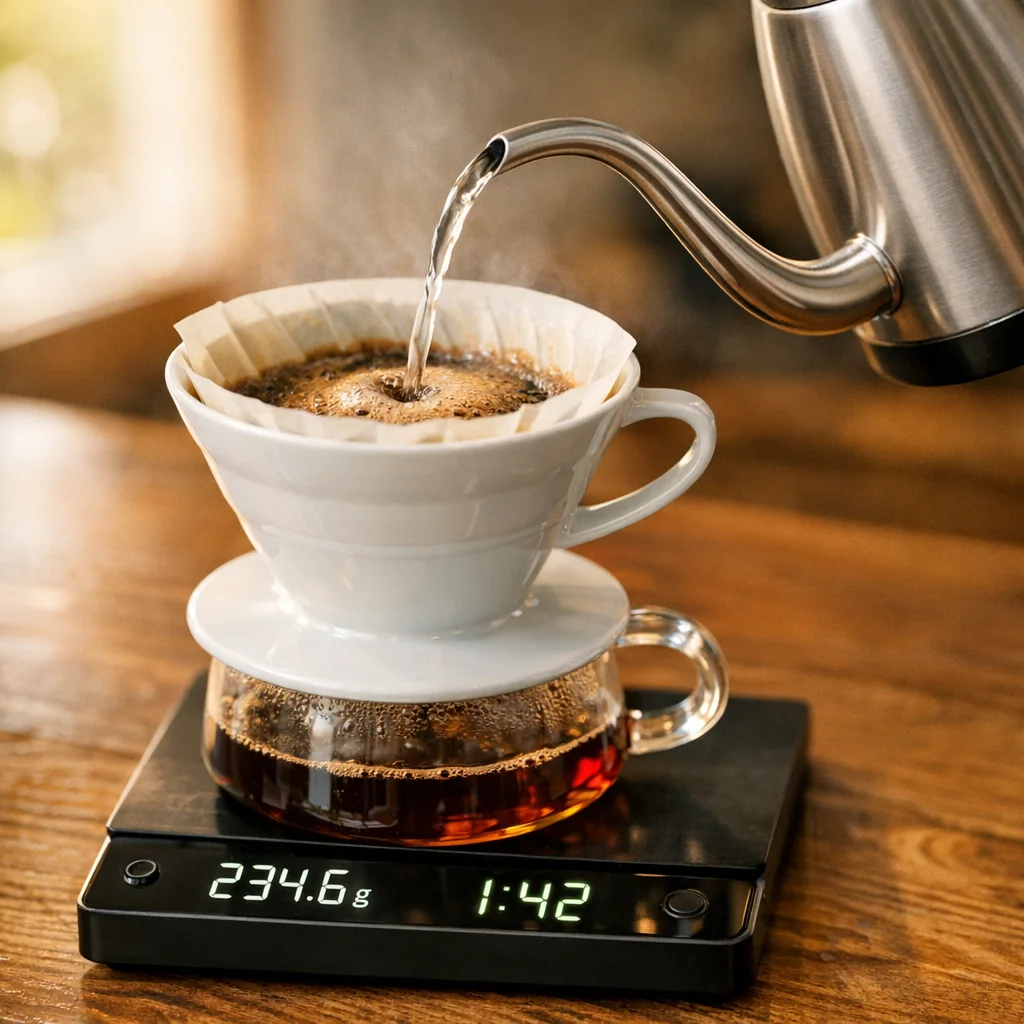
Pour over is where a scale makes the biggest practical difference. Here’s the full process:
- Place your dripper on your server and set both on the scale.
- Place a rinsed paper filter in the dripper and add your ground coffee.
- Press tare to zero the scale.
- Start your timer (either built into the scale or on your phone).
- Pour bloom water — roughly twice the weight of your coffee dose. For 20g of coffee, add 40g of water.
- Wait 30–45 seconds.
- Continue pouring in slow, circular stages until you reach your total water target.
- For 20g of coffee, target a total of 300g of water (including bloom water).
Watching the scale display while pouring teaches you exactly how fast you’re adding water — a valuable feedback loop for improving technique.
Example recipe: 20g coffee → 300g water → target brew time 2:30–3:30 from start of bloom.
See Pour Over Coffee Ratio Explained and the Pour Over Coffee Guide for the full method.
How to Use a Coffee Scale for French Press
French press scale use is simpler than pour over because there’s no active pouring technique to manage:
- Place your French press on the scale.
- Press tare.
- Add ground coffee until you reach your target dose.
- Press tare again.
- Pour hot water until you reach your total water target.
- Start your timer and steep for 4 minutes.
Example recipe: 30g coffee → 450g water → steep 4 minutes → press and serve immediately.
This produces a balanced, full-bodied cup at a standard 1:15 ratio. Adjust coffee weight up (to 35g) for a bolder cup, or down (to 25g) for a milder one.
See French Press Coffee Ratio Explained for more detail.
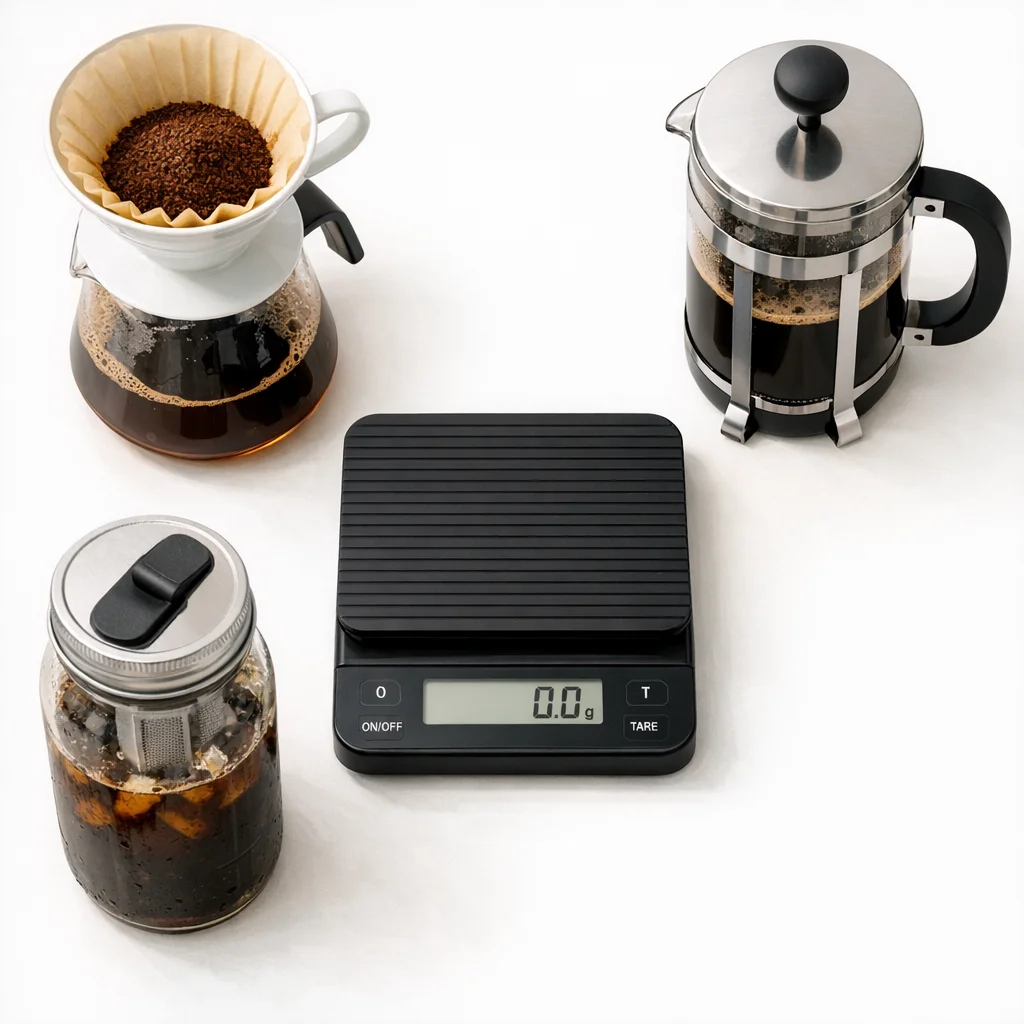
How to Use a Coffee Scale for Cold Brew
Cold brew batches are typically larger than pour-over or French press servings, which makes weighing even more valuable — small measurement errors compound significantly at scale.
- Place your cold brew container on the scale.
- Press tare.
- Add ground coffee to your target dose.
- Press tare again.
- Pour cold or room-temperature water slowly until you reach your water target.
- Cover and steep for 12–24 hours.
Weighing water for cold brew is more accurate than using measuring cups, particularly for large batches where volume measurement errors are more significant.
Example recipe (standard concentrate): 100g coffee → 500g water → steep 14–18 hours → filter and dilute 1:1 before serving.
See the Cold Brew Ratio Chart for a full breakdown of ratios by strength.
Coffee Scale Mistakes Beginners Make
Forgetting to tareThis is the most common mistake. If you forget to tare after placing your brewer on the scale, your water weight reading will include the brewer’s weight. Always tare before adding anything you intend to measure.
Measuring in ounces instead of gramsCoffee recipes are almost universally written in grams. Ounces offer less precision and make ratio calculations harder. Check your unit setting before every brew if you share the scale with others who use different units.
Placing the scale on an uneven surfaceA scale on an uneven countertop gives inconsistent readings. Move it to the flattest spot available, or use a cutting board as a stable base.
Water damage from a non-resistant scaleBoth pour-over and French press involve pouring near the scale. A scale without any water resistance is at constant risk from splashes and steam. If you’re buying new, water resistance is worth prioritizing.
Assuming the scale is accurate without checkingBasic digital scales can drift over time or arrive slightly out of calibration. A simple check: weigh a known reference (a full 500ml water bottle, for example) and see if the reading matches the expected weight. If it’s consistently off, recalibrate if the scale allows it.
See Coffee Scale Not Accurate? for a full troubleshooting guide.
Do You Need a Coffee Scale With a Timer?
A separate timer works perfectly well for most brewing situations. Your phone’s timer app is free, always available, and as accurate as any built-in scale timer.
A scale with a built-in timer offers one specific convenience: for pour over, you can watch a single display for both weight and elapsed time rather than glancing between two devices. When you’re learning pour over technique and tracking bloom time alongside water weight, that consolidated view is genuinely helpful.
For French press and cold brew, a separate timer is just as practical as a built-in one — there’s no need for simultaneous weight and time tracking.
See Do You Need a Timer for Coffee Brewing? for a full guide on timing in home brewing.
FAQs
Can I use a normal kitchen scale for coffee?
Yes — a basic kitchen scale accurate to 1g works well for French press and cold brew. For pour over, a scale accurate to 0.1g gives you more precision on small dose changes, but 1g accuracy is a workable starting point for any method.
Is 0.1g accuracy necessary for pour over?
Helpful but not essential. The difference between 19.9g and 20.1g of coffee is small enough that most palates won’t notice it. That said, if you’re systematically fine-tuning your recipe, 0.1g accuracy makes incremental adjustments easier to track.
How much coffee should I use for one cup?
A reliable starting point is 15–20g of coffee for a standard single serving (around 250–300ml of water). Use 15g for a milder cup and 20g for a stronger one, keeping the water volume proportional to maintain the 1:15 ratio.
Do I need a scale for French press?
Not strictly — French press is one of the more forgiving methods and many people make excellent French press coffee using a scoop and approximate measurements. But a scale makes the ratio more consistent and troubleshooting much easier when results vary.
Is a coffee scale worth buying?
Yes, for most home brewers. Even a basic, affordable digital scale significantly improves consistency and takes much of the guesswork out of ratio. For pour over specifically, it’s the single most impactful equipment addition after the grinder and kettle.
Key Takeaways
- Tare before adding coffee, then tare again before adding water — this is the core habit that makes using a scale effective.
- Use grams, not ounces — grams are more precise and all standard coffee recipes use them.
- 1:15 is the reliable starting ratio across most brewing methods — adjust from there based on taste.
- A built-in timer is convenient for pour over, but a separate phone timer works perfectly for French press and cold brew.
- Water resistance and platform size matter when choosing a scale for coffee use.
Related Reading
- Coffee Brewing Ratio Explained
- Essential Coffee Brewing Tools
- Coffee Scale Not Accurate?
- Do You Need a Timer for Coffee Brewing?
- Pour Over Coffee Guide
- Pour Over Coffee Ratio Explained
- French Press Coffee Ratio Explained
- Cold Brew Ratio Chart