
Quick Answer Box
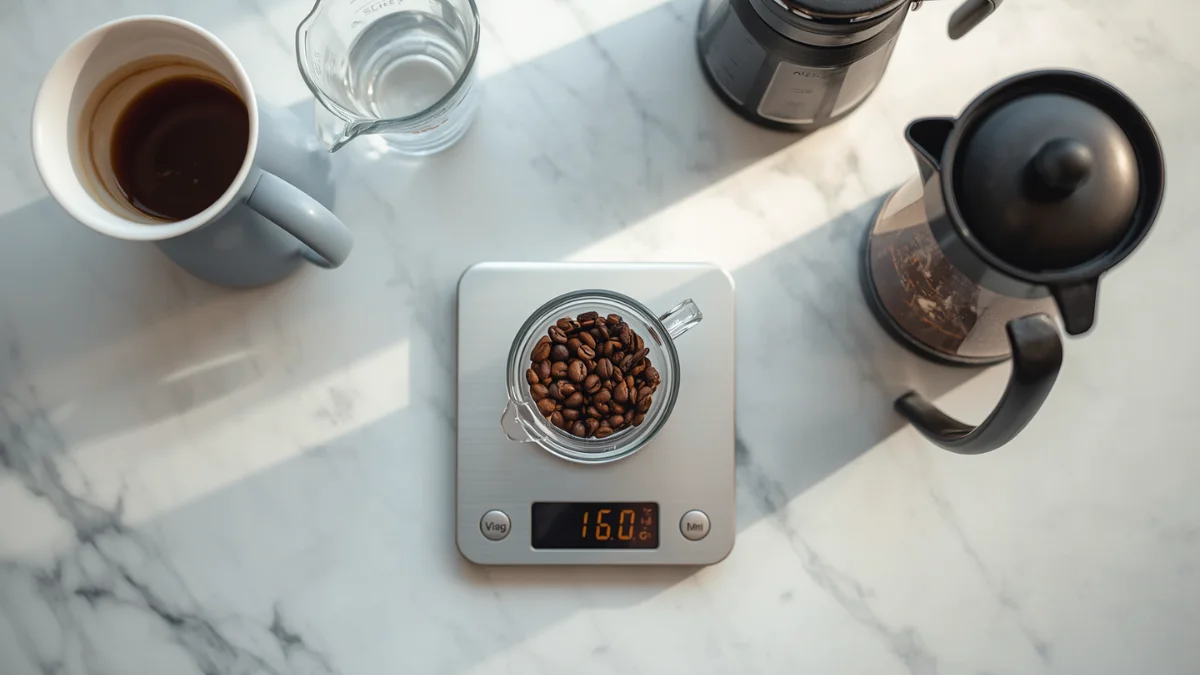
The most reliable starting point for most brewing methods is a 1:16 ratio — 1 gram of coffee for every 16 grams of water. For a standard 250ml cup, that’s roughly 15–16 grams of coffee. Brew once, taste, then adjust from there. Weighing both coffee and water removes the guesswork that tablespoons and scoops can’t.
Introduction
Most people measure coffee with a scoop. It feels intuitive — a heaped tablespoon, maybe two, and fill the cup. The problem is that volume measurement is inconsistent. A tablespoon of finely ground coffee weighs significantly more than a tablespoon of coarse cold brew grounds. The same scoop produces a completely different dose depending on the bean, the roast, and how tightly you pack it.
That inconsistency is why coffee-to-water ratio — measured by weight — is the foundation of repeatable, great-tasting coffee. It’s the one variable that ties everything else together.
This article covers everything you need to get ratio right: a quick reference calculator table, the Golden Ratio, method-by-method ratios, a measurement chart for common brew volumes, and a guide to the mistakes that quietly ruin otherwise good coffee.
Best Drip Coffee Makers (2026): 6 Picks for an Easy Morning Cup
Coffee-to-Water Ratio Calculator
Until an interactive calculator is available on this page, use this quick reference table. All measurements use a 1:16 ratio — a reliable, balanced starting point for most brewing methods.
| Servings | Coffee (grams) | Water (ml) |
|---|---|---|
| 1 small cup | 15g | 240ml |
| 1 standard cup | 16g | 250ml |
| 1 large mug | 22g | 350ml |
| 2 cups | 30g | 500ml |
| 4 cups | 60g | 1,000ml |
| 6 cups | 90g | 1,500ml |
| 8 cups | 120g | 2,000ml |
How to use this table: Find your target water volume, weigh out the corresponding coffee dose, and brew as normal. If the result tastes too strong, use slightly less coffee or slightly more water next time — no need to change method or grind.
What Is the Coffee-to-Water Ratio?
A coffee-to-water ratio is simply a way of expressing how much coffee you use relative to the amount of water. It’s written as coffee-to-water, so the first number represents the coffee and the second represents the water.
1:15 means 1 gram of coffee for every 15 grams of water. 1:16 means 1 gram of coffee for every 16 grams of water. 1:17 means 1 gram of coffee for every 17 grams of water.
A higher second number means more water relative to coffee — a lighter, more diluted cup. A lower second number means less water relative to coffee — a stronger, more concentrated cup.
In practical terms:
- For 20g of coffee at 1:15: use 300g of water
- For 20g of coffee at 1:16: use 320g of water
- For 20g of coffee at 1:17: use 340g of water
Those 20–40g differences in water weight produce a noticeable difference in cup strength. This is why precision matters — and why measuring by weight is far more reliable than measuring by volume.
Note that water and grams are interchangeable at a 1:1 ratio for practical brewing purposes — 1ml of water weighs approximately 1 gram. So 300ml of water and 300g of water are effectively the same measurement.
For a deeper explanation of how ratio interacts with extraction, see Coffee Brewing Ratio Explained and Coffee Extraction Explained.
The Golden Ratio for Coffee
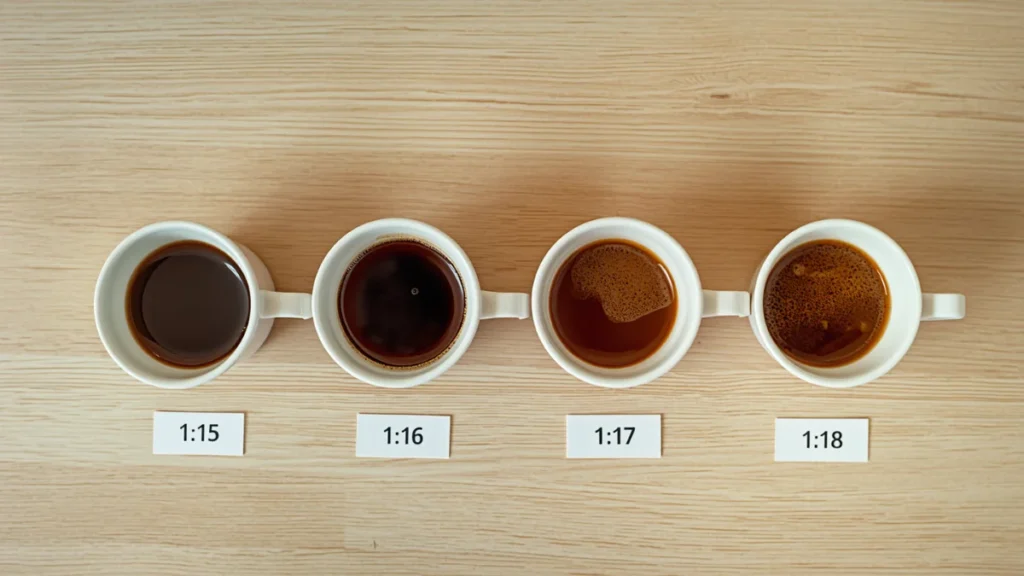
The Specialty Coffee Association (SCA) — the professional body that sets standards for the global specialty coffee industry — recommends a brewing ratio of approximately 1 gram of coffee per 18ml of water for drip-style brewing, or roughly 55 grams of coffee per litre of water. This has become known in the coffee world as the Golden Ratio.
In practice, most specialty coffee professionals brew slightly stronger than the SCA standard — typically in the 1:15 to 1:16 range — particularly for pour over and manual brewing methods where body and extraction clarity are priorities.
The Golden Ratio is a useful starting point, not a strict rule. Taste preference, roast level, bean density, grind size, and brewing method all affect what ratio actually produces the best result for a specific coffee.
| Ratio | Strength Profile |
|---|---|
| 1:15 | Strong — full body, bold flavor |
| 1:16 | Balanced — the most common recommendation |
| 1:17 | Light — gentle, less intense |
| 1:18 | Very light — mild, SCA standard territory |
| 1:5 (cold brew) | Very strong concentrate — dilute before drinking |
The best ratio for you is the one that produces a cup you genuinely enjoy. Start at 1:16, taste the result, and adjust one step in whichever direction your preference takes you. Small changes — moving from 1:16 to 1:15, for example — produce noticeable differences in strength without requiring any other adjustments.
Coffee Ratio by Brewing Method
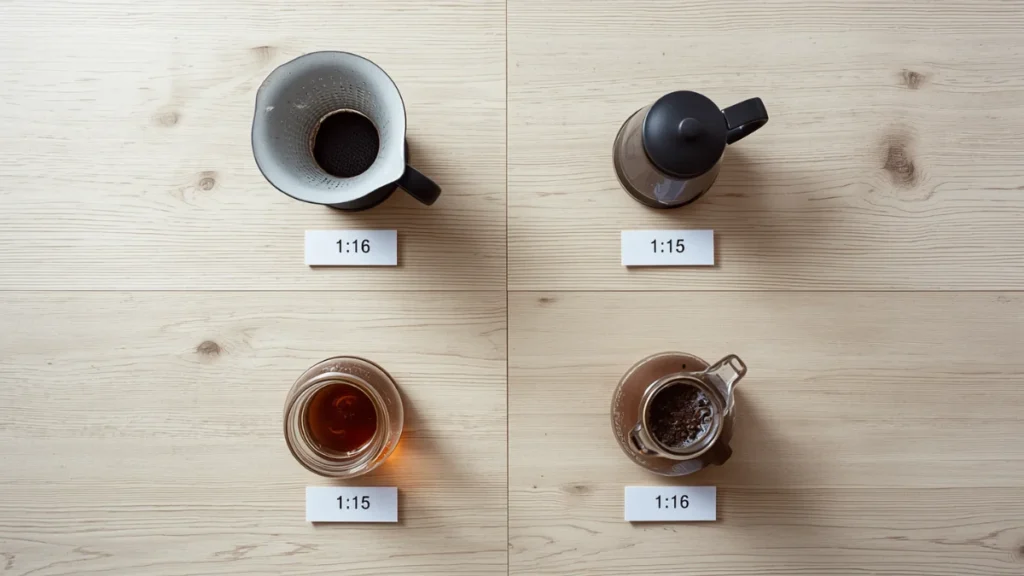
Different brewing methods have their own optimal ratio ranges. This is because body, extraction efficiency, and filter type all affect how a ratio translates into actual cup strength.
| Brewing Method | Recommended Starting Ratio | Notes |
|---|---|---|
| Pour over | 1:16 | Clean, bright cup; adjust to 1:15 for more body |
| French press | 1:15 | Fuller body from immersion; slightly stronger ratio suits the method |
| Drip coffee | 1:16 | Standard drip; adjust based on machine performance |
| AeroPress | 1:12 to 1:16 | Wide range depending on recipe style |
| Moka pot | Fill the basket; don’t tamp | Ratio is determined by equipment design |
| Cold brew concentrate | 1:5 | Strong concentrate — dilute 1:1 with water or milk before drinking |
| Cold brew ready-to-drink | 1:8 | Brewed to drinking strength — no dilution needed |
A few things worth noting:
French press uses a slightly stronger ratio than pour-over because the metal filter retains less of the coffee’s extraction than a paper filter does. Slightly more coffee compensates for what paper filtering would have removed in a pour over.
Cold brew ratios look completely different because it’s almost always made as a concentrate intended for dilution. A 1:5 concentrate mixed 1:1 with water produces a drinking-strength coffee closer to 1:10 — which is much more comparable to the other methods once dilution is accounted for.
AeroPress is the most flexible method in this list. Some AeroPress recipes use very little water for a concentrated shot style; others use a full 250ml for a filter-style cup. Let your recipe guide you rather than applying a fixed ratio.
If you’re new to AeroPress coffee, read our guide on How to Use an AeroPress for everything you need to get started
For method-specific ratio guidance, see:
Coffee Measurement Chart
Use this chart to find your coffee dose quickly for common brew volumes. All measurements use a 1:16 ratio as the baseline.
| Target Water Volume | Coffee at 1:15 (Strong) | Coffee at 1:16 (Balanced) | Coffee at 1:17 (Light) |
|---|---|---|---|
| 250ml (1 cup) | 17g | 16g | 15g |
| 350ml (1 large mug) | 23g | 22g | 21g |
| 500ml (2 cups) | 33g | 31g | 29g |
| 750ml (3 cups) | 50g | 47g | 44g |
| 1,000ml (4 cups) | 67g | 63g | 59g |
| 1,500ml (6 cups) | 100g | 94g | 88g |
To calculate any volume yourself, divide your target water weight in grams by your chosen ratio. For 400ml of water at 1:16: 400 ÷ 16 = 25g of coffee.
Coffee Ratio for Beginners
If you’re just getting started with ratio-based brewing, the most important thing to know is this: keep it simple.
Start with 1:16. This is the most widely recommended ratio across brewing methods and the most reliable neutral starting point. Brew one cup at 1:16, taste it, and decide whether you want it slightly stronger (move to 1:15) or slightly lighter (move to 1:17). That’s the entire adjustment process.
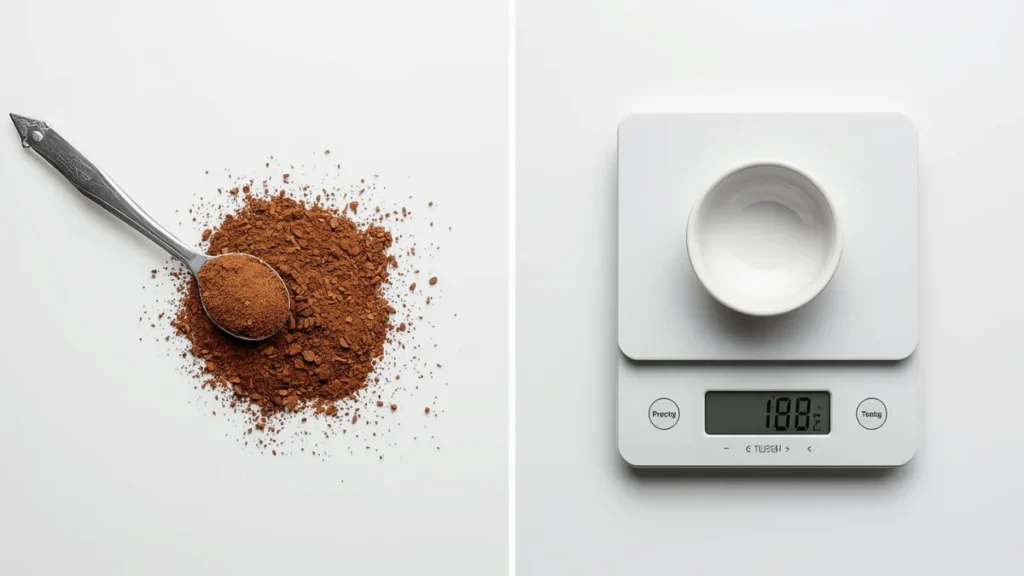
Use grams, not tablespoons. A tablespoon of coffee is a volume measurement. Volume measurements vary based on grind size, bean density, and how firmly you pack the scoop. Two tablespoons of espresso-fine grounds and two tablespoons of cold brew-coarse grounds contain completely different amounts of coffee — even though the volume appears identical. Grams measure mass, not volume. They’re consistent regardless of grind size.
Buy a scale. A basic digital kitchen scale, accurate to 1 gram, costs very little and immediately solves the consistency problem that volume measurements create. For pour over specifically, a scale with a built-in timer is the most convenient option. See How to Use a Coffee Scale for a full beginner walkthrough.
Don’t adjust ratio and grind size at the same time. If your coffee tastes off and you change both ratio and grind size together, you won’t know which change actually improved it. Change ratio first (it’s the simpler variable), evaluate the result, then address grind size if needed.
Common Coffee Ratio Mistakes
Using too much coffeeMore coffee doesn’t automatically mean better coffee. An excessive dose relative to water produces a dense, heavy, sometimes muddy cup — particularly in French press and drip methods. It also makes extraction uneven, since there’s more coffee than the water can properly saturate. Stay within the 1:15 to 1:17 range and adjust grind size if strength isn’t where you want it.
Using too little coffeeUnder-dosing produces a weak, thin cup that often also tastes slightly sour — because the small amount of coffee extracts quickly and the water passes through under-extracted grounds. If your coffee tastes weak and hollow, check ratio before anything else.
Measuring with tablespoonsAs covered above, tablespoons measure volume, not mass. They produce inconsistent doses that change with grind size and packing. The fix is a scale — it costs less than most brewing equipment and solves the problem completely.
Changing ratio and grind size simultaneouslyA very common beginner mistake when troubleshooting. Each variable needs to be evaluated separately to understand its contribution to the final result.
Treating the ratio as fixed foreverThe best ratio for a light Ethiopian single-origin may differ from that for a dark Sumatran blend. As you work through different bags, small adjustments — half a gram up or down on the coffee dose — are normal and expected. Build the habit of making small, intentional changes rather than rigidly sticking to one number across all beans.
Ignoring the brewing methodA 1:16 ratio tastes different in a French press than it does in a pour over, because the metal filter and immersion process change how that ratio translates into cup strength and body. Use method-specific starting ratios rather than applying one universal number across all methods.
FAQs
How much coffee do I need for 500ml of water?
At a 1:16 ratio, you need approximately 31 grams of coffee for 500ml of water. At 1:15 (stronger), use 33 grams. At 1:17 (lighter), use 29 grams.
How much coffee do I need for one mug?
A standard mug holds approximately 350ml. At 1:16, that’s around 22 grams of coffee. If you prefer a stronger cup, use 23 grams at 1:15.
Can I use tablespoons instead of grams?
You can, but results will be inconsistent. A level tablespoon of coffee weighs approximately 5–7 grams depending on grind size and bean density. The same tablespoon at a fine grind may weigh 7g, while at a coarse grind it may weigh only 5g. Grams are always more reliable. If you must use tablespoons, a rough guideline is 2 level tablespoons (approximately 10–12g) per 180–200ml of water — but this is an approximation, not a precision measurement.
Should I weigh my coffee?
Yes. Weighing both coffee and water is the single most effective habit you can build for consistent home brewing. It costs nothing if you already own a kitchen scale, and takes about ten seconds per brew.
Does the ratio change if I use pre-ground coffee?
The ratio itself doesn’t change, but pre-ground coffee may extract slightly differently from freshly ground beans at the same dose, particularly if the pre-ground coffee isn’t at the optimal coarseness for your method. Start with the same ratio and adjust to taste.
Key Takeaways
- Start at 1:16 — 1 gram of coffee per 16 grams of water — for most brewing methods and adjust from there.
- Measure by weight, not volume — grams produce consistent results; tablespoons don’t.
- Method matters — French press suits 1:15, cold brew concentrate uses 1:5, pour over typically sits at 1:16.
- The Golden Ratio is a starting point, not a rule — your taste preference is the final authority.
- Change one variable at a time — adjust ratio first, then grind size if needed, never both simultaneously.
Recommended Reading
- Coffee Brewing Ratio Explained
- How to Use a Coffee Scale
- Coffee Scale Guide
- Pour Over Coffee Ratio Explained
- French Press Coffee Ratio Explained
- Cold Brew Ratio Chart
- Coffee Extraction Explained
- Home Coffee Brewing Guide