
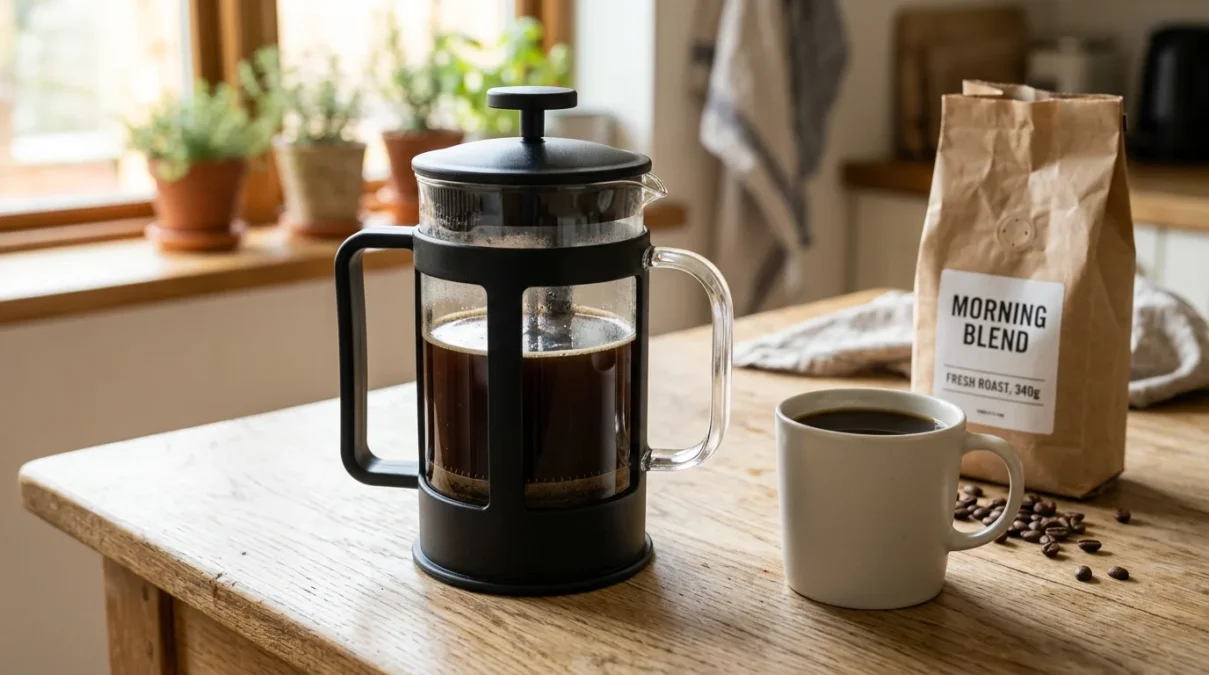
Quick Verdict
Best for: First-time French press buyers, students, budget-conscious home brewers, and anyone who wants to try French press without significant investment.
Not ideal for: Those who want premium aesthetics, need maximum heat retention, or are hard on kitchen equipment.
Rating: 4.1 / 5
Bottom line: The Bodum Brazil is the most honest budget French press on the market. It uses the same borosilicate glass beaker and stainless steel filter system as the more expensive Chambord — the only real difference is the plastic frame instead of stainless steel.
It brews identically to its pricier sibling. If your main goal is a great cup of French press coffee at the lowest reasonable cost, the Brazil delivers.
Introduction
Every French press category needs a budget option that doesn’t embarrass itself. The Bodum Brazil is that option.
At around $20–$25 for the 34oz model, it sits firmly below the Chambord (~$40) and well below the ESPRO P3 (~$40) and Frieling (~$90+). The question worth asking: what do you give up for that price difference?
The honest answer is: mostly aesthetics and the feel of the frame. The brewing result is essentially identical to the Chambord. For a first French press, a secondary press, or a brewer that lives in a work kitchen, the Brazil makes a compelling case.
Our Review & Research Disclaimer
At RoastVista, our product reviews are based on detailed research and analysis rather than hands-on physical testing. We study manufacturer information, product specifications, independent sources, and feedback from real users to understand a product’s performance, quality, features, strengths, and limitations. We also compare products with similar alternatives to provide a broader perspective.
Our goal is to give prospective buyers a clear, balanced, and well-researched picture of each product so they can make a more informed purchasing decision.
Specifications
| Feature | Details |
|---|---|
| Sizes available | 12oz (3-cup), 34oz (8-cup), 51oz (12-cup) |
| Material | Borosilicate glass beaker, BPA-free plastic frame |
| Filter type | Three-part stainless steel mesh (same as Chambord) |
| Dishwasher safe | Yes — beaker, plunger, and filter |
| Made in | Portugal |
| Colours available | Black, white, red, and others |
| Price range (34oz) | ~$20–$25 on Amazon |
| Replacement glass | Available separately |
Build Quality
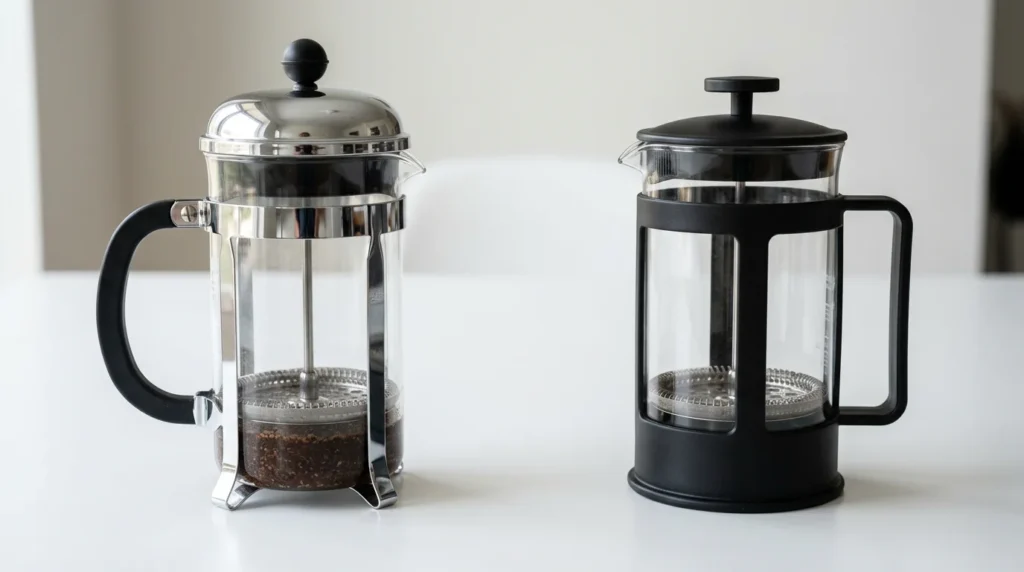
The Brazil uses the same borosilicate glass beaker as the Chambord. That’s a significant detail. The Brazil features a BPA-free plastic frame and a borosilicate glass carafe that preserve the flavor of your coffee without adding any chemicals or unwanted tastes.
The plastic frame is the most obvious difference from the Chambord. It’s lightweight — noticeably so. When you hold the Brazil, it doesn’t have the solid, premium feel of a stainless steel frame.
The frame is functional: it holds the beaker securely, and the handle provides a comfortable grip. But it won’t age as gracefully as stainless steel, and it’s more susceptible to discoloration and wear over years of daily use.
The Brazil feels more casual and practical than the Chambord. That description is apt. This is a workhorse press, not a display piece. The glass remains the same quality; the frame is the trade-off.
The three-part stainless steel mesh filter is identical to the Chambord — the same spiral plate design that keeps mesh in place and ensures water flows through without grounds. Sediment levels and filter performance between the two presses are effectively the same.
Brewing Performance
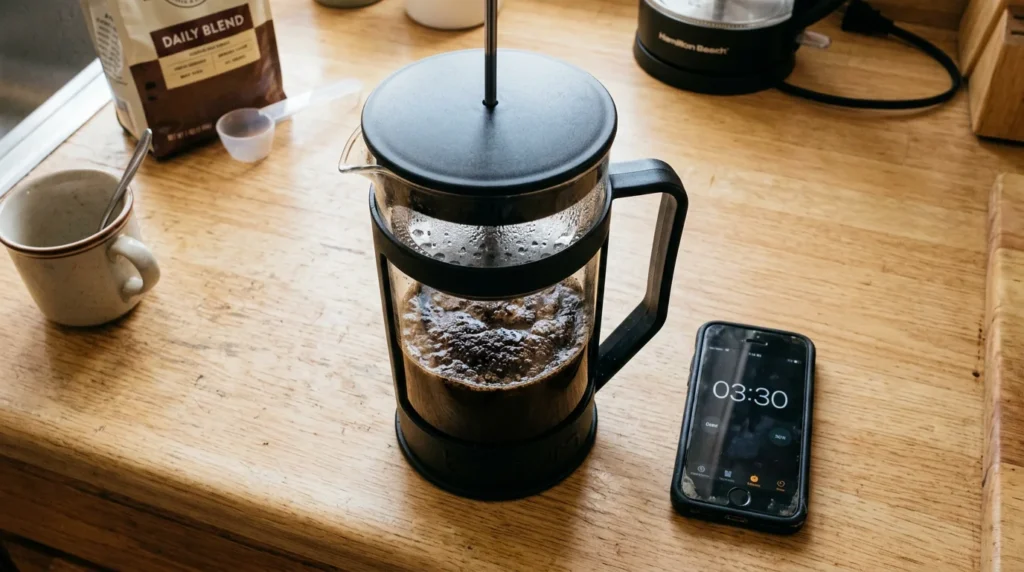
The Brazil brews identically to the Chambord. Same glass, same filter system, same four-minute steep, same result. French press produces its characteristic rich, full-bodied, oil-forward cup regardless of whether the frame around the glass is plastic or stainless steel.
The sediment profile mirrors the Chambord — a small amount of fine sediment at the bottom of the cup is normal. This is a characteristic of the French press method, not a Brazil-specific issue. Using a burr grinder set to a coarse setting minimizes it significantly.
Heat retention is comparable to the Chambord — the glass carafe loses heat at a similar rate. Coffee stays warm for about 20–30 minutes before it cools noticeably. Pour and serve promptly after pressing.
Ease of Use
Identical to the Chambord. The Brazil is a beginner’s press in the best sense — there is no technique to master, no special equipment needed, and no complicated steps between opening the bag of coffee and pouring a cup.
The lighter weight of the plastic frame makes the Brazil feel slightly more manageable than the Chambord during filling and pouring — a minor point, but worth noting for anyone who finds heavier kitchenware awkward.
Cleaning
The beaker, plunger, and filter are dishwasher-safe. The plastic frame should be hand washed — the same routine as the Chambord frame, though Brazil’s plastic is arguably more durable in the dishwasher than chrome-plated stainless in the long run.
Disassemble the three-part filter and rinse after every use. Coffee oils accumulate quickly in the mesh and affect taste if left to build up.
Pros and Cons
| Pros | Cons |
|---|---|
| Same brewing result as the Chambord | Plastic frame — less premium feel and appearance |
| Lowest price of any quality French press | Frame discoloration over time |
| Same borosilicate glass beaker as Chambord | Glass breakage risk — same as any glass press |
| Same three-part stainless filter | Average heat retention |
| Made in Portugal | Single mesh — normal French press sediment levels |
| Available in multiple colors | Lighter build — feels less substantial |
| Dishwasher-safe beaker and filter | — |
Who Should Buy the Bodum Brazil
Buy it if:
- You want the lowest reasonable entry point into French press brewing
- You’re not sure yet whether you’ll stick with French press and don’t want to overspend
- You need a secondary press for a work kitchen, travel bag, or guest use
- You want the same Bodum brewing quality without paying for the Chambord’s aesthetics
Skip it if:
- You want a press that looks premium on the counter — the Chambord is worth the extra $15–20
- You want maximum durability — the Frieling’s all-stainless construction is the answer
- Sediment bothers you — the ESPRO P3’s double micro-filter addresses this more directly
How It Compares
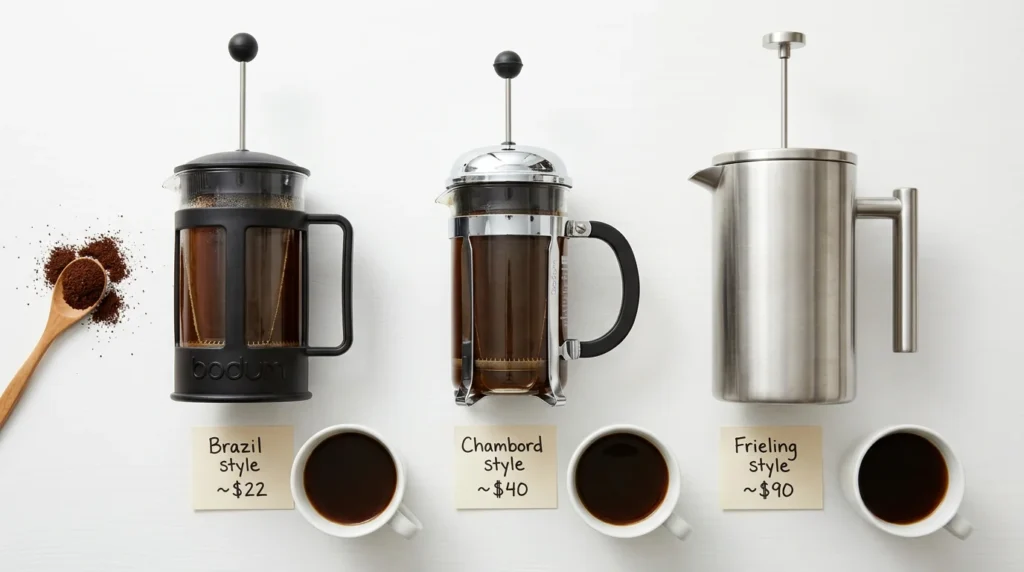
vs Bodum Chambord (~$40):
The Chambord has stainless steel; the Brazil has plastic. The coffee from both is essentially identical. Choose the Chambord if you want something that feels premium and lasts longer. Choose the Brazil if budget is the priority.
The $15–20 difference buys you a noticeably better-feeling frame and a more durable long-term press.
→ See Bodum Chambord French Press Review (2026)
vs ESPRO P3 (~$40)
The P3 costs roughly twice as much as the Brazil and produces a meaningfully cleaner, less gritty cup thanks to its double micro-filter. If sediment bothers you and budget allows, the P3 is the better investment. If you’re fine with normal French press sediment and want to spend as little as possible, the Brazil delivers.
→ See ESPRO P3 French Press Review (2026)
vs Frieling 36oz (~$90+)
Not a realistic comparison at the price points involved. The Brazil is for budget-first buyers; the Frieling is for durability-and-heat-retention buyers. Different priorities entirely.
→ See Frieling Double-Wall Stainless Steel French Press Review (2026)
Common Complaints
“The plastic frame feels cheap.”
It does feel lighter and less substantial than the Chambord. This is accurate and expected at this price point — the frame material is the primary cost saving.
“The glass broke.”
Glass breakage is a risk with any glass-body French press. Brazil’s glass is the same borosilicate as the Chambord and breaks under the same conditions. Handle carefully and store away from edges.
“It doesn’t keep coffee hot.”
Correct — glass presses lose heat faster than insulated steel. Preheat the carafe before brewing and serve promptly after pressing.
Pro Tips
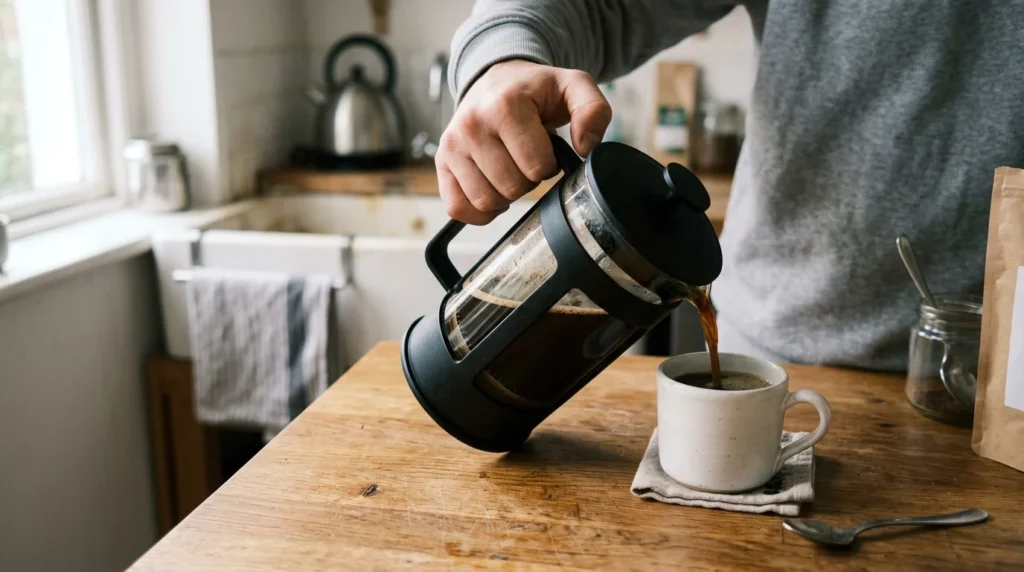
- Preheat the carafe. Fill the beaker with hot water for 60 seconds before adding coffee and water. This slows the initial heat loss and produces a slightly hotter final cup.
- Grind coarser than you think. The Brazil uses the same filter as the Chambord — same sediment profile, same sensitivity to grind size. A genuinely coarse grind significantly minimizes sediment.
- Pour immediately after pressing. Don’t leave coffee in contact with grounds. The Brazil is a pour-and-serve press — serve everything promptly and pour any remainder into a thermos if not drinking immediately.
- Consider buying a replacement beaker when you purchase. At the Brazil’s price point, having a spare beaker on hand costs very little and eliminates the inconvenience of a broken press until a replacement arrives.
Bodum Brazil French Press: FAQs
Is the Bodum Brazil worth buying?
For budget-conscious buyers and first-time French press users, yes. It brews coffee of the same quality as the Chambord at roughly half the price. The trade-off is the plastic frame — functional but less premium. If budget allows, the Chambord’s stainless frame is worth the upgrade.
What’s the difference between the Bodum Brazil and the Bodum Chambord?
The brewing result is essentially identical. The difference is the frame material — stainless steel on the Chambord, BPA-free plastic on the Brazil — and the price (~$20 vs ~$40). Both use the same borosilicate glass beaker and three-part stainless filter.
Does the Bodum Brazil produce sediment?
Yes — a small amount of fine sediment at the bottom of the cup is normal for all single-mesh French presses. It’s a method characteristic, not a flaw. Using a coarse grind minimizes it.
How long does the Brazil keep coffee hot?
Around 20–30 minutes before noticeable cooling — typical for a glass-body press. Preheat the carafe before brewing and serve promptly for the best temperature.
Can I put the Bodum Brazil in the dishwasher?
The glass beaker, plunger, and filter are dishwasher safe. The plastic frame should be hand washed for longevity.
Final Verdict
The Bodum Brazil does what it sets out to do: deliver a genuine, quality French press brewing experience at the lowest reasonable price. It brews identically to the Chambord, uses the same glass beaker and filter system, and is made in Portugal with the same Bodum quality standard.
The only meaningful sacrifice is the plastic frame — which affects how the press feels and looks, not how it brews.
For a first French press, a work-kitchen press, or anyone who wants to try the method without committing significant money, Brazil is the easy recommendation.
Recommended Reading
- French Press Coffee Guide
- French Press Coffee Ratio Explained
- How to Reduce Sediment in French Press Coffee
- Best Coffee Beans for French Press
- Bodum Chambord French Press Review
- Coffee Grind Size Chart