
Quick Verdict
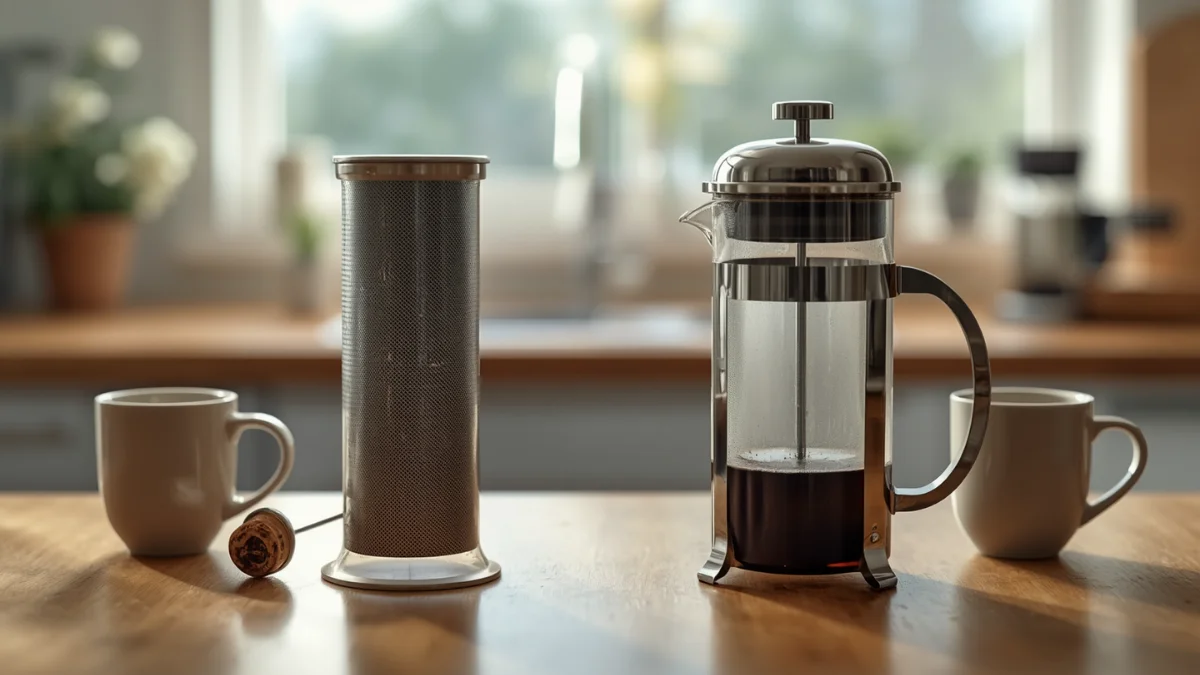
Best for most coffee drinkers: a French press. It brews real batches (three mugs at once), forgives any decent grinder, and delivers the full-bodied, unfiltered cup most people picture when they think of “real” coffee at home.
Best for singles, travelers, and cleanup-haters: an AeroPress. It brews a sweet, clean cup in about two minutes, including cleanup, weighs nothing, is nearly indestructible, and adapts to more recipes than any brewer we know—but it makes one serving at a time.
Choose an AeroPress if: you drink alone, want low-bitterness coffee without buying a better grinder, or need gear that survives a suitcase.
Choose a French press if: you brew for two or more, love body and oils, and want the most forgiving daily brewer per dollar.
The 30-second answer
The AeroPress is a small immersion brewer with a gentle press finish: coffee and water sit together for a minute or two, then a light press pushes the brew through a paper micro-filter. You get a clean, sweet, low-bitterness cup in a single serving — plus a spent puck you pop out and rinse in ten seconds.
A French press is a pure immersion brewer with a metal mesh filter: coarse grounds steep fully for about four minutes, then a plunger separates them. Nothing filters out the oils or fines, which is exactly why the cup is rounder, heavier, and more textured than AeroPress coffee.
They’re two answers to the same question — “what’s the easiest good coffee?” — tuned for different drinkers. Here’s how they compare on the nine factors that matter.
How We Compared Them
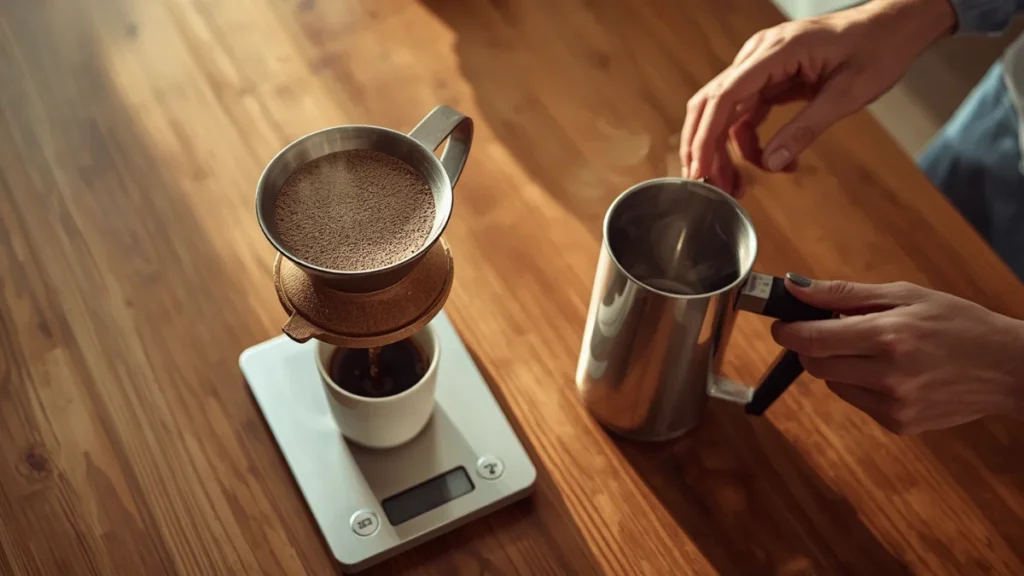
This comparison is based on the mechanics of each brewer and consistent findings across independent tests and user feedback — not on lab testing:
- Brewing principle — immersion plus light pressure vs pure immersion
- Flavor and body — paper micro-filter vs metal mesh
- Strength and caffeine — per-cup and per-sip
- Grind requirements — and how forgiving each is with budget grinders
- Speed and cleanup — weekday reality, not weekend fantasy
- Capacity — one drinker or a household
- Durability, travel, and price — including what breaks and what doesn’t
- Versatility — iced coffee, espresso-style shots, cold brew, travel
Our Review & Research Disclaimer
At RoastVista, our product reviews are based on detailed research and analysis rather than hands-on physical testing. We study manufacturer information, product specifications, independent sources, and feedback from real users to understand a product’s performance, quality, features, strengths, and limitations. We also compare products with similar alternatives to provide a broader perspective.
Our goal is to give prospective buyers a clear, balanced, and well-researched picture of each product so they can make a more informed purchasing decision.
At-a-Glance Comparison
| Factor | AeroPress | French Press |
|---|---|---|
| Brewing principle | Immersion + light manual pressure | Pure immersion, mesh plunge |
| Filter | Paper micro-filter (metal optional) | Stainless steel mesh |
| Cup character | Clean, sweet, low bitterness | Full-bodied, oily, textured |
| Grind | Medium-fine | Coarse |
| Brew time | ~2 min total | ~4 min + plunge and decant |
| Capacity | 1 serving (~8–10 oz; XL ~10–12 oz) | 12–51 oz — real multi-mug batches |
| Cleanup | Pop the puck, rinse — ~10 seconds | Rinse mesh and beaker — ~1 minute |
| Durability | Nearly unbreakable (Tritan/copolyester) | Glass breaks; stainless doesn’t |
| Travel | Excellent (Go model is pocket-sized) | Poor (glass) to decent (steel) |
| Price band | ~$40–$70 | ~$25–$130 |
Prices are approximate at publication — check the live Amazon listing for the current price.
Head-to-Head: The Factors That Matter
1. Brewing method: press-finished immersion vs steeped immersion
Both are immersion brewers — the coffee steeps in the water, which is why both are far more forgiving than pour-over. The difference is the ending. The AeroPress finishes with 30 seconds of gentle pressure through paper, adding a touch of agitation and extraction at the end. The French press finishes with a mesh screen that stops filtering the moment it stops moving — everything below the mesh stays in your cup until you pour.
Verdict: a tie on principle; the filters decide everything (next point).
2. Flavor and body
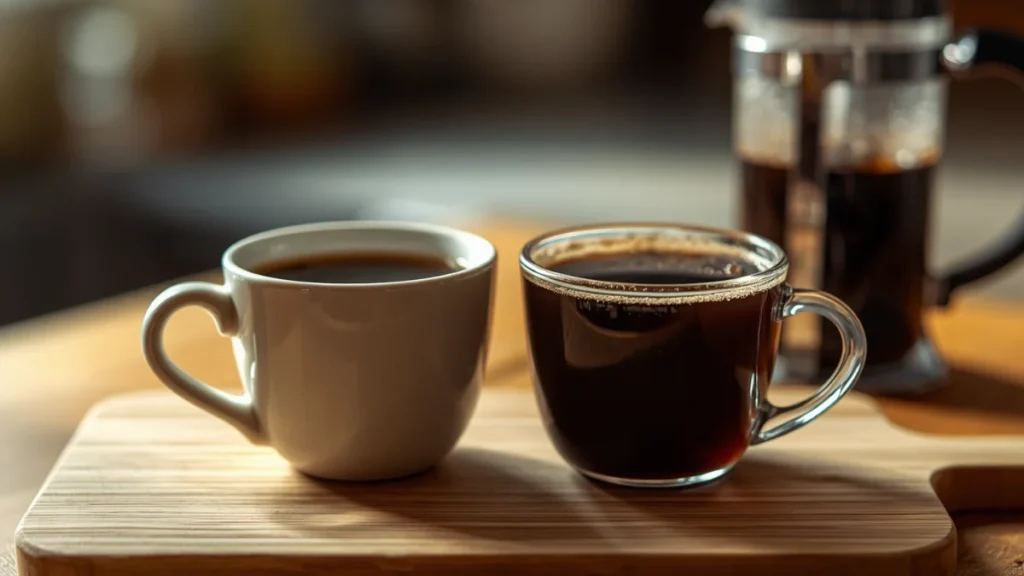
The AeroPress’s paper micro-filter catches oils and fines, so the cup lands closer to a good filter coffee: clean, sweet, and easy to drink black, with bitterness kept low. The trade-off is texture — there’s simply less of it.
The French press keeps the oils and a share of the fines in the cup, which reads as body, weight, and that classic “hearty” mouthfeel — with sediment at the bottom of the mug as the price of admission (our guide to reducing sediment in French press coffee minimizes it).
Verdict: French press for body and presence; AeroPress for clarity and sweetness.
3. Strength and caffeine
Per ounce, AeroPress coffee usually wins — typical recipes use a tight ratio (around 1:12 to 1:15) and brew short and strong, close to a mugged-up Americano when diluted. A French press uses a more relaxed ratio (~1:15) in a larger volume, so each sip is gentler while keeping comparable total caffeine.
Our French press ratio guide shows how to dial strength either way, and the coffee-to-water ratio calculator works for both brewers.
Verdict: AeroPress for a strong single cup; French press for a big, steady mug.
4. Grind size and forgiveness
The AeroPress wants a medium-fine grind — finer than the French press, coarser than espresso — and it’s famously tolerant of imperfect grinds because the contact time is short and the press adds extraction at the end. Budget blade-grinder owners routinely get their best cup from an AeroPress.
The French press wants a coarse grind and punishes fines with silt, but it’s the most forgiving brewer on extraction errors: a four-minute steep in full immersion is hard to ruin badly. The two grind settings are in our coffee grind size chart.
Verdict: both forgiving; the AeroPress is slightly more forgiving on grind, and the French press is more forgiving on timing.
5. Speed and weekday mornings
AeroPress: heat water, add coffee and water, stir, press — about 90 seconds of brew and a 10-second cleanup. It is the fastest route to a genuinely good cup we know of.
French press: about four minutes of steeping plus a minute of cleanup, and the coffee should be decanted immediately, or it turns bitter sitting on the grounds.
Verdict: AeroPress, decisively, for one drinker. The French press’s four minutes scale across a household — the AeroPress’s speed does not.
6. Cleaning and care
The AeroPress invented the ten-second cleanup: unscrew the cap, press out the puck, rinse. Filters are one paper at a time (or reusable metal). The French press is a rinse of the beaker and a scrub of the mesh — a minute of work, occasionally more if fines pack under the filter disc.
Verdict: AeroPress, but the gap is smaller than the internet claims — both are far easier than a pour-over setup or a drip machine’s carafe and basket.
7. Capacity: one drinker or four
This is the AeroPress’s hard limit: one serving per pressing (the standard brews about 8–10 oz; the XL pushes toward 12 oz). Two people means two pressings, two cleanups, staggered mugs. A 34 oz French press serves four mugs from one four-minute steep.
Verdict: French press for couples and families; AeroPress is a solo instrument.
8. Durability, travel, and price
The AeroPress is shatterproof, feather-light, and ships in a mug-friendly size — the travel-brewer crown isn’t close (the pocketable AeroPress Go variant exists precisely for this). A glass French press is a countertop instrument; a stainless one (see our best insulated stainless French presses) can travel and keeps coffee hot for hours. Entry prices overlap at $30–$50, and both last for years with nothing to replace but filters.
Verdict: AeroPress for bags and tents; stainless French press for the cabin; glass French press stays home.
9. What each one is genuinely good at
Beyond the daily mug: the AeroPress makes excellent iced americano (brew concentrated over ice), credible “espresso-style” bases for milk drinks, and cold brew in minutes with room-temperature water. The French press is a quiet workhorse for iced coffee by the pitcher and — with coarse grounds and an overnight steep — a fine improvised cold brew maker (our cold brew vs iced coffee comparison covers when each drink is worth brewing).
The Picks: What We’d Actually Buy
AeroPress Original — the default pick
- The classic: 1–2 minute brews, paper micro-filters, pop-out puck cleanup
- Brews about 8–10 oz per pressing; shatterproof body
- Includes 100 paper filters, stirrer, and scoop
- Endless recipe space — inverted, standard, concentrate, iced
Approx. $40–$50 — confirm the live price before purchase.

Three brew styles: You can make French press-, pour-over-, or espresso-style coffee with one compact brewer.
Smooth, clean cup: You get less grit and bitterness from pressure brewing and micro-filtration.
Compact but limited: You can brew quickly and carry it easily, but the small capacity may not suit multiple coffee drinkers.
The most recommended brewer in specialty coffee for a reason: it’s cheap, fast, and nearly impossible to break. If you drink alone, stop comparing and buy this.
AeroPress Clear (Black) — the same brewer, counter-worthy
- Identical brew mechanics to the Original in a clear Tritan body
- Shatterproof and dishwasher-friendly
- Lets you see the bloom and drawdown — genuinely useful for learning recipes
Approx. $60–$70 — confirm the live price before purchase.

Clear, durable design: You can watch the brewing process through the shatter-resistant Tritan chamber.
Flexible brewing: You can adjust your recipe for French press-, pour-over-, or espresso-style coffee.
Easy to carry: You get a lightweight brewer with low sediment, though it won’t match the results of dedicated coffee equipment.
Pay the premium only for looks and visibility — the coffee is identical. It also photographs well if you share brews online.
French presses — start with our full reviews
Rather than repeat our full write-ups, start with the model that matches your priority:
- Bodum Chambord French Press Review — the classic glass-and-chrome press, our default budget-friendly pick
- ESPRO P3 French Press Review — the best choice if sediment is what keeps you away from French press
- Frieling Double-Wall Stainless French Press Review — the premium heat-retention workhorse
- MuellerLiving French Press Review — the value pick
- Best Insulated Stainless Steel French Presses — the full roundup for durability and heat retention
Whichever you choose, beans matter as much as hardware — our best coffee beans for French press guide covers which roasts suit a coarse grind and full immersion.
Common Mistakes With Each Brewer
AeroPress: pressing too hard (you’re compressing the puck, not squeezing tea — press gently and stop at the hiss), water straight off the boil with dark roasts (bitterness — check our brewing temperature guide), and grinding far too fine, which turns the press into a thumb workout.
French press: grinding too fine (silt and a stalled plunge), letting the brew sit on the grounds after plunging (decant immediately into mugs or a carafe), skipping the 30-second bloom stir, and pouring aggressively, which lifts the settled fines back into the cup.
If either brew tastes harsh or sour, our guides to why coffee tastes bitter and why coffee tastes sour will pinpoint the variable to fix.
Frequently Asked Questions
Is AeroPress coffee stronger than French press coffee?
Per sip, usually yes — AeroPress recipes use a tighter ratio and a shorter, press-assisted extraction. Per full mug, a French press delivers comparable total caffeine in a larger, gentler volume.
Does the AeroPress make real espresso?
No. It makes a concentrated “espresso-style” coffee that works respectably in milk drinks and recipes, but it can’t reach the 9 bars of pressure real espresso requires.
Which is cheaper long-term?
Both are cheap. The AeroPress costs more upfront and uses paper filters; a glass French press costs less upfront and has no consumables. Over years, they’re effectively even.
Which is better for travel?
The AeroPress, and it’s not close — shatterproof, light, and self-contained. If you want to press coffee on the road, a stainless French press is the only sensible option.
Can I use the same coffee in both?
Yes — you’ll just grind it differently: medium-fine for the AeroPress, coarse for the French press. Our guide to adjusting grind on a burr grinder makes the switch easy.
Which is easier for a complete beginner?
Both. The AeroPress is easier to hit “good” immediately; the French press is easier to hit “good forever” because the technique isn’t timing-critical.
Final Thoughts
These two brewers disagree about what coffee should feel like, and that’s the point. The AeroPress is the fast, clean, solo machine for people who drink one excellent mug and hate cleanup. The French press is the forgiving, full-bodied workhorse for people who drink two or more mugs — or one very good-sized one — and want a ritual that hasn’t changed in a century.
If you’re still torn: solo drinker, AeroPress. Household, French press. And if you own both already — they cover more than almost any two brewers can, from a two-minute single cup to a four-minute table.
Recommended Reading
- French Press vs Moka Pot (2026)
- French Press Coffee Ratio Explained
- French Press Grind Size Guide
- How to Reduce Sediment in French Press Coffee
- Best Coffee Beans for French Press
- Coffee Grind Size Chart