
Quick Verdict
Buy the Chemex if: you brew for more than one person, love an exceptionally clean, tea-like cup, and want a brewer beautiful enough to leave on the counter. The thick bonded filter strips out oils and fines like no other dripper — but it punishes a bad grind with stalling, and you must buy its proprietary filters forever.
Buy the Hario V60 if: you brew one or two mugs, want more control over extraction, and enjoy the ritual of pouring. Its fast-flowing cone rewards technique with bright, sweet, complex cups—and it’s cheaper, made from more materials, and far more compact.
Choose a Chemex if: batch size, table-worthy looks, and the cleanest cup possible are your priorities.
Choose a V60 if: speed, control, and flavor clarity—plus sweetness in a single mug — are your priorities.
The 30-second answer
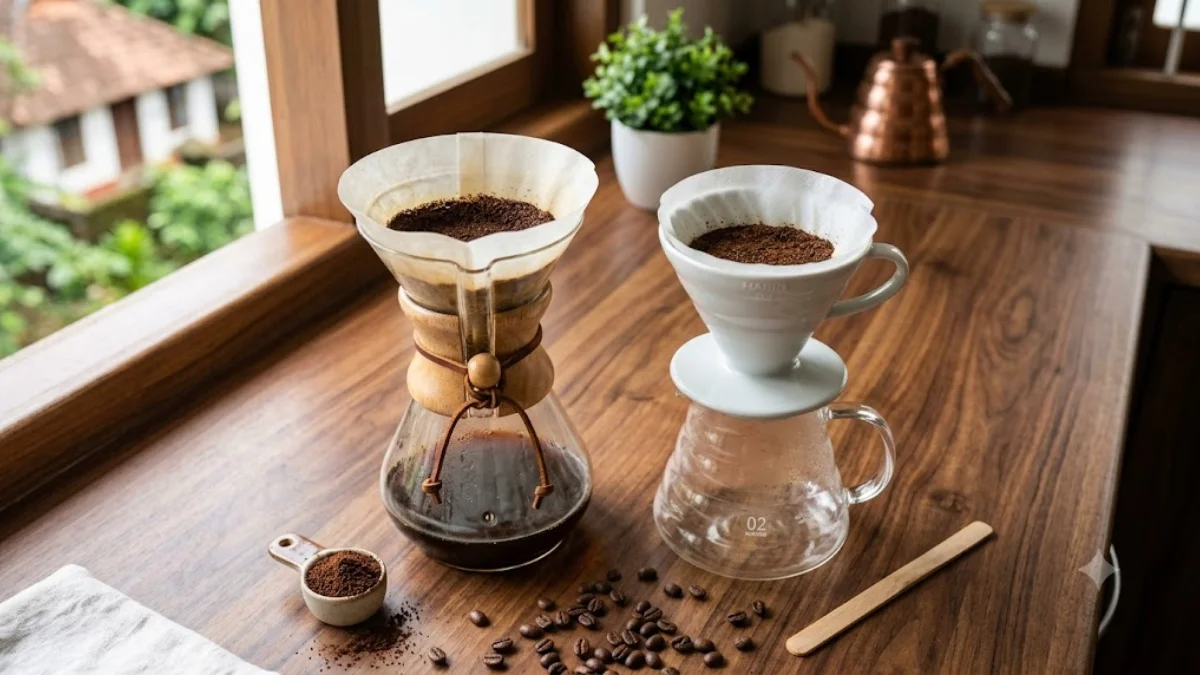
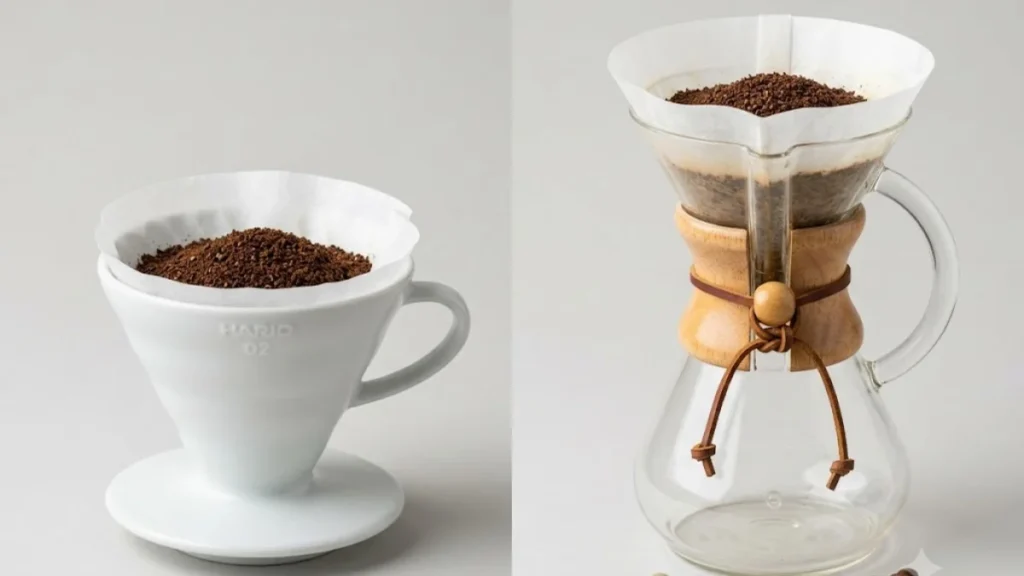
The Chemex is an hourglass-shaped borosilicate glass brewer that uses unusually thick, bonded paper filters. That filter is the whole story: it removes most oils and fine particles, producing the cleanest, smoothest cup of any common pour-over dripper — at the cost of slower drainage, larger batches, and stricter grind requirements.
The Hario V60 is a 60-degree cone with spiral ribs and a single large hole. Water drains fast, the brew is quick, and everything depends on your pour. Done well, it makes a brighter, sweeter, more aromatic cup with a touch more body than a Chemex. Done carelessly, it makes thin or bitter coffee faster than any other brewer can.
They aren’t really rivals — they’re the two ends of the pour-over spectrum. This comparison covers the eight factors that actually matter, plus the exact models worth buying in each camp.
How We Compared Them
This comparison is based on the mechanics of each brewer, published specifications, and consistent findings across independent brewer tests and the specialty coffee community — not on lab testing:
- Filter design — thickness, fit, cost, and what it does to the cup
- Flavor profile — body, clarity, oils, and sweetness
- Grind requirements — how each brewer punishes or forgives your grind
- Technique and forgiveness — learning curve and repeatability
- Brew time and batch size — one mug or a shared carafe
- Capacity and materials — sizes, glass, ceramic, plastic options
- Price and running costs — brewer plus a year of filters
- Counter appeal — honestly, part of the Chemex is the object itself
Our Review & Research Disclaimer
At RoastVista, our product reviews are based on detailed research and analysis rather than hands-on physical testing. We study manufacturer information, product specifications, independent sources, and feedback from real users to understand a product’s performance, quality, features, strengths, and limitations. We also compare products with similar alternatives to provide a broader perspective.
Our goal is to give prospective buyers a clear, balanced, and well-researched picture of each product so they can make a more informed purchasing decision.
At-a-Glance Comparison
| Factor | Chemex | Hario V60 |
|---|---|---|
| Shape | Hourglass, wood collar | 60° cone, spiral ribs |
| Materials | Borosilicate glass only | Ceramic, glass, plastic, metal |
| Filter | Proprietary bonded paper, very thick | Conical paper (or metal/cloth), standard thickness |
| Cup character | Extremely clean, tea-like, smooth | Bright, sweet, aromatic, light-to-medium body |
| Grind | Medium-coarse | Medium-fine |
| Brew time | 4–6 min (stalls easily if grind is off) | 2.5–3.5 min |
| Batch size | 3-, 6-, 8-, 10-cup models (5 oz “cups”) | 01 (1–2 cups), 02 (up to ~4), 03 (up to ~6) |
| Forgiving? | Moderately — pours are easy; grind is critical | Technique-sensitive — pour quality decides the cup |
| Running cost | Higher (proprietary filters) | Lower (commodity filters) |
| Price band | ~$40–$60 | ~$20–$40 (dripper + server) |
Prices are approximate at publication — check the live Amazon listing for the current price.
Head-to-Head: The Factors That Matter
1. Design and materials
The Chemex is one piece of thick-walled borosilicate glass, shaped in 1941 and unchanged since, with a wooden collar and leather tie you must remove before washing (or never soak — the tie stains and the collar swells). It’s fragile, it’s gorgeous, and it doubles as a carafe.
Verdict: the V60 is the more practical, more versatile tool; the Chemex is the more beautiful one.
2. Filters — the real difference
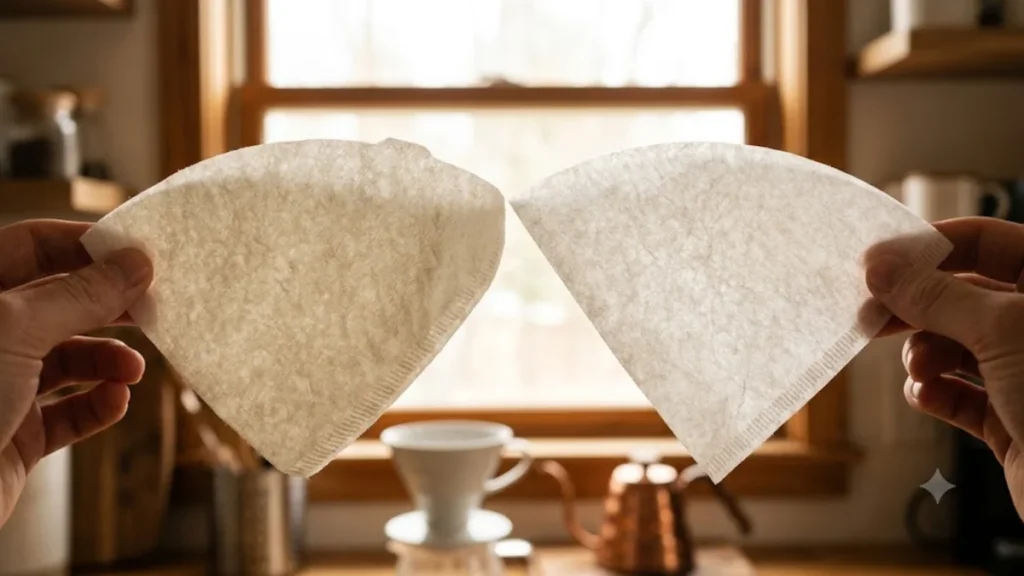
Chemex’s bonded filters are noticeably thicker than standard papers—which produces the famously clean, crisp cup and keeps sediment and oils almost entirely out of your mug. It’s also the brewer’s weakness: the thick paper resists flow, so a slightly too-fine grind can stall the drawdown completely, and you’re locked into proprietary filters (they’re easy to find, but they cost more than commodity cones and square folds take a second to seat properly).
The V60 is a cone you set on top of a mug or server, and Hario sells it in every material: cheap and unbreakable plastic, heat-hungry ceramic, thin glass, even copper. The 60° walls, spiral ribs, and single large hole exist for one reason — to let water exit as fast as you pour it.
V60 papers are thinner and drain quickly. They’re commodity items available from several brands, cheap in bulk, and — if you want to experiment — metal and cloth conical filters exist too.
Verdict: the Chemex filter makes the cleaner cup; the V60 filter makes the cheaper, faster, more flexible system.
3. Flavor and body
Brew the same coffee in both, and the difference is immediate. The Chemex cup is rounded, polished, and light on its feet — clarity to the point of tea-likeness, with almost no residue at the bottom of the mug. Bright, delicate coffees (washed Ethiopians, for example) can taste stunning this way; heavy, chocolatey coffees can taste a little hollow.
The V60 keeps a little more oil and fines in suspension, so the cup has slightly more texture and intensity, with pronounced aromatics and a long sweet finish. High-grown light roasts tend to shine here — but so do flaws: a poor pour or a stale bean has nowhere to hide.
Verdict: Chemex for maximum clarity; V60 for maximum vibrancy. Neither is “better” — they filter the same coffee differently.
4. Grind size and forgiveness
A Chemex wants a medium-coarse grind (coarser than you’d use in most cones) because its thick filter drains slowly. Combined with a large, open brew bed, small grind errors get absorbed. Bigger grind errors cause the classic Chemex failure: the dreaded stall, where the drawdown crawls and the coffee over-extracts into bitterness. Where you are on the dial matters — our coffee grind size chart shows exactly where medium-coarse sits, and our guide to adjusting a burr grinder gets you there in two minutes.
A V60 wants a medium-fine grind, and it cares about the rest of your technique just as much: pour speed, water level, and bed agitation all show up in the cup immediately. The single large hole means your pour, not the brewer, controls the flow— that’s the control people love and the steep learning curve beginners don’t.
Verdict: the Chemex forgives pours but not grind; the V60 forgives grind slightly better but demands a good pour.
5. Technique: which is easier to learn?
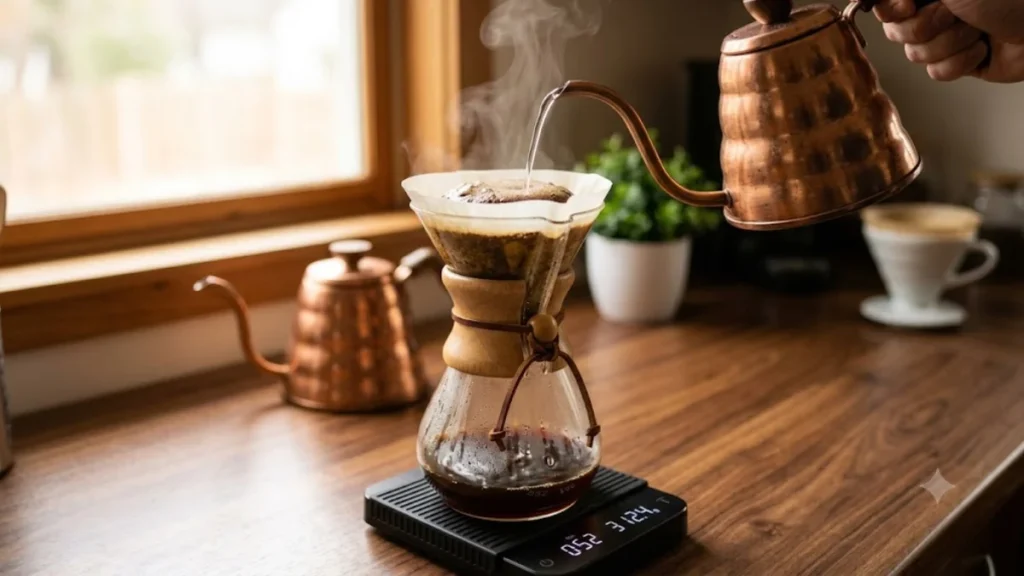
Chemex technique is simple: saturate the grounds, bloom, then pour in two or three slow stages. Because the filter throttles the flow, your pour mistakes get smoothed out. If you can make tea, you can brew a decent Chemex on day one — though its deep bed rewards a proper recipe for the best result (see our pour-over coffee guide for the full method).
The V60 punishes the same carelessness: pour too hard, and fines clog the bed; pour down the walls, and you bypass the coffee; forget to preheat a ceramic cone and your brew temperature collapses. It takes a dozen brews to get consistently good — and that process is exactly why pour-over fans end up loving it. Our guide to pour-over pouring covers the technique in detail.
Verdict: Chemex for beginners; V60 for the technique-driven.
6. Brew time and batch size
A V60-02 brews one to two mugs in about three minutes. A Chemex 6-cup comfortably brews 500–900 ml in five to six minutes. For two or more drinkers — or a leisurely weekend brew you won’t re-boil the kettle for — the Chemex is the tool; for a fast weekday single mug, the V60 wins. If two-cup brewing is your main use case, see our guide to brewing pour-over for two.
Verdict: V60 for one; Chemex for a table.
7. Price and running costs
The V60 system is cheaper to start (about $20–$35 for dripper and server), and its filters cost pennies. The Chemex costs more upfront (~$40–$60), and its proprietary filters cost meaningfully more per brew — over a year of daily brewing that’s real money. Neither requires maintenance beyond washing.
Verdict: V60 on total cost of ownership, comfortably.
8. Countertop appeal
Part of the Chemex price is the object: it’s in the Museum of Modern Art’s permanent collection, and it makes full batches look ceremonial. The V60 is a workmanlike cone that disappears into a mug. If the ritual and the look matter to you, that’s a legitimate reason to pay for the Chemex.
The Picks: What We’d Actually Buy
1. Chemex Classic Series, 6-Cup — best overall Chemex

- The original 1941 hourglass silhouette in thick borosilicate glass
- 6-cup size (30 fl oz) — the sweet spot for 2–3 real mugs
- Wood collar and leather tie; glass is dishwasher-safe (collar off)
- Uses thick bonded Chemex filters (squares or circles)
Approx. $45–$50 — confirm the live price before purchase.
The one to buy if you want the Chemex of postcards and cafés. The 6-cup handles a weekend table without being unwieldy; the 3-cup is small and stalls more easily with its deeper, narrower bed.
2. Chemex Glass Handle Series, 6-Cup — best for easy handling

- Same brewer and filters as the Classic, with a glass handle
- No wooden collar to remove before washing
- Slightly more modern look, same capacity
Approx. $40–$50 — confirm the live price before purchase.
Choose it if the collar-and-tie routine annoys you or you want a fully dishwasher-friendly body. Brews identically to the Classic.
3. Hario V60 Ceramic Dripper, Size 02, White — best single-mug upgrade

- The classic matte-white ceramic cone with spiral ribs
- Size 02 brews 1–2 mugs (up to ~600 ml with care)
- Ceramic holds heat through the brew (preheat it to avoid temperature dips)
- Uses cheap, widely available 02 conical papers
Approx. $22–$28 — confirm the live price before purchase.
The dripper that defines pour-over for most of the coffee world. Pair it with any mug or a simple server to start.
4. Hario V60 Ceramic Pour-Over Set, Size 02 — best complete V60 starter kit

- Dripper, matching glass server, and a scoop in one box
- Everything you need for a full V60 setup in one purchase
- Same 02 cone as above, same filters
Approx. $32–$40 — confirm the live price before purchase.
The set saves a few dollars over buying a dripper and server separately, and it looks cohesive on the counter.
And the filters?
Don’t cheap out on filters for either brewer — they’re the actual brewing surface. For the Chemex, buy genuine Chemex bonded filters (the generic ones are thinner and undo the brewer’s whole point). For the V60, any quality 02 conical paper works; start with the tabbed ones, which seat easily in the wet cone.
Common Mistakes With Each Brewer

Chemex: grinding too fine (the #1 killer — stalled brews and bitter cups), skipping the pre-wet of the filter (paper taste in the cup), removing the wooden collar and then putting it back on while wet (it swells and stains), and buying thin generic filters that undo the brewer’s design.
V60: pouring too fast or too high (agitation and channeling), pouring down the walls instead of on the coffee bed (water bypasses the grounds), ignoring preheat on the ceramic version (a cold cone can drop your slurry temperature several degrees — see our coffee brewing temperature guide), and letting the bed drain fully between pours when the recipe calls for keeping it topped up.
If either cup comes out wrong, our guide to the most common pour-over mistakes has the fix, and our coffee-to-water ratio calculator will get your dose right before you touch anything else.
Frequently Asked Questions
Is the Chemex just a fancy V60?
No. The brewers have opposite filter philosophies. The Chemex’s ultra-thick bonded paper strips oils and fines for a very clean cup; the V60’s thin, free-flowing paper keeps more character in the cup. Same family, very different results.
Can I use V60 filters in a Chemex?
No — conical V60 papers won’t seat against the Chemex’s hourglass walls, and water will run straight down the sides. Chemex papers come in square and circular sizes for their specific models.
Which one is better for beginners?
The Chemex, slightly. Its slow filter absorbs pour mistakes, and the recipe is simpler. The V60 has a higher cup ceiling, but it takes more brews to reach consistency.
Which brews faster?
The V60 — roughly 3 minutes versus 5–6 minutes for a Chemex batch, when both are ground correctly.
Which is better for light roasts?
Both handle light roasts well; use the hotter end of the range (200–205°F) for both, per our temperature guide. Delicate, floral coffees often show best in the V60, where their aromatics stay in the cup.
Do I need a gooseneck kettle?
For the V60, effectively yes — flow control is the brew. For the Chemex, it’s still recommended but less critical. Our gooseneck kettle guide covers the options at every budget.
Final Thoughts
Pick the Chemex if you want the cleanest cup, brew for more than one person, and smile every time you see it on your counter. Pick the V60 if you want the most control per dollar, brew single mugs on a schedule, and enjoy the process as much as the result.
Many serious home brewers own both — the Chemex for slow weekends and guests, the V60 for the daily ritual. Between them and a decent burr grinder (see our best electric coffee grinders guide), you’ve covered the entire pour-over spectrum.