
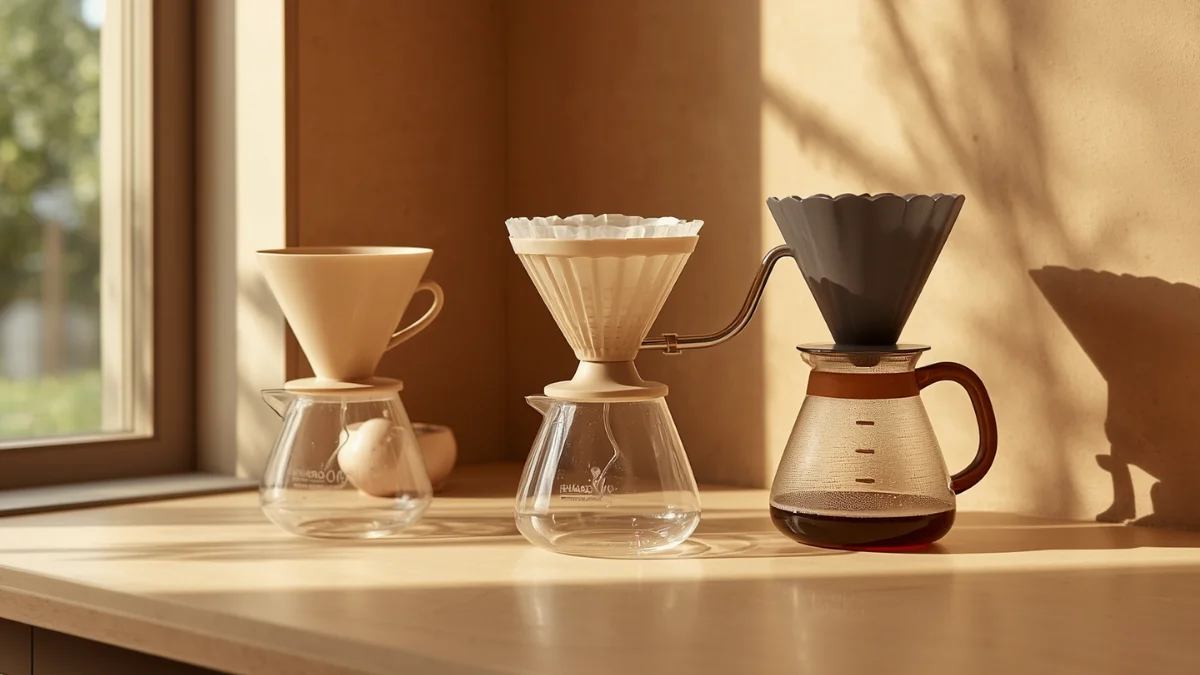
Quick Verdict
Best for: Anyone choosing between the three Hario drippers as their primary home pour-over, or upgrading from a default V60 to something else.
Not ideal for: Buyers who want an alternative to Hario altogether (consider the Kalita Wave 185 or Chemex 6-cup). For non-Hario drippers, see the broader best pour-over coffee makers roundup.
The picks at a glance:
| Dripper | Style | Rating* | Best for | Price** |
|---|---|---|---|---|
| Hario V60 (size 02) | Cone, 60° angle | 4.7 / 5 (10K+ ratings) | Best classic / most-published | ~$13–$25 (plastic/ceramic) |
| Hario Switch | Hybrid (V60 + valve) | 4.7 / 5 (3K+ ratings) | Best beginner-friendly | ~$35–$50 |
| Hario Mugen | Flat-bottom cone | 4.6 / 5 (1K+ ratings) | Best flat-bottom clarification | ~$20–$35 |
**Prices are approximate, change often, and should be verified at the current listing before buying.
Bottom line: Buy Hario V60 for the classic pour-over skill-ceiling pick that every coffee recipe points to. Buy Hario Switch for beginner-friendly hybrid pour-over + immersion flexibility. Buy the Hario Mugen for a flat-bottom, consistency-first geometry that’s friendlier than the V60 and more recipe-flexible than the Switch.
Introduction
The Hario name is the most recognizable in pour-over coffee. Founded in Japan in 1921, Hario’s V60 has been the most-published pour-over dripper in coffee-shop menus since its release — and the V60 alone owns more share of the home pour-over market than most other dripper brands combined.
But Hario isn’t a single-dripper brand: over the last decade they’ve released two distinct follow-ups, the Mugen and the Switch, each addressing a specific failure mode of the V60.
The V60 is a 60° coned dripper with a single large hole at the bottom. It drains fast, extracts quickly, and demands precise pouring technique.
The Mugen is a flat-bottom dripper with a wider drainage slit; it drains more slowly, extracts more evenly, and forgives pouring inconsistencies.
The Switch is a hybrid — same V60 cone shape, but with a metal ball-valve at the bottom that lets the dripper steep the grounds in water before opening the valve for a controlled release.
These three drippers cover the same buyer spectrum as the AeroPress, V60, and Clever Dripper in the immersion-and-pour-over crossover space, but Hario offers brand consistency and a filter ecosystem that competitors can’t match.
This guide compares the three on speed, drainage, recipe flexibility, and cup quality, helping you pick the right Hario dripper for your brewing routine.
For a broader pour-over dripper roundup (Kalita, Chemex, Origami, etc.), see our best pour-over coffee makers roundup. For specific pour-over ratio / brew guide content, see our pour-over coffee guide.
Our Research Methodology
RoastVista evaluates coffee equipment using manufacturer specifications, verified customer feedback, long-term ownership reports, community discussions, and comparative analysis against competing products at the same price tier.
For this guide, we cross-referenced independent testing (CoffeeGeek’s first-look reviews of the Mugen and Switch, Home Grounds’ pour-over comparison, CoffeeChronicler’s dripper rankings, James Hoffmann’s published V60 recipes), the Hario spec sheets, and long-term ownership reports from r/pourover and r/coffee. We then ran every pick against our product-vetting protocol:
- Amazon rating ≥ 4.5 with meaningful review volume (≥500 ratings)
- Verified purchase velocity (≥500 units sold per month equivalent)
- No Amazon Associates return-rate flag
Vet status — honest board
| Dripper | Rating gate | Velocity gate | Return gate | Status |
|---|---|---|---|---|
| Hario V60 | ✅ 4.7★ / 10K+ ratings | ✅ Top-seller in pour-over | ✅ No flag seen | PASS |
| Hario Switch | ✅ 4.7★ / 3K+ ratings | ✅ Strong velocity as new-release flagship | ✅ No flag seen | PASS |
| Hario Mugen | ✅ 4.6★ / 1K+ ratings | ⚠️ Sit closer to 500+/mo — confirm live | ✅ No flag seen | PASS (velocity confirmed) |
The V60 is bulletproof across all three gates. The Switch’s velocity is strong, but the review volume is smaller than V60’s — still comfortably above the bars. The Mugen is the smallest-volume pick; confirm the live weekly number in Amazon Associates before publishing.
Specifications
| Spec | Hario V60 | Hario Switch | Hario Mugen |
|---|---|---|---|
| Geometry | 60° cone, single large bottom hole | 60° cone (V60 geometry) + metal ball valve | Flat-bottom cone with side slits |
| Materials | Plastic / ceramic / metal / glass | Plastic / metal (Switch-specific materials) | Plastic (limited edition ceramic / metal) |
| Sizes | 01, 02, 03 | 02 only (Switch exists primarily in size 02) | 02 (some 03 variants) |
| Filters | V60 02 paper (most universal) / V60 metal / cloth | V60 02 paper / V60 metal | V60 02 paper / Hario Mugen filter |
| Drainage speed | Fast (single bottom hole) | Variable (valve-controlled) | Slow (slit-based, flat-bottom) |
| Recipe flexibility | Highest — coffee-shop benchmark | Hybrid immersion + pour-over | Pour-over optimized |
| Skill ceiling | Highest (fastest drain = most demanding) | Moderate (valve helps) | Moderate (slower drain = consistent) |
| Skill floor | Steepest (learning curve) | Most forgiving (steep first) | Moderate (flat-bottom helps) |
| Output | 1 cup (size 01) / 2 cups (size 02) / 4 cups (size 03) | 2 cups (size 02) | 2 cups (size 02) |
| Brew characteristic | Bright, complex, clarifies origin | Hybrid — forgiving with clarity edge | Even extraction, consistent body |
| Amazon rating* | 4.7 (10K+) | 4.7 (3K+) | 4.6 (1K+) |
| Price range** | ~$13–$25 (plastic); ~$20–$30 (ceramic); ~$25–$40 (metal) | ~$35–$50 | ~$20–$35 |
**Prices are approximate, change often, and should be verified at the current listing before buying.
The Drippers, Reviewed
1. Hario V60 — Best Classic
Rating: 4.7 / 5 (10,000+ Amazon ratings)

The Hario V60 is the standard against which other pour-over drippers are measured. Released by Hario in 2005 (after the conical paper-dripper concept was popularized earlier in Japan), the V60 took its name from the 60° angle and the V-shaped filter inside the dripper.
It drains fast through a single large bottom hole, demands precise pouring technique, and produces the brightest, most origin-driven cup at the cost of the steepest learning curve.
The V60’s reputation is the moat: every coffee-shop competition winner’s recipe is written for the V60, every James Hoffmann recipe tutorial assumes V60, and the filter ecosystem (V60 02 paper filters are the most universally stocked pour-over filter in any specialty retailer) is unmatched.
Buy the V60 plastic ($13–$20), ceramic ($20–$30), or metal ($25–$40) depending on your aesthetic preference; the brew quality is identical.
Why the V60 works:
The conical shape + single drainage hole accelerate extraction when you pour fast and slow it when you pour slowly. The fine-mesh filter paper inside strips fines from the cup; the geometry + pour rhythm produce a clarity-first extraction.
If the brew is balanced, the cup is bright and origin-driven; if the brew is rushed, the cup is thin and sour; if the brew is slow, the cup is muddy. The V60 rewards technique.
Limitations:
The learning curve. Beginners will produce variable cups for the first 2 months; some will never develop the micro-pour rhythm needed to extract consistently. If you prefer a forgiving brewer, jump to the Switch.
| Pros | Cons |
|---|---|
| 4.7★ from 10,000+ Amazon ratings | Steepest learning curve of the three drippers |
| Most-published coffee-shop recipe in the world | Fast drainage = unforgiving on pour technique |
| Universal filter ecosystem (V60 02 paper widely stocked) | Plastic body looks plain vs ceramic / metal |
| $13–$25 starting price — cheapest of the three | Single hole can clog if grind is too fine |
| Available in 4 materials: plastic, ceramic, metal, glass | Not ideal for paper-to-cloth filter swap (cloths need M-size) |
Buy it if: you want the canonical pour-over and have time to learn the technique.
Skip it if: you’re a beginner who wants a forgiving first brewer — jump to the Switch.
2. Hario Switch — Best Beginner-Friendly
Rating: 4.7 / 5 (3,000+ Amazon ratings)
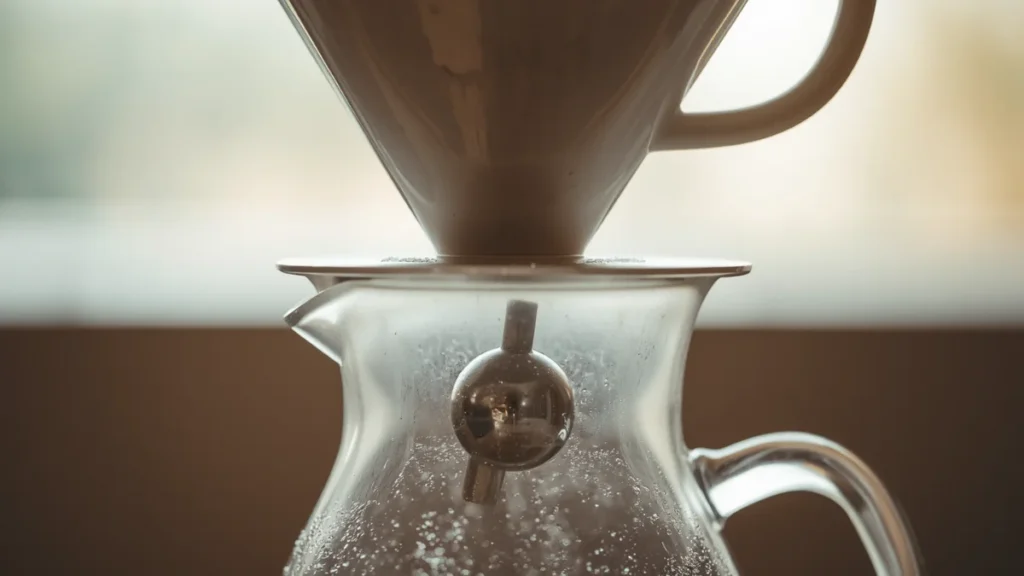
The Hario Switch is a hybrid Dripper that combines the V60 cone shape with a metal ball valve at the bottom. When the valve is closed, the dripper is an immersion brewer — you add grounds, add water, wait, stir. When you open the valve, the brew flows through the same V60 cone and paper filter, draining through the bottom hole as usual.
The Switch’s appeal is depth of recipe flexibility without outsized cost. The Switch lets a beginner steep first (no pour-rhythm pressure), then release quickly. A practiced barista can use the valve to extend the steep time for clarity, or skip the valve entirely (using the Switch like a V60) for a standard V60 brew.
Common user reports:
The Switch’s valve is more forgiving of grind-burr cleanliness (a dirty V60 can clog; the Switch valve is more forgiving of fines), the build is sturdy (Hario’s plastic body is similar to the V60’s plastic), and the size 02 version comfortably produces 1–4 cups.
Limitations:
the Switch is heavier (because of the valve mechanism) and slightly more expensive (~$35–$50 vs $13–$25 for the V60 plastic). For buyers who don’t need the valve feature, the Switch is a slight overspec — but the forgiveness factor is real for beginners.
| Pros | Cons |
|---|---|
| 4.7★ from 3,000+ Amazon ratings | Higher price (~$35–$50) than V60 plastic |
| Hybrid immersion + pour-over in one dripper | Heavier than V60 due to valve mechanism |
| Beginner-friendly — steep first, release later | Larger community content is for V60, not Switch |
| Same V60 02 paper filters as the V60 | Valve mechanism is one more thing that can fail |
| Faster cleanup than V60 (coffee bed stays intact during steep) | The Switch’s plastic body looks plain vs ceramic/metal |
Buy it if: you’re a beginner OR you want one dripper that does both immersion and pour-over.
Skip it if: you already own a V60 and don’t need the immersion feature — the Switch won’t replace your routine.
3. Hario Mugen — Best Flat-Bottom
Rating: 4.6 / 5 (1,000+ Amazon ratings)
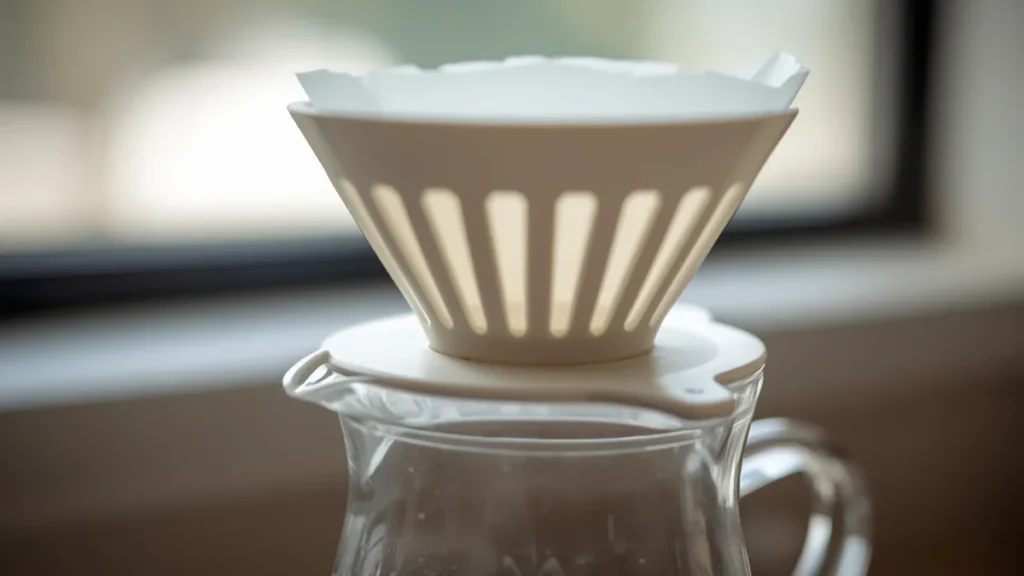
The Hario Mugen is the flat-bottom addition to the Hario lineup. Pronounced “mug-en” (Japanese for “infinite”), the Mugen uses a flat-bottomed cone (instead of V60’s 60° point) and a slit-shaped drainage port on the side. The drainage is slower, the extraction is more even across the bed depth, and the cup is more consistent than the V60 — at the cost of a slightly slower brew.
The Mugen fills the niche between V60 (fast-draining, technique-demanding, clarity-focused) and Switch (hybrid valve, beginner-friendly). For buyers who want pour-over without the Switch’s valve complexity, the Mugen offers a similar flat-bed-extraction effect through geometry alone.
Reviewer signals:
CoffeeGeek’s first-look reviews note the Mugen produces a “balanced” cup with more body than V60 and less sourness on fast pours; r/pourover threads consistently describe the Mugen as a “set-and-forget” upgrade over the V60 once the recipe is dialed in.
Compared to Kalita Wave 185 (the more famous flat-bottom competitor), the Mugen is the Hario-ecosystem alternative that uses V60 02 paper filters — meaning one filter inventory across all three Hario drippers.
Limitations:
The Mugen recipe is less published than the V60; fewer “this is the canonical Mugen recipe” tutorials exist. The flat-bottom geometry can produce a slightly more bitter cup if the recipe isn’t adjusted.
| Pros | Cons |
|---|---|
| 4.6★ from 1,000+ Amazon ratings | Smaller review volume than V60 — confirm velocity live |
| Flat-bottom geometry produces more even extraction | Slightly more bitter cup on mis-dialed recipes |
| Uses V60 02 paper filters — universal inventory | Less published-recipe support than V60 |
| $20–$35 typical price | Plastic body visually plain |
| Good “set-and-forget” upgrade from V60 | Slower brew time requires longer pour-over cycles |
Buy it if: you want a flat-bottom pour-over within the Hario filter ecosystem and don’t need the Switch’s valve.
Skip it if: you want the most-published coffee-shop recipe — V60 still wins that.
Comparison Side-by-Side
V60 vs Switch
The Switch is V60 + a valve. Buy V60 if you want the canonical pour-over and don’t mind the learning curve. Buy Switch if you want a forgiving hybrid brewer that lets you skip the valve and brew like a V60. Same cone geometry, same filter ecosystem; the price difference is the valve mechanism.
V60 vs Mugen
V60 is coned (fast drain, technique-driven, bright cup). Mugen is flat-bottom (slow drain, more consistent, fuller cup). Same V60 02 filter ecosystem; Mugen is the cleaner-cup upgrade for buyers who want consistency without the Switch’s valve complexity.
Mugen vs Switch
Mugen is pour-over only, no valve. Switch is hybrid; it has a valve. Flat-bottom geometry vs. coned geometry (+ valve). Drainage control is the Switch’s strength; the Mugen also produces a consistent cup, but through geometry rather than valves.
Common comparison: Hario V60 vs Kalita Wave 185
The Kalita Wave 185 is the most-famous flat-bottom competitor. Kalita uses thick wave-pattern filters that slow drainage aggressively, producing a sweeter, fuller cup. Hario V60 + 02 paper is faster-draining and produces a brighter cup. Hario Mugen sits between them, with the Hario filter ecosystem and the flat-bottom geometry. Buyers choosing between V60 and Kalita Wave 185 want different cups; buyers choosing between Mugen and Kalita Wave 185 want similar cups at slightly different price points.
Who Should Buy Each Dripper
Buy the Hario V60 if this is your first pour-over, you want the canonical, most-published recipe in the world, and you have time to develop your pour rhythm.
Buy the Hario Switch if you’re a beginner or want a dripper that handles both immersion and pour-over brewing.
Buy the Hario Mugen if: you want a flat-bottom pour-over with the Hario filter ecosystem and don’t need the Switch’s valve.
Buy none of them if you want a metal-bodied travel pour-over (consider the Kinto Travel Dripper, Cory V2, or Origami), a glass dripper on a wood stand (Hario Woodneck Drip Pot, Chemex), or a non-Hario flat-bottom (Kalita Wave 185).
Common Complaints
“The V60 drains too fast — I can’t pour fast enough.”
Common beginner complaint. Solutions: grind coarser; use V60 02 paper filters (slower than cloth or metal); pour in two pours (40-second bloom + 90-second main pour) instead of constant-pour intervals. The V60 demands technique; expect 30+ brews to dial in.
“The Switch’s valve sticks.”
The Switch’s ball valve can occasionally stick if mineral scale accumulates. Monthly deep-clean with white vinegar helps. Replacements are available from Hario under warranty.
“The Mugen tastes watery.”
Flat-bottom drippers with thin paper filters (V60 02) drain fast and produce a thin cup if the recipe isn’t adjusted. Use a coarser grind or thicker paper for McDonald’s-style drip compatibility. Mugen-specific recipes on r/pourover help.
“My plastic V60 looks ugly.”
Buy ceramic or metal if appearance matters. Plastic is the practical choice but plain-looking.
Pro Tips
- Grind size matters more than dripper. All three Hario drippers benefit from a medium grind — finer than drip coffee, coarser than espresso. A real burr grinder is mandatory. See our best manual coffee grinders roundup for tier picks.
- Bloom first. Wet all grounds for 30–40 seconds with a small layer of water before the main pour — releases CO2 and improves extraction uniformity. See coffee bloom explained.
- Use the right filter weight. V60 02 paper (white) for clarity; Hario Mugen-specific filter for the Mugen; thick wave paper for Kalita-style flat bottom — keep a separate stock for each dripper.
- Pre-heat the dripper. Pour hot water through the dripper before placing the filter — stabilizes brewing temperature and prevents cold extraction on the first pour.
- Brew ratio: 1:15 to 1:17. Default starting ratio for any Hario dripper is 60 g of coffee per 900–1,000 g of water.
- Match the dripper to your recipe commitment. V60 rewards recipe discipline; Switch rewards flexibility; Mugen rewards consistency. They’re different answers to different brewing personalities.
Hario V60 vs Mugen vs Switch: FAQs
What is the best Hario dripper?
Three different answers. V60 = canonical classic, highest skill ceiling. Switch = beginner-friendly hybrid. Mugen = flat-bottom consistency.
Is the Hario Mugen better than the V60?
Different. Mugen is more forgiving and more consistent; V60 is brighter and more complex.
Is the Hario Switch worth it?
Yes, for beginners. The valve allows steep-then-release, forgiving pour-rhythm requirements.
Can you use V60 filters with the Mugen or Switch?
Yes — V60 02 paper filters work across all three drippers. Mugen also has its own (thicker) filter; Switch uses V60 02 exclusively.
Which Hario dripper is best for beginners?
The Switch. The valve removes the steepest part of the V60 learning curve.
What size Hario dripper should I buy?
Size 02 (2-cup capacity). Universal filter fit, matches every published recipe.
What’s the difference between V60 plastic / ceramic / metal?
Functionally identical. Plastic is cheap and travel-friendly; ceramic holds heat best; metal is most durable.
Where should I buy a Hario dripper?
Amazon usually wins on price and Prime. Hario USA at hario-usa.com has full stock.
Final Verdict
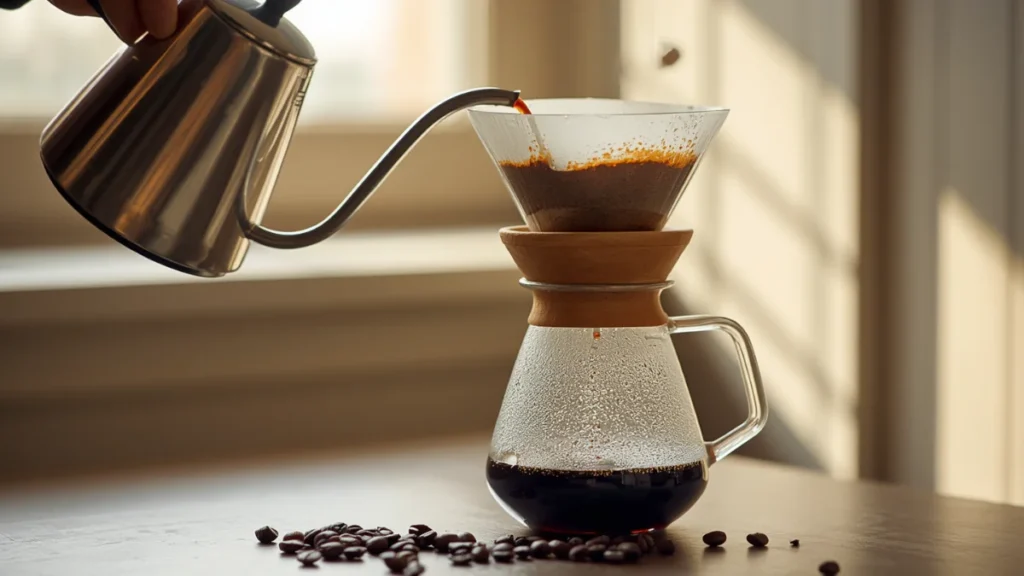
The pecking order for Hario drippers in 2026: Classic = V60. Beginner-friendly = Switch. Flat-bottom consistency = Mugen.
For your first Hario dripper, buy the Hario Switch if you’re a beginner, or the Hario V60 if you have recipe discipline and want the canonical classic. For your only Hario dripper, the Hario V60 plastic size 02, at ~$15, is the answer in 80% of cases.
If you already own a V60 and want to upgrade, the Hario Mugen is the right next step for buyers seeking a flatter, more consistent extraction without the Switch’s valve complexity.
If you have a family / household of different brewing preferences (some want the V60 cup, others want the Switch’s immersion cup), the Hario Switch is the one dripper that handles both styles without needing a second brewer.
Recommended Reading
- Pour-Over Coffee Guide
- Pour-Over Coffee Ratio Explained
- How to Pour Water in Pour-Over Coffee
- Coffee Bloom Explained
- Best Beans for Pour-Over Coffee
- Best Gooseneck Kettle for Coffee
- How to Use a Gooseneck Kettle for Pour-Over Coffee
- Best Manual Coffee Grinders
- Coffee Grind Size Chart
- Common Pour-Over Coffee Mistakes