
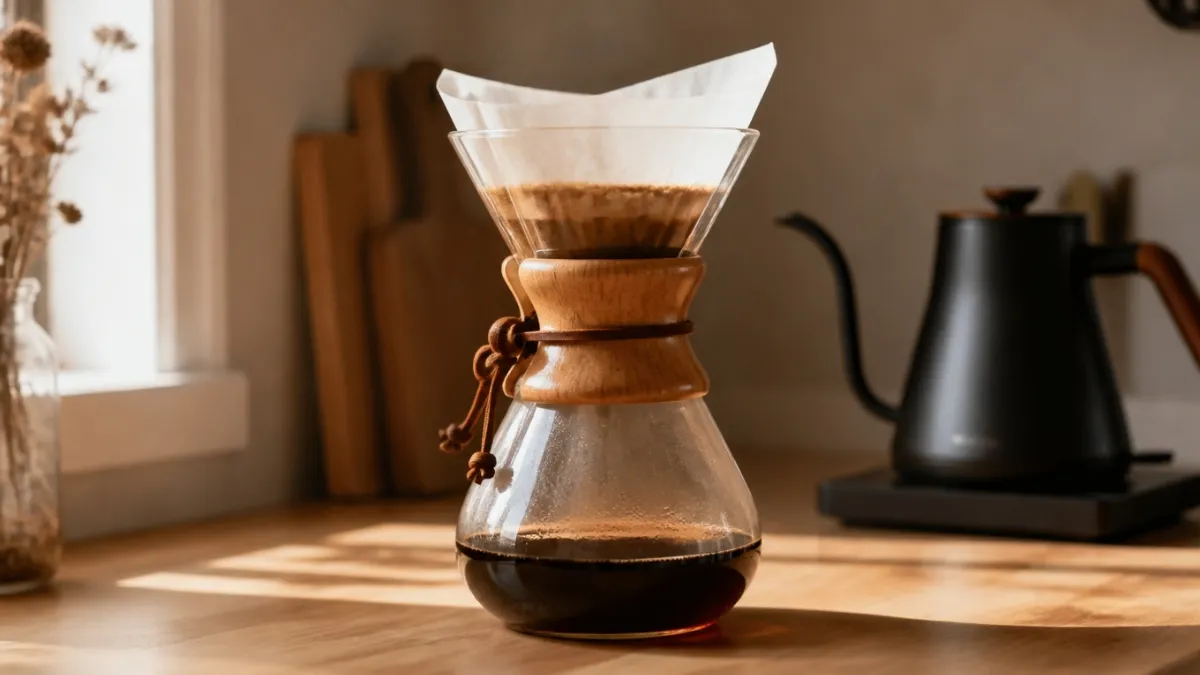
The Short Answer
Use a 1:16 coffee-to-water ratio, a medium-coarse grind (like coarse sea salt), water at 200°F (93°C), and a 4–5 minute brew that starts with a 40-second bloom. Rinse the filter first — always.
The Chemex is the most forgiving brewer in the pour-over family and the least forgiving in one specific way: its filter. Get the grind and the rinse right, and you get a cup with more clarity than almost any other manual method. Get them wrong, and you get a stalled bed, a papery taste, or a brewer that takes eight minutes to drain.
This guide covers the exact recipe for every Chemex size, our pour schedule, and fixes for the three problems that cause most bad Chemex coffee.
What Makes the Chemex Different
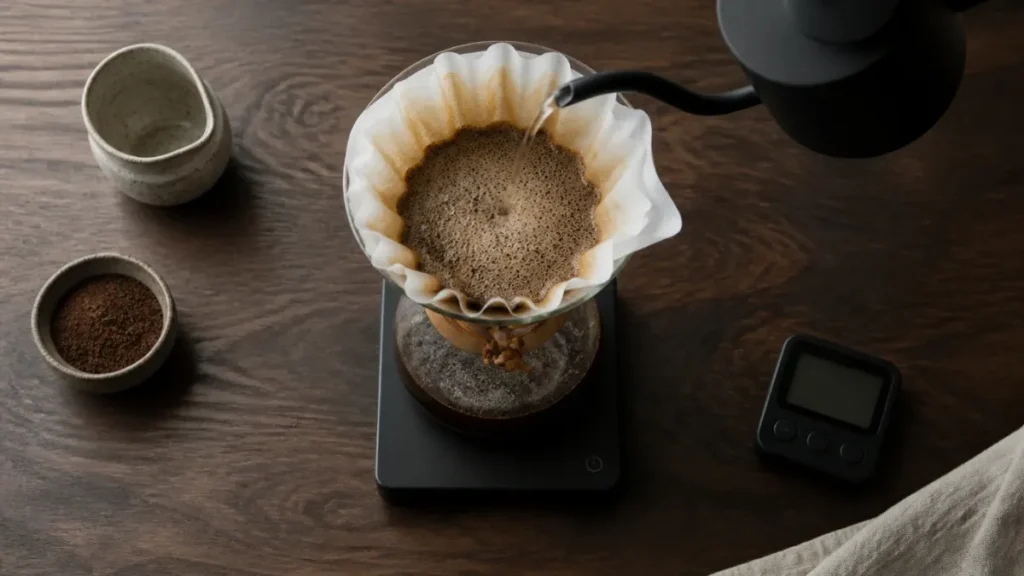
Peter Schlumbohm, a chemist, designed the Chemex in 1941, wanting a coffee maker that looked like laboratory glassware. It remains in the Museum of Modern Art’s permanent collection, which is a strange thing to mention in a coffee guide—but it explains the design: one piece of borosilicate glass, an hourglass shape, and no moving parts.
The brewing difference comes down to the filter. Chemex bonded filters are roughly 20–30% thicker than standard cone filters, and they trap most of the oils and fine particles that pass through a metal or thin paper filter. That is why Chemex coffee tastes lighter and cleaner than French press coffee, and why the body is thinner than a V60 brewed with the same beans.
The trade-off is flow. A thick filter slows drawdown, so you need a coarser grind than you would use in a V60. Most Chemex problems start with a grind that is too fine for the filter.
Which Chemex Size Should You Use?
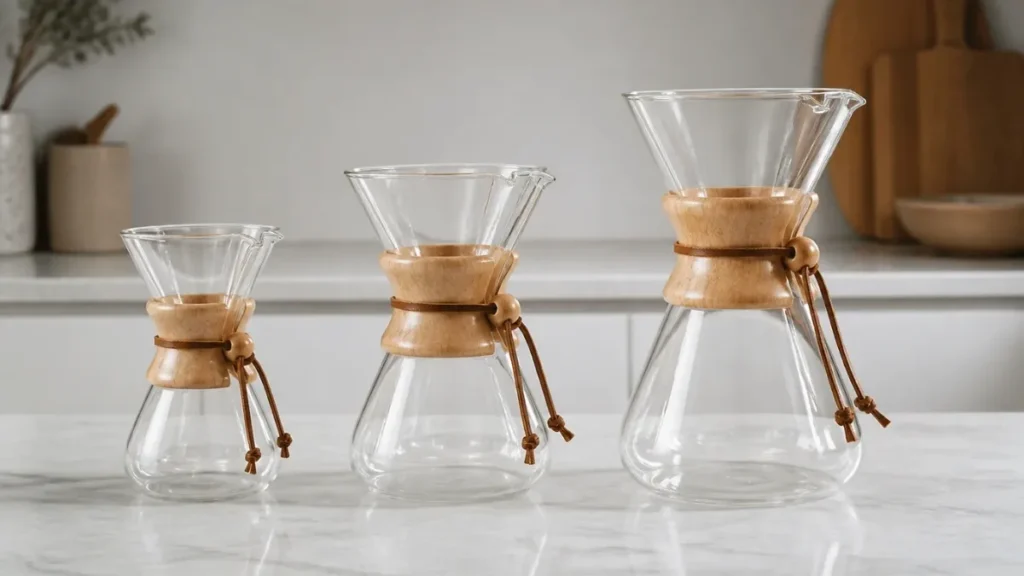
Chemex measures capacity in 5-ounce “cups,” not standard mugs. A 6-cup model holds 30 oz of brewed coffee — about two large mugs, not six.
| Model | Brewed capacity | Coffee | Water | Best for |
| 3-cup | 15 oz (450 ml) | 22 g | 350 g | One person, one large mug |
| 6-cup | 30 oz (900 ml) | 42 g | 700 g | Two people, the most popular size |
| 8-cup | 40 oz (1.2 L) | 55 g | 900 g | Two to three people |
| 10-cup | 50 oz (1.5 L) | 66 g | 1,100 g | Entertaining, batch brewing |
If you are buying your first Chemex, the 6-cup is the right default. It brews enough for two without forcing you to make a full batch every time, and the recipe scales down reasonably well. The 3-cup is charming but cramped; the 10-cup is too much glass to heat and clean for a daily single mug.
One caveat: you do not have to fill the brewer. A 6-cup Chemex with a 350 g brew works fine, though the bed will be shallow and the temperature will drop a little faster.
What You Need
- Chemex brewer (any size)
- Chemex bonded filters — the square ones, folded into a cone
- Medium-coarse coffee, ground fresh
- Gooseneck kettle (a controlled spout matters more here than on any other brewer)
- Scale accurate to 1 g
- Timer
- Mug or server, preheated
A gooseneck kettle isn’t strictly mandatory, but the Chemex’s narrow neck makes an uncontrolled pour genuinely difficult. If you are still using a standard kettle, read our guide to using a gooseneck kettle before your next brew — the pouring mechanics are the same, and they matter.
The Chemex Ratio
Start at 1:16. That means one gram of coffee for every 16 grams of water. It is the same starting point as most pour-over recipes, and it produces a cup that is strong enough to taste clearly without becoming muddy.
Adjust from there:
- 1:15 — heavier body, more sweetness, slightly less clarity
- 1:16 — balanced; the default for most beans
- 1:17 — lighter, tea-like, better for very light roasts
Use our coffee-to-water ratio calculator to scale a recipe to a different mug size. Just remember that the Chemex retains some water in the bed and filter — expect to lose roughly 50–70 g of your brew water to the slurry.
Step-by-Step Chemex Recipe
This is a 6-cup recipe: 42 g coffee, 700 g water, 200°F (93°C).
Step 1 — Heat and rinse
Boil the kettle, then let it settle to 200°F. While it heats, place the filter in the Chemex with the three-folded side facing the spout. Rinse the entire filter with hot water until it is saturated, then discard the rinse water.
Do not skip this. Rinsing removes loose paper fibers that can taste like wet cardboard and preheats the glass so the first part of the brew doesn’t lose heat immediately.
Step 2 — Add the coffee
Grind 42 g at a medium-coarse setting — coarser than V60, finer than French press. Add it to the rinsed filter and shake gently to level the bed.
Step 3 — Bloom
Start the timer and pour 90 g of water, just enough to saturate all the grounds. Use a circular motion from the center outward, then gently swirl the Chemex. Wait 40 seconds.
The bloom is carbon dioxide escaping from fresh coffee. If the bed does not bubble at all, your beans are likely stale. Our guide to coffee bloom explains what you should be seeing.
Step 4 — First pour
At 0:40, pour in a slow spiral to 300 g total. Stay away from the filter walls — water running down the paper bypasses the coffee and produces a thin, under-extracted cup. Keep the water level below the filter rim.
Step 5 — Second pour
At 1:30, pour to 500 g. At 2:15, pour to 700 g. Keep the bed flat and the water level steady. A gentle swirl after the final pour helps settle the grounds and produces an even extraction.
Step 6 — Drawdown and serve
The bed should be flat, and the brewer should finish draining between 4:00 and 5:00. Remove the filter while the brewer still has a little liquid left — leaving it in keeps extracting and can add bitterness. Swirl the carafe once and serve.
Chemex Grind Size
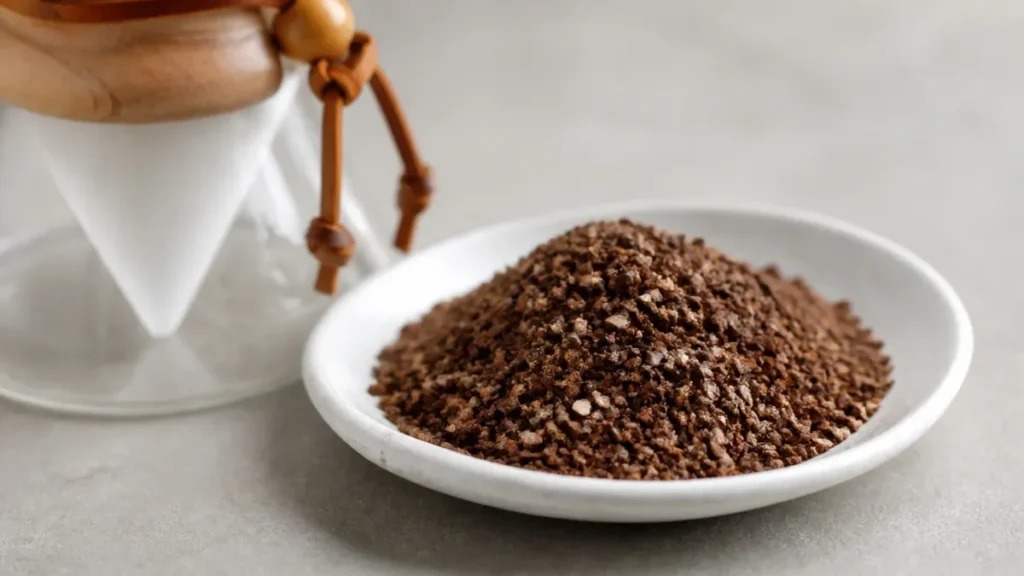
Medium-coarse is the correct starting point: roughly the texture of coarse sea salt, with visible flat flakes rather than powder. On a numbered grinder, that is usually:
| Grinder type | Starting setting |
| Baratza Encore ESP | 22–26 (filter range) |
| Timemore Chestnut C2 Max | 20–24 clicks |
| 1Zpresso J | 2.5–3.0 rotations |
| OXO Brew Conical | Medium, one notch coarser than drip |
These are starting points, not laws. The Chemex filter is the real variable: if your drawdown runs past 5:30, go coarser. If it finishes under 3:30 and tastes thin, go finer. Our full coffee grind size chart maps settings across common grinders.
Related: Read Coffee Grind Size Chart: A Complete Guide for Every Brewing Method for more details about grind size
Water Temperature
Use 200°F (93°C). A Chemex loses heat quickly because of the large glass surface, so starting a little hotter than you would for a V60 is reasonable. If you are brewing a small batch in a cold kitchen, 202–205°F is fine.
Do not use boiling water. It dulls aromatics and pushes extraction toward bitterness on darker roasts. Our water temperature guide covers the 195–205°F range in more detail.
Why Your Chemex Is Draining Too Slowly
A Chemex that stalls is almost always a grind problem, but not always. Work through these in order:
| Symptom | Likely cause | Fix |
| Drawdown over 6 minutes | Grind too fine | Go 2–3 clicks coarser |
| Water sits on top, bed looks muddy | Too many fines | Coarser grind; avoid pre-ground |
| Filter clogs near the end | Pouring onto the filter wall | Pour only in the center bed |
| Slow from the first pour | Filter seated wrong | Re-seat with the folded side at the spout |
| Fast drawdown, sour cup | Grind too coarse | Go finer in small steps |
If the problem persists at a coarse setting, the beans may be producing an unusual amount of fines — common with some decafs and very fresh light roasts.
Five Mistakes That Ruin Chemex Coffee
- Not rinsing the filter. The most common cause of a papery aftertaste.
- Grinding too fine. The thick filter magnifies the effect. Medium-coarse, not medium.
- Pouring down the filter wall. Water bypasses the coffee and leaves the cup weak.
- Using too little coffee. Under 20 g in a 6-cup brewer produces a thin, over-extracted brew because the bed is too shallow to filter properly.
- Letting the brew sit on the grounds. Remove the filter as soon as the drawdown finishes.
Chemex vs V60 vs French Press
| Chemex | Hario V60 | French Press | |
| Filter | Thick bonded paper | Thin cone paper | Metal mesh |
| Grind | Medium-coarse | Medium-fine | Coarse |
| Brew time | 4–5 min | 2.5–3.5 min | 4 min steep |
| Body | Light, clean | Medium | Heavy, oily |
| Batch size | 2–10 cups | 1–2 cups | 2–4 cups |
| Forgiveness | High | Low | High |
The Chemex wins on clarity and batch size; the V60 wins on control and single-cup speed. We compared them in detail in Chemex vs Hario V60. If you want the heaviest body and the least fuss, a French press is the better tool — just expect sediment.
Related: Chemex vs. Hario V60: Which Pour-Over Is Better? (2026)
Which Beans Work Best in a Chemex?
The Chemex flatters light and medium roasts. Its thick filter strips oils, so a dark, oily bean can taste thin and ashy rather than rich. Look for washed African coffees for floral acidity, or a medium Central American roast for balance.
Avoid very dark roasts and flavored coffees. Both rely on oils and additives that the filter removes. Our guide to the best pour-over beans covers specific origins and roast levels.
Cleaning and Care
The glass carafe is dishwasher-safe; the wood collar and leather tie are not. Remove them first. For daily cleaning, hot water and a drop of dish soap are enough. For coffee oil buildup, use a teaspoon of espresso-machine cleaner or baking soda in warm water, soak for ten minutes, and rinse thoroughly. Don’t use abrasive scouring pads on the glass—they scratch and leave a haze that is impossible to remove.
Store the Chemex without the filter, and don’t stack anything inside the carafe.
Related: Best Coffee Beans for Pour Over: A Beginner’s Guide to Choosing the Right
Chemex Brewing FAQ
How much coffee do I use for a Chemex?
Use 22 g for a 3-cup, 42 g for a 6-cup, 55 g for an 8-cup, and 66 g for a 10-cup model, all at a 1:16 ratio. Weigh the coffee instead of scooping.
What grind size is best for a Chemex?
Medium-coarse — coarser than V60, finer than French press. Aim for a 4–5 minute total brew time and adjust from there.
Do I have to rinse the Chemex filter?
Yes. Rinsing removes paper dust, eliminates a papery taste, and preheats the brewer. It takes ten seconds.
Can I make cold brew in a Chemex?
You can, but it is slow and the filter clogs. A dedicated cold brew maker or a mason jar with a filter is a better tool. If you want to try it, use a coarse grind and expect a 12-hour steep.
Why does my Chemex coffee taste weak?
Usually too coarse a grind, too little coffee, or water pouring down the filter wall. Check the bed after brewing — it should be flat, not cratered.
Can I brew a single mug in a 6-cup Chemex?
Yes. Use 22–25 g of coffee and 350–400 g of water. The bed will be shallow, so expect a slightly faster brew and a lighter body.
Is a Chemex worth it if I already own a V60?
If you regularly brew for two or more people, yes. The Chemex is easier to use in larger batches and produces a cleaner cup. For single mugs, the V60 is faster and gives you more control.
Final Thoughts
The Chemex rewards a simple routine: rinse the filter, weigh the coffee, use a medium-coarse grind, and pour in three stages. It does not reward improvisation. Once you dial in the ratio and grind, the brewer is remarkably consistent—which is exactly why it has stayed in kitchens for eighty years.
Start with the 6-cup recipe above, change one variable at a time, and use drawdown time as your guide. If the brew finishes in the four-to-five-minute window and the bed is flat, you are already making good Chemex coffee.
Scientific References
- Moroney, K.M., Lee, W.T., O’Brien, S.B.G., Suijver, F., & Marra, J. (2015). “Modeling of coffee extraction during brewing using multiscale methods: An experimentally validated model.” Chemical Engineering Science, 137, 216–234. DOI: 10.1016/j.ces.2015.06.021. Models the coffee bed as a doubly porous medium and validates a two-stage extraction mechanism — rapid release from damaged surface cells, slower release from intact cells in the grain kernel.
- Batali, M.E., Frost, S.C., Lebrilla, C.B., Ristenpart, W.D., & Guinard, J.-X. (2020). “Brew temperature, at fixed brew strength and extraction, has little impact on the sensory profile of drip brew coffee.” Scientific Reports, 10, 16450. nature.com/articles/s41598-020-73341-4 (open access).
- Specialty Coffee Association. Coffee Standards — the Golden Cup / Brewing Control Chart targets (TDS 1.15–1.35%, extraction yield 18–22%) and the 92–96°C brewing temperature requirement for certified brewers. sca.coffee/research/coffee-standards
- Chemex. “How to Brew with Chemex” — official filter folding and seating instructions, including why the three-layer side faces the spout. chemexcoffeemaker.com
- Citation note: reference 3 is the industry standard this recipe targets; reference 2 is the controlled test of how much temperature actually matters once strength and extraction are held constant. The two are consistent — the standard sets a range, and the study explains the mechanism inside it.