
Last updated: 28 October 2026
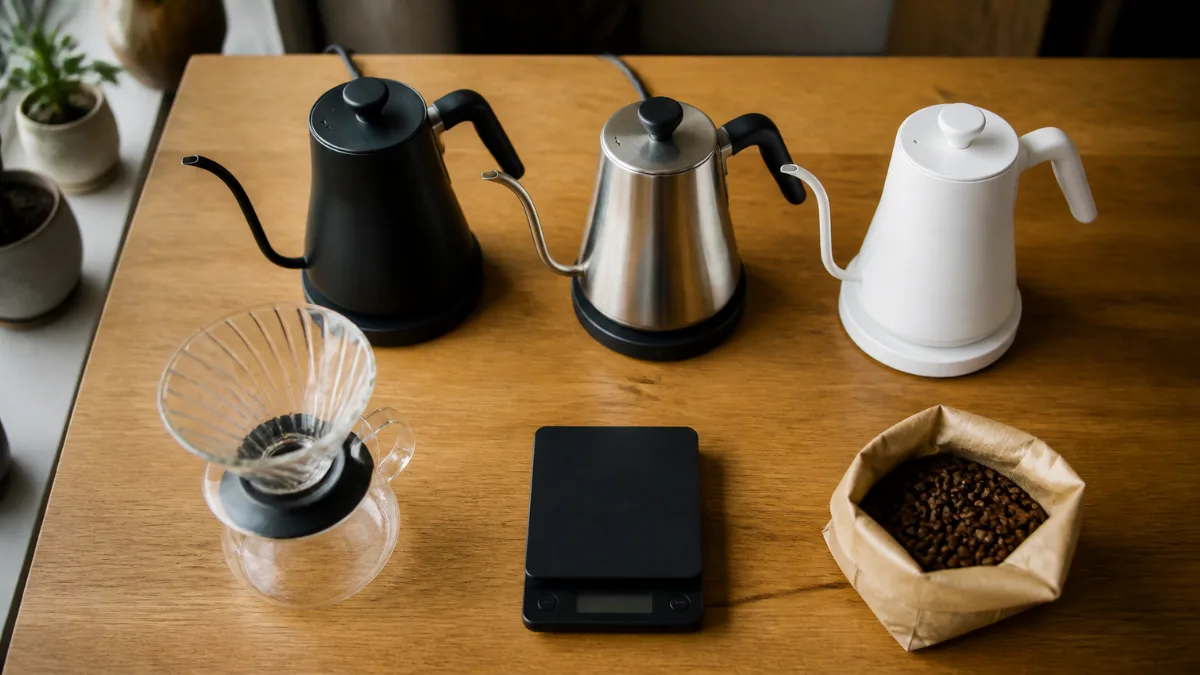
If your pour-over tastes thin one morning and bitter the next, and you have not changed beans, grind, or ratio, the variable you are overlooking is usually the kettle. A gooseneck does not magically improve coffee. It removes two sources of error that technique alone cannot fix: water at the wrong temperature and an unmanageable stream.
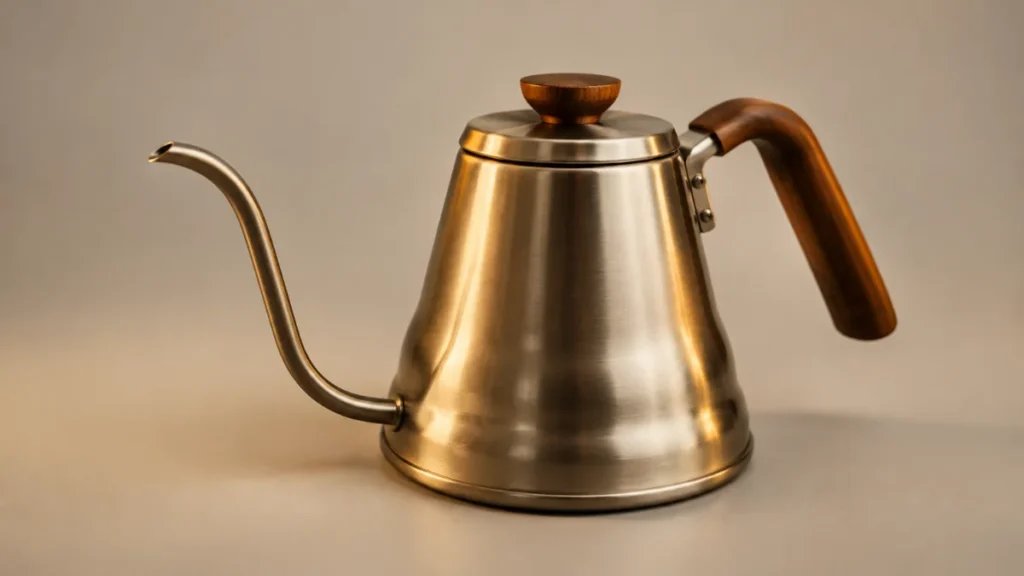
This guide compares three electric gooseneck kettles at three price points, using published specifications, independent testing, and owner-reported experience, and tells you which one to buy based on how you brew rather than on how it looks on a countertop.
If you are still working out your fundamentals, start with our pour-over coffee guide and come back here for the hardware.
How We Researched This Guide
We do not claim to have brewed with these kettles. What follows is research-based, and here’s what that means.
- We gathered manufacturer specifications for capacity, wattage, temperature range, hold duration, materials, and safety features from current Amazon listings and each brand’s product documentation.
- Independent testing and editorial reviews from outlets that do measure these kettles, including CoffeeGeek’s full review of the OXO Brew, which reports temperature overshoot behavior, build assessment, and spout performance.
- Verified owner feedback across each listing’s review corpus, weighted toward reviewers who describe their brewing setup, because a complaint from someone brewing 40 g doses tells you more than a one-line rating.
- Cross-compare against alternatives in and around each price band, so recommendations reflect the market rather than a single product in isolation. For the wider context, see our essential coffee brewing tools guide and best pour-over coffee makers.
Three filters decided which kettles qualified:
- Temperature control you can actually set. Not a boil-and-guess kettle with a spout glued on. All three here let you choose a target and hold near it.
- Pour control by design. A narrow, well-finished gooseneck and handle geometry support a slow, steady pour.
- Available on Amazon with a live listing. So you can verify current pricing and specifications yourself rather than trusting a review written against a discontinued model number.
We deliberately excluded stovetop kettles and the ultra-premium app-connected tier. The jump from a preset kettle to a degree-level kettle genuinely matters. The jump from degree-level to Bluetooth scheduling usually doesn’t matter, unless you are chasing repeatability across a lot of brews.
If your budget is below this range, our best beginner coffee setup under $100 is a solid entry point.
The Short Answer
If you only read one section, read this table.
| If you… | Buy this | ASIN | Price checked 27 Oct 2026 |
| Want the best value and brew one or two cups a day | COSORI 0.8 L Gooseneck Kettle | B07T1CH2HH | $69.99 |
| Want the best-documented pour control under $125 | OXO Brew Pour Over Gooseneck Kettle | B074KHPS7F | $119.97 |
| Want degree-level precision and will pay for it | Fellow Stagg EKG Electric Kettle | B077JBQZPX | $179.95 |
Three Kettles Compared
| COSORI 0.8 L | OXO Brew | Fellow Stagg EKG | |
| ASIN | B07T1CH2HH | B074KHPS7F | B077JBQZPX |
| Price (27 Oct 2026) | $69.99 | $119.97 | $179.95 |
| Capacity | 0.8 L | 1.1 qt (approx. 1.04 L) | 0.9 L |
| Power | 1200 W | 1500 W | 1200 W |
| Temperature control | 5 presets | Adjustable set point | Variable, degree level |
| Keep warm | 60 min | 30 min | Hold mode: Customizable Hold Mode |
| Built-in timer | Yes | Yes (current models) | Brew stopwatch |
| Water-contact materials | Stainless interior, no plastic contact | Stainless body, silicone lid insert | Stainless, food-grade |
| Cordless pour | No | Yes | No |
| Best for | First gooseneck, small kitchens | Pour control on a budget | Precision across several methods |
| Watch out for | Preset steps, not free-set | Overshoots set temp by approx. 2-4 F | Price |
| Star rating / review count | 4.6/5 | 4.4/5 | 4.4/5 |
1. COSORI Electric Gooseneck Kettle, 0.8 L – Best Value
ASIN B07T1CH2HH · $69.99 at time of writing
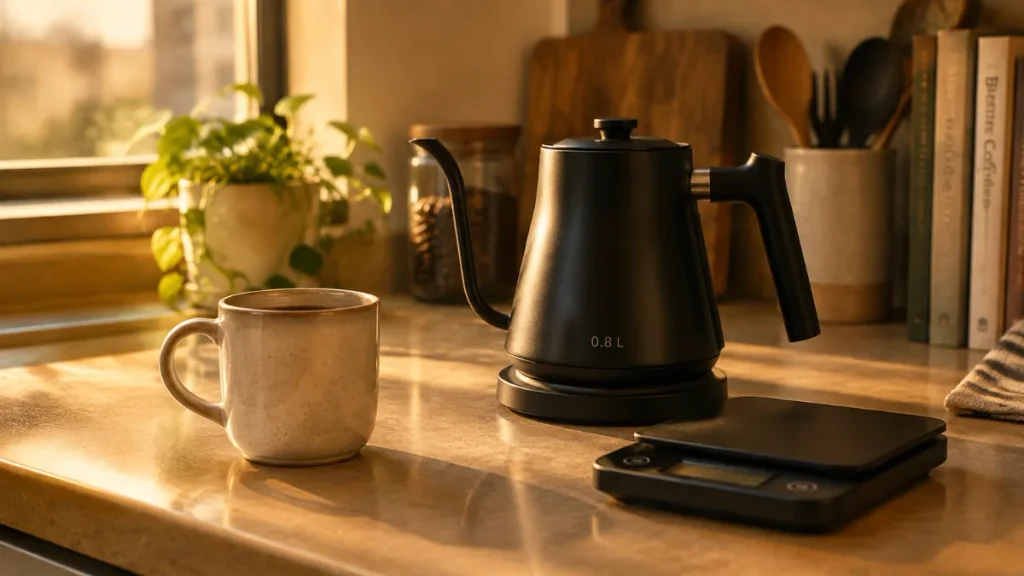
The 0.8 L Cosori is the kettle the specs point to for someone who’s just decided to take pour-over seriously but isn’t ready to spend $200 to find out whether they like it. It is the lowest-cost route to real temperature control rather than boil-and-guess brewing.

What the specs and owner reports show
Five presets cover the temperatures most brewers cycle through in a week: green tea, oolong, light-roast pour-over, dark-roast, and boil. The interior and spout path are stainless steel, and Cosori says no plastic touches water.
That matters more than most buyers realize, because off-tasting water is one of the few material variables people reliably notice in the cup. The 60-minute keep-warm is the longest of the three, which helps when you brew two cups back to back or make a second V60 for someone else. Auto shut-off and boil-dry protection are both confirmed in the published feature set.
Documented limitations
Five presets are not the same as setting any temperature. If your recipe calls for 201 F and the nearest preset is 205 F, you are brewing at 205 F. For most people, most of the time, that is fine, and there is a good reason why in the temperature section below.
But if you keep a brew log and adjust in single degrees, the preset architecture is the wrong tool. The 0.8 L capacity is also tight for three or four people: two 250 ml cups plus a rinse is about its comfortable ceiling, based on the stated capacity rather than on any measured pour.
Pros and cons
- Lowest entry price for a genuinely temperature-controlled gooseneck
- Longest keep-warm of the three at 60 minutes
- No plastic contact with water; stainless interior and spout path
- Fast 1200 W heat-up as specified
- Smallest footprint of the three
- Presets only, no free-set temperature
- 0.8 L limits batch size to roughly two cups
- Preset steps may not match your exact recipe
- Build finishing and materials sit a tier below the other two
Buy it if: you brew one or two cups a day, this is your first gooseneck, or you want a second kettle for the office.
2. OXO Brew Pour Over Gooseneck Electric Kettle – Best Pour Control
ASIN B074KHPS7F · $119.97 at time of writing
This is the sleeper pick of the three, and the one independent testing supports most strongly for the price.
What the specs and independent testing show
The spout is the story. In CoffeeGeek’s full review, the tester described the pour as “pretty much best in class” and “industry-leading,” crediting the spout angle, kettle height, and handle geometry.
Together, those three properties determine whether a slow pour feels controlled or fights you, which is why a documented assessment of them carries more weight than a spec sheet. The same review rated build quality at 9.5 out of 10, describing the construction as solid rather than thin, with a silicone insert in the lid and handle for grip and heat protection. Those are the observations behind the recommendation here, not our own bench notes.
The body is stainless steel, and the kettle is cord-free once lifted, so you can pour, set it down, and lift it again for the second pulse without managing a base. An adjustable set-point temperature and a built-in timer cover the two things you need to repeat a recipe, and OXO revised the timer after the original review, so current models include the improved version.

Documented limitations
Temperature overshoot is the documented flaw. CoffeeGeek reports that the kettle reliably reaches at least the set temperature but typically lands 2 to 4 F above it.
For pour-over, that sits inside the noise, as the temperature section explains. For delicate green tea, set it deliberately low. The hold period is shorter than the Cosori’s.
Pros and cons
- Independently assessed as class-leading spout and handle geometry
- Build quality rated 9.5 out of 10 in independent review
- Cord-free pouring
- Adjustable set-point temperature rather than fixed presets
- Built-in timer on current models
- Overshoots set temperature by roughly 2 to 4 F, per independent testing
- Shorter hold period than the Cosori
- Mid-tier price buys control, not precision
- Heavier than the Cosori by specification
Buy it if: your brews are inconsistent and you suspect your pour rather than your grinder. If you are also fighting sour cups, read why your coffee tastes sour before you buy anything.
3. Fellow Stagg EKG – Best Precision
ASIN B077JBQZPX · price varies by finish; check the listing
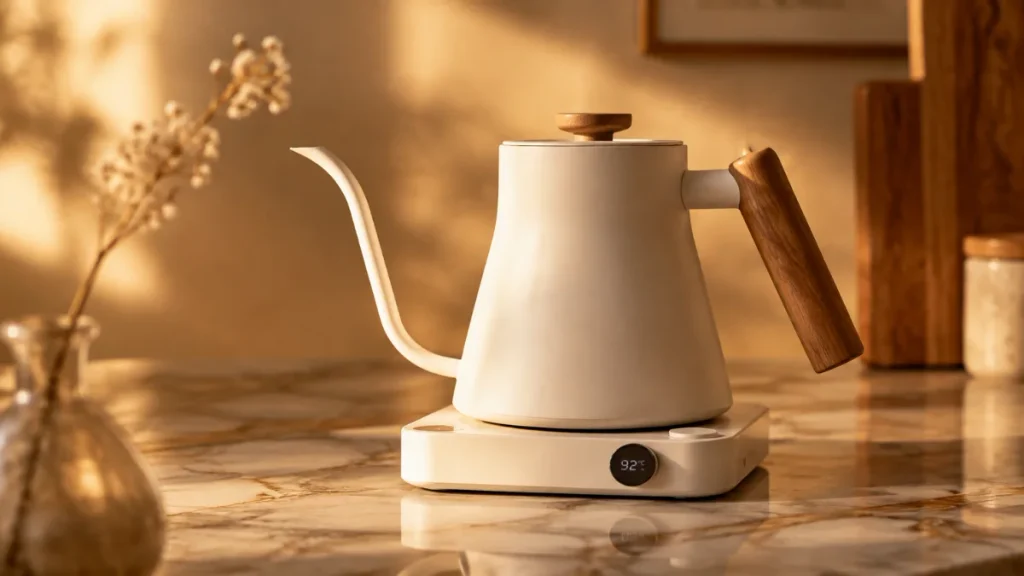
The Stagg EKG is the kettle that made this category visible, and it remains the reference point. It offers variable temperature control, a 1200 W element for quick heat-up, and a built-in brew stopwatch, so you don’t have to juggle a phone timer.
What the specs and owner reports show
It does degree-level control properly, the only feature that changes what you can do rather than how pleasant it is. If you brew light-roast washed coffees and dark-roast naturals in the same week, or work through our brewing temperature guide one variable at a time, this kettle lets you hold everything else constant.
Owner feedback consistently highlights the counterweighted handle and slim spout as making long, slow pours easier to control. It is also the most design-led of the three, which isn’t a coffee argument, but it is why people keep it on the counter instead of in a cupboard, and a kettle you use beats a kettle you store.

Documented limitations
Price, obviously. And the honest caveat: the Stagg’s advantage over the OXO is precision and finish, not documented pour superiority.
Independent comparisons haven’t established a pour-control gap that would justify the difference on its own. If you only ever brew one method at one temperature, you are paying for headroom you will never use.
Pros and cons
- True variable temperature at degree level
- 1200 W fast heat-up as specified
- On-base brew stopwatch removes a piece of kit from the counter
- Best-in-class design and materials
- Holds resale value and looks right on a counter
- Most expensive by a wide margin
- Overkill if you brew one recipe
- Finish-dependent pricing, so always check before buying
- No independently documented pour-control advantage over the OXO
Buy it if you brew several methods, dial recipes in single degrees, or have already upgraded your grinder and this is the last bottleneck.
If your grinder is the weak link, fix that first, then compare burr vs. blade coffee grinders and the best manual coffee grinders.
What Actually Matters When You Are Choosing
Temperature control, honestly assessed
The industry reference point is 195–205 °F (90–96 °C) for brewed coffee, and the National Coffee Association puts French press at 93 ± 3 °C. (Reference: National Coffee Association).
But the most useful recent finding cuts against the folklore: When UC Davis researchers held extraction (TDS and percentage extraction) constant and varied brew temperature across 87–93 °C, flavor differences were “mostly insignificant,” and a consumer panel couldn’t tell. (Reference: Specialty Coffee Association—How Hot is Hot Enough? Brew Temperature, Sensory Profile and Consumer Acceptance of Brewed Coffee)
What that means for a buying decision: a kettle that hits a consistent temperature is worth more than a kettle that hits a specific one. The Cosori’s presets and the OXO’s 2–4 °F overshoot both land inside the range where temperature stops being the dominant variable. Buy degree-level control because it helps you repeat a recipe, not because 1 °F will transform your cup.
Pour control is fluid dynamics, not marketing
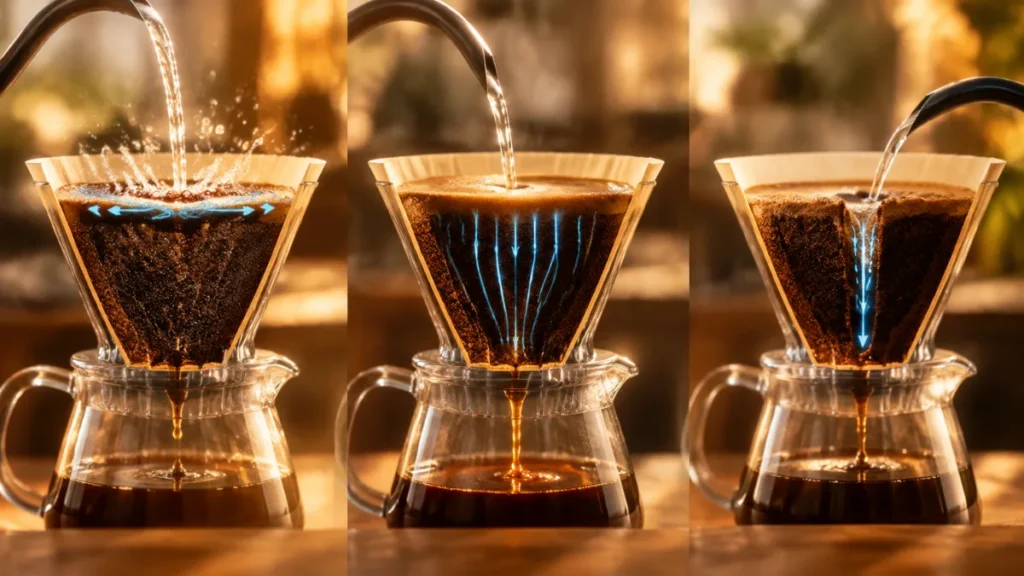
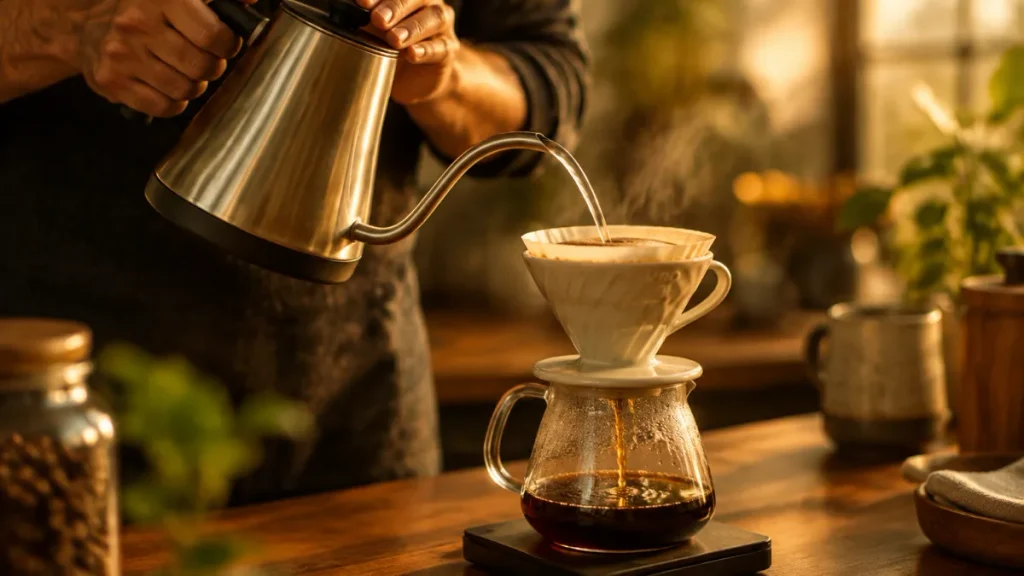
Where your stream breaks up determines how much turbulence reaches the coffee bed, and turbulence is what distributes fresh water to every particle. Pour too close and too fast, and you get laminar flow that digs a hollow and channels; pour from too high and agitation stays at the surface and the bed underneath never gets disturbed.
The sweet spot is just below the height where the stream starts to splatter. (Reference: Coffee Ad Astra-Jonathan Gagne; The Physics of Kettle Streams)
The practical sweet spot is just below the height where the stream starts to splatter, which is why spout geometry and handle balance, the OXO’s documented strengths, matter more than they sound like they should. For the technique side, see how to pour water in pour-over coffee.
Capacity maths
One 250 ml cup plus a rinse needs roughly 0.5 L of headroom. 0.8 L comfortably serves two. 0.9 to 1.04 L is comfortable for two to three. If you regularly brew for four, none of these is the right answer; go up a size. Doing the arithmetic before you buy is the single most common thing buyers skip.
Materials at the water line
You want a stainless interior and a stainless or silicone path. “No plastic contact with water” is a claim worth verifying on the listing rather than assuming, because it is the one material variable people reliably report noticing in the cup.
Hold time and timer
A hold mode lets you brew a second cup without re-boiling. A built-in timer means one less device on the counter. Neither is essential, but both can be the difference between a kettle you like and one you resent. If you are currently timing on your phone, our piece on whether you need a timer for coffee brewing will save you $30.
Skip it if
You brew exclusively French press or cold brew. A gooseneck adds nothing to an immersion brew, so spend the money on a better grinder or on a coffee storage container instead. And if you are not weighing your coffee yet, no kettle will save you.
Start with the coffee brewing ratio guide and the coffee-to-water ratio calculator. If your grinder is the bottleneck, the Baratza Encore ESP is the upgrade most people should make before any kettle.
Three Things to Do in Your First Week With a New Kettle
- Boil once, dump it. Manufacturing residue is real, and every manufacturer here recommends a first boil and discard. Then brew.
- Weigh everything, including water. A good spout makes it tempting to eyeball. Do not. 250 g in, 250 g out, so you can actually compare brews. Use our digital scale guide if you don’t have one.
- Fix temperature, change one thing. Pick a temperature, hold it for five brews, and adjust grind instead. If you change both, you learn nothing. This is exactly the loop in coffee extraction explained.
Frequently Asked Questions
Is a gooseneck kettle actually necessary for pour-over?
Not strictly, but it is the cheapest way to remove pour variability. A steady, controllable stream helps keep the coffee bed level and reduces agitation. That said, a good grinder affects your coffee more than a good kettle.
What temperature should I set for pour-over?
Start at 200°F for medium roasts, 205°F for light roasts, and 195°F for dark roasts, but treat those as starting points, not rules. Research found that holding extraction constant across 87–93 °C made flavor differences largely insignificant, so consistency beats the exact number. (Reference: SCA)
Is the Fellow Stagg EKG worth it over the OXO Brew?
Only if you need degree-level control, or if you are buying it as much for the object as for the tool. On documented pour performance, they are close. On precision and design, the Fellow wins. On value, the OXO does.
Does the OXO Brew kettle really overshoot the set temperature?
Yes — it reliably reaches at least your set temperature and typically lands 2–4 °F above it. CoffeeGeek: For pour-over, that’s negligible; for delicate tea, set it a few degrees low.
Can I use a gooseneck kettle for French press or AeroPress?
You can, and the temperature control is genuinely useful for both — the NCA’s French press guidance is 93 ± 3 °C, which is exactly what a settable kettle gives you.(Reference: NCA). But the gooseneck spout itself does nothing for immersion brewing.. See our French press coffee guide and AeroPress coffee guide.
How often should I descale an electric gooseneck kettle?
Descale every four to eight weeks with normal filtered water, and more often with hard water. Scale on the element slows heat-up and can distort the temperature reading. The same logic applies as in our how-to-clean-a-coffee-grinder-properly guide: maintenance is cheaper than replacement.
Does kettle material affect taste?
A stainless interior with no plastic in the hot-water path is the safest choice. Plastic in the hot water path is the one material variable people reliably report noticing.
Which is best for a two-person household?
The OXO Brew at roughly 1.04 L or the Fellow at 0.9 L. The Cosori’s 0.8 L works for two 250 ml cups but leaves little margin for a rinse or a third cup.
The Verdict
Buy the OXO Brew if you want the best-documented pour for the money. Based on the evidence, it is the one most likely to make an inconsistent brewer consistent. Buy the COSORI if you are starting out or brewing for one and would rather spend the difference on beans. Buy the Fellow Stagg EKG if precision is the whole point and you have already upgraded everything upstream.
Whichever you pick, remember that the kettle is the last ten percent of the cup. Grind, ratio, and water get you the first ninety, which is why our home coffee brewing guide is still the right place to start.
How we made this guide: we base our product reviews on detailed research and analysis rather than hands-on physical testing. We review manufacturer information, product specifications, independent sources, and real-user feedback to understand a product’s performance, quality, features, strengths, and limitations, and we compare products with similar alternatives. Read the full Review & Research Disclaimer.
Prices checked 28 October 2026 and may change. As an Amazon Associate, we earn from qualifying purchases. Specifications reflect the live listings on that date; confirm on the product page before purchase.