
Quick Facts
| Question | Answer |
| What “SCA Certified” means | The brewer passed third-party testing under the SCA Certified Home Brewer program against the SCA’s brewing and performance standards for temperature stability, brew time and extraction uniformity |
| Best for most households | OXO Brew 8-Cup Coffee Make,r (Certified 2025) — thermal carafe, true single-serve mode, the smallest footprint in the category, about $197.99 on Amazon (list $219.99) |
| Best large-batch flexibility | Braun MultiServe Plus 10-Cup (Certified 2024) — seven brew sizes plus cold brew, about $249.95 in stainless on Amazon |
| Best premium control | Café Specialty Drip Coffee Maker, 10-Cup Thermal Carafe (Certified 2026) — app and voice control, 1–10 cup, 185–205°F adjustable, about $299 on Amazon |
| Best enthusiast machine | Fellow Aiden Precision (Certified 2024) — custom brew profiles, single-cup cone basket, thermal carafe, about $399.95 on Amazon |
| Best under $200 | Bonavita BV1900TS 8-cup one-touch thermal (SCA certified) — about $189.95 on Amazon |
| Certification standard | Built on the SCA’s 55 g/L ±10% ratio, 92–96°C contact temperature and 18–22% extraction targets |
| Who should still brew manually? | Anyone chasing a single dialed-in cup of light roast — auto brewers optimise for batches, not for one mug |
Introduction
Here is an uncomfortable truth for the pour-over faithful: on weekday mornings, most people do not want to stand at a kettle timing four pours. They want good coffee, in quantity, at the push of a button. The industry’s answer is the SCA-certified home brewer — an automatic drip machine engineered to meet the same brewing standards a skilled barista hits with a manual pour-over, and verified through the Specialty Coffee Association’s third-party testing program.
The category has quietly exploded. The SCA’s certified home brewer list now includes machines from Technivorm Moccamaster, Bonavita, Breville, OXO, Braun, Café, Fellow, Zwilling and others — many costing less than the gooseneck-kettle-plus-scale-plus-dripper path to equivalent quality. But certification doesn’t guarantee a machine suits you: they differ wildly in batch size, carafe type, single-serve ability, cleaning burden, and price.
This guide explains what SCA certification actually tests, why an automatic brewer can legitimately be called “pour-over style”, and which certified machine fits your counter, your batch size and your budget in 2026 — written from the buyer’s side of the counter: what a machine is like to own on a Tuesday, not just what it scores on a lab sheet. It completes our coverage of the method — pair it with our manual pour-over coffee guide and our best pour-over coffee makers roundup if you are weighing manual versus automatic — or start from the coffee brewing guides hub if you are new to all of this.
Availability note (updated 15 November 2026): this revision replaces two picks that are no longer reliably stocked on Amazon.com — the Breville Luxe Brewer Thermal (Certified 2025) and the Technivorm Moccamaster KBGV Select (Certified 2026). Both remain excellent certified brewers, and both are still on the SCA list; they are simply not consistently purchasable through Amazon at the time of writing. They have been replaced by two certified machines: the Café Specialty Drip Coffee Maker with thermal carafe and the Fellow Aiden Precision. ASINs for every product are listed in the Amazon Link Map at the end.
1. What “SCA Certified” Actually Means
The Specialty Coffee Association maintains the coffee industry’s brewing standards, and its certification program for home brewers is documented on the SCA’s certified home brewer list and coffee standards pages. A machine on the list “has successfully completed SCA third-party testing and satisfied the certification requirements for home brewing equipment,” per the SCA — in practice this means testing against the SCA’s brewing and performance standards for:
Water temperature at the grounds: holding coffee in the roughly 92–96°C (198–205°F) range at the coffee bed — the band where favourable coffee compounds extract efficiently and bitter ones do not. Our coffee brewing temperature guide explains why that window matters more than any other single variable.
Brew contact time and flow: wetting and draining through the coffee bed at rates consistent with balanced extraction.
Extraction uniformity: finished brews landing in the target extraction range associated with the SCA’s framework, which builds on the classic 55 grams of coffee per litre ratio (±10%) — the ratio our coffee brewing ratio guide and coffee-to-water ratio calculator apply to every manual method.
What certification does not mean is equally important. It is not a taste award, it is not a guarantee of durability, and it says nothing about carafe insulation, noise, or how easy the machine is to clean. Two certified machines can produce noticeably different cups from the same coffee, because certification defines a floor, not a flavour profile.
(Note: older machines were marketed as “Golden Cup Certified” under the SCA/ECBC program; the current program page brands certified machines “SCA Certified Home Brewers”, though some manufacturers still use “Golden Cup” as a brew-mode name.)
That distinction is why this guide weighs ownership experience as heavily as certification. Two brewers can both hit the temperature spec and still be a joy or a chore to live with: one pours cleanly and wipes down in a minute, the other drips on the counter and needs descaling every three weeks.
2. Why These Machines Count as “Pour-Over Style”
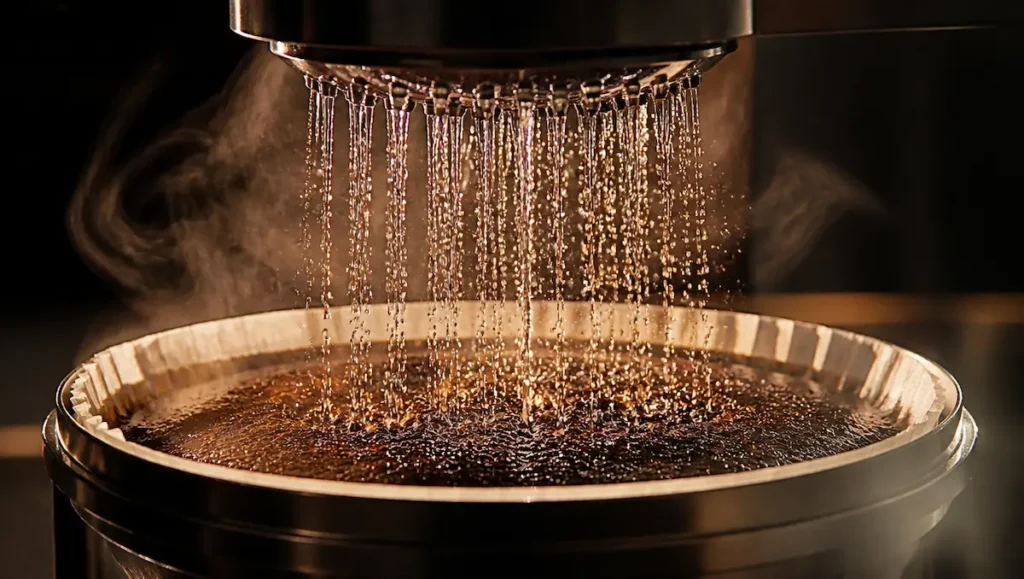
A manual pour-over is, mechanically, just three things: water at the right temperature, delivered at a controlled rate, through a filter bed of the right depth. An SCA-certified brewer automates exactly those three things—a pump and shower head replace your kettle and wrist, and the certification proves the automation lands inside the same performance window a skilled human does.
The honest differences from manual brewing remain real, though:
Batch size bias. Certified brewers are optimised for carafe batches. Most brew poorly (or have explicit small-batch modes) below about four cups, while a manual V60 shines with single cups. If your household brews one mug at a time, read section 4 carefully — the OXO’s single-serve mode and the Aiden’s single-cup basket are the exceptions, not the rule.
No live bloom control. Some machines add an artificial “bloom” pause, but none replicate the adjustment a human makes when the bed rises or stalls. If you care about dialling in light roasts, our pour-over coffee guide covers what automation misses in the bloom section.
Filter format. Most certified machines use flat-bottom basket papers, not cone papers. That changes the extraction geometry—for how flat-bottom and cone brewing differ, our best pour-over coffee makers guide compares dripper and filter geometries side by side.
The upshot: for batches of full-flavoured, balanced coffee with zero technique, these machines deliver genuine pour-over quality. For dialled-in single cups of delicate light roasts, manual still wins — and our how to brew pour-over for two guide covers the small-batch manual workflow.
3. The Certification Test, Translated Into Buying Criteria
Before comparing machines, know which specs actually separate them — because the certification does not.
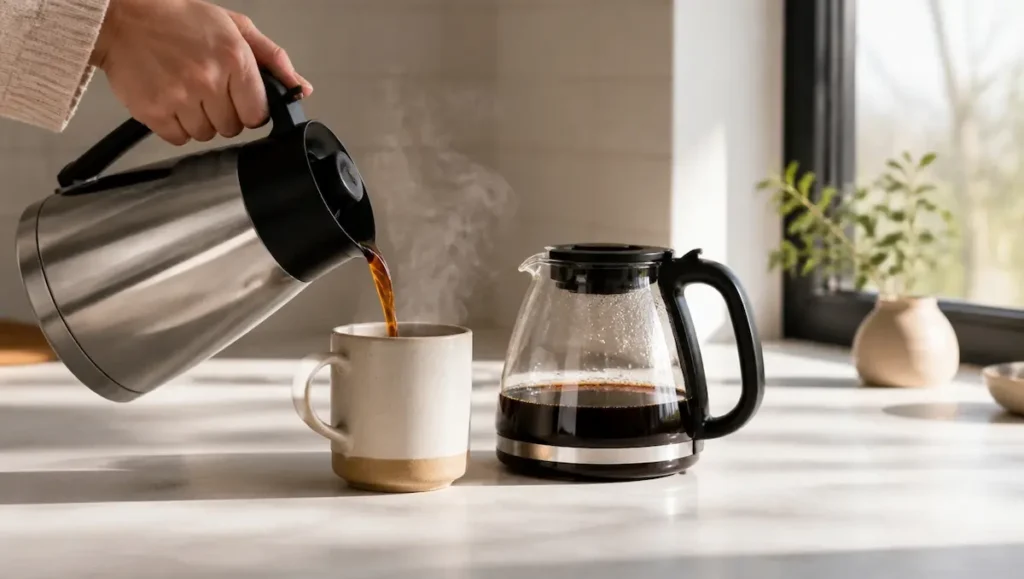
Thermal carafe vs glass on a hotplate. Glass-on-hotplate designs scorch coffee sitting on the plate and waste energy; thermal (insulated stainless) carafes hold heat without cooking the brew. Every machine featured below either offers thermal insulation or avoids the hotplate problem by design. If you are buying primarily for heat retention at the table, our French press guides cover the same logic from the immersion side.
Minimum brew volume. Check the smallest sensible batch. A 10-cup machine brewing a 2-cup batch usually underfills the shower head and under-extracts. Machines with dedicated small-batch or single-serve modes (OXO, Braun, Café, Fellow) sidestep this — and this is the single spec most buyers overlook before discovering that their new brewer makes a worse two-cup pot than their old cheap machine.
How you will actually clean it. Ask where the water reservoir opens, whether the brew basket and carafe are dishwasher-safe, and whether you can reset the descaling reminder without a manual. A brewer that is awkward to fill from the tap becomes a daily annoyance; one that needs the whole unit tilted under the faucet gets neglected, and neglected machines scale up and lose temperature performance long before they break.
Filter cost and availability. These machines take #4 basket papers or proprietary flat-bottom papers, all cheap — the economics are covered in our pour-over coffee makers guide, and unlike dripper papers there is no compatibility puzzle: a box of Melitta #4 natural brown filters — check price on Amazon — fits many cone-style machines, and standard 8–12-cup basket filters fit most of the rest. Melitta’s own store lists its full filter range for reference. Check the listing before you buy a machine that forces you into a filter habit you already own.
Grind quality still decides the ceiling. A certified brewer with pre-ground supermarket coffee will lose to a mediocre machine with fresh, burr-ground beans every time. If you are building the full setup, our grinder guides — from the Baratza Encore ESP review to the burr vs blade comparison and the conical vs flat burr explainer — cover the upgrade that matters most.
4. The Best SCA-Certified Coffee Makers of 2026
Every machine below appears on the SCA’s official certified home brewer list (certification year noted from the SCA list; Amazon data from live Amazon listings at publication). Prices move — treat every figure as a snapshot, and check the live listing before you decide.
Best compact pick — OXO Brew 8-Cup Coffee Maker (SCA Certified 2025)
ASIN: B07H9G93WK (thermal carafe, stainless) · B0FG8HNWYJ (glass carafe) · about $197.99 on Amazon, list $219.99

The OXO Brew 8-Cup solves the category’s biggest problem — terrible small batches — with a podless single-serve accessory that brews 2–4 cups into a mug or the carafe. OXO’s official product page documents its BetterBrew precision brewing engine, which controls water temperature, volume, and brew time; SCA certification is confirmed on the official 8-Cup page, and the model is lilist.
Why owners keep i confirms SCA certificationt: at roughly 7 inches wide, it fits counters no other certified brewer does, and the double-wall vacuum carafe means the second cup at 10 a.m. still tastes like the first — it is our best-for-small-households pick in the drip coffee maker roundup. For a one- or two-person household, this is the machine you’ll actually use every day.
What to know before buying: the 8-cup capacity fills fast when guests arrive, and the single-serve basket is an accessory, not the default — you swap baskets between modes, which some owners find fiddly at 6 a.m. The thermal-carafe stainless version is an Amazon’s Choice listing at about $197.99 with a 4.0-star rating across roughly 4,800 reviews — check price on Amazon — and the glass-carafe version sells for about $179.97
Buy it if: you brew small batches, lack counter space, or want one machine that does both mugs and carafes. Skip it if: you regularly brew for four or more people.
Best large-batch value — Braun MultiServe Plus (SCA Certified 2024)
ASIN: B0CTKNG5K9 (KF9270SI, stainless) · B0CTKX82FG (lower-priced variant) · about $249.95 on Amazon

Braun’s MultiServe Plus earned its certification alongside rare flexibility: seven brew sizes including single-cup and iced modes, plus a hot-water spout for tea. The model appears on the SCA certified list as “Braun MultiServe Plus Coffee Maker (with Cold Brew)” (Certified 2024), and the SCA announced the certification in an official SCA news post. On Amazon, the stainless KF9270SI sells for about $249.95 — check price on Amazon — with a lower-priced variant at about $179.95
Why owners keep it: it is the only machine here that brews a single mug, a full 10-cup carafe and a batch of cold brew without a second appliance on the counter — and our cold brew guide is the place to go if iced coffee is half your habit — and the hot-water spout means tea drinkers in the house stop feeling like an afterthought.
What to know before buying: the glass carafe sits on a warming plate, which is the one real caveat — pour and transfer promptly rather than letting coffee cook for an hour. Owners also report the machine is tall; measure the clearance under your upper cabinets before ordering.
Buy it if: you want maximum batch flexibility under $250 and a household that splits between coffee and tea. Skip it if: you want a thermal carafe at this price.
Best premium control — Café Specialty Drip Coffee Maker, 10-Cup Thermal Carafe (Certified 2026)
ASIN: B09648KFJ4 (thermal carafe) · about $299 on Amazon · model C7CDAAS3PD3

This is the pick that replaces the Breville Luxe Brewer Thermal—and it is a genuine substitute, not a consolation prize. Café’s Specialty Drip appears on the SCA certified list as Certified 2026, brews anywhere from a single cup to a full 10-cup carafe, and lets you set brew temperature across 185–205°F with four strength modes, including an over-ice setting that brews strong directly onto ice. Wi-Fi and voice control through the SmartHQ app handle scheduling and “start the coffee” from bed; the thermal carafe keeps the pot hot without a hotplate.
Why owners keep it: it is the machine for the household that wants control without a lab bench — set a temperature and a strength, schedule it, and stop thinking about it. The 1–10 cup range means a two-cup Sunday and a ten-cup brunch both work. CNET’s review found it brews large pots quickly and well, while flagging the price as steep—which is the honest trade: you are paying for temperature control and app convenience, not a dramatically better cup than the OXO.
What to know before buying: the app is a convenience, not a requirement, but some owners find the pairing process and firmware prompts more effort than a dial. The stainless finish shows fingerprints, and the machine is wider than the OXO — check your counter depth. Resale and support are US-centric, which matters if you move.
Buy it if: you want programmable temperature, app scheduling and a thermal carafe in one certified machine. Skip it if: you want the simplest possible brewer — a dial and a switch — because you will be paying for features you never open.
Best enthusiast machine — Fellow Aiden Precision Coffee Maker (SCA Certified 2024)
ASIN: B0FDS15FK4 (thermal carafe, Malted Chocolate) · B0D8HVBVS6 (Matte Black) · about $399.95 on Amazon

The Aiden is the natural successor to the Moccamaster’s place on this list: the machine an enthusiast buys when the coffee matters more than the convenience. The SCA lists the Aiden Precision as Certified 2024 with a single-serve option, 10-cup capacity and app connectivity, and the SCA’s own announcement confirms the award. What sets it apart is custom brewing: you can build profiles that control temperature, bloom, pulse pattern, and ratio, then repeat them—the closest thing to scripting a pour-over.
Why owners keep it: Serious Eats’ review sums up the case — worth it if you prefer pour-over-style coffee but want the ease of a machine. Coffee Chronicler found it makes better coffee than conventional brewers, especially on smaller batches, and owner discussion on r/Coffee repeatedly singles out the single-cup cone basket as the best-tasting mode. If you brew one excellent mug most mornings and a carafe on weekends, nothing else here is as capable — our drip coffee maker roundup names it the best smart/precision pick for the same reason.
What to know before buying: this $399 machine rewards attention. Owners describe a learning curve in the app, a need to grind finer than they expected for small batches, and a brew basket that wants rinsing immediately. It is also the largest footprint on this list — it needs vertical clearance and a dedicated spot. Unlike a Moccamaster, there is no decade-long service story to lean on; you are buying capability, not an heirloom build.
Buy it if: you want single-cup quality and repeatable profiles, and you enjoy tuning. Skip it if: you want to press one button and walk away, or you are buying for a household that will never open the app.
Also certified: Bonavita Enthusiast and BV1900TS (SCA Certified 2026)
Bonavita’s current lineup carries the certification forward: the Enthusiast 8-cup brewer appears on the SCA list as Certified 2026 (both finishes), and the brand’s own SCA-certified brewers collection lists it at $229.99. On Amazon, you have options: the Enthusiast with glass carafe in matte black at about $229.95 and the older-generation 8-cup one-touch thermal brewer (BV1900TS, SCA certified, 4.0-star rating across more than 10,000 reviews) at about $189.95 —
From an owner’s point of view: the BV1900TS remains the easiest certified machine under $200 to find, and its one-button workflow is the least intimidating in this guide. It is also the plainest — no app, no profiles, a shower head and a thermal carafe. Check out our best coffee makers with built-in grinders if you want the same convenience with a built-in grinder.
Side-by-side: what actually differs
| Brewer | SCA cert. | Batch range | Carafe | Control | Approx. Amazon price | Best for |
| OXO Brew 8-Cup | 2025 | 2–8 cups (single-serve accessory) | Thermal or glass | Dial + preset | $197.99 | Small kitchens, 1–2 drinkers |
| Braun MultiServe Plus | 2024 | 1–10 cups + cold brew | Glass + hotplate | Dial + modes | $249.95 | Mixed coffee/tea households |
| Café Specialty Drip 10-Cup | 2026 | 1–10 cups | Thermal | App, voice, 185–205°F | $299 | Scheduled, temperature-controlled brewing |
| Fellow Aiden Precision | 2024 | 1–10 cups | Thermal | App + custom profiles | $399.95 | Enthusiasts brewing single cups |
| Bonavita BV1900TS | Certified | 8 cups | Thermal | One button | $189.95 | Lowest-cost certified entry |
Read that table as a budget-versus-attention graph: the further down you go, the more the machine asks of you and the more it gives back. The OXO asks nothing and delivers a very good pot; the Aiden asks you to learn it and delivers the best single cup here.
5. What Living With One Is Actually Like
Spec sheets stop at the buy button. These are the things that decide whether you still like the machine in month six.
The first week is a calibration week. Every certified brewer ships with a factory grind assumption that will not match your beans — start from our coffee grind size chart and adjust from there. Expect to adjust grind two or three times before the cup lands where you want it — and expect small batches to need a finer grind than full carafes. This is normal, not a defect, and it is the single most common reason a new owner concludes the machine “makes weak coffee”.
Thermal carafes need preheating. A cold stainless carafe pulls heat out of the first pour. Fill it with hot tap water for a minute while the brew runs, and the difference at the table is noticeable. Glass carafes on hotplates have the opposite problem: they hold temperature by cooking the coffee, which is why we avoid them for anything you plan to drink 40 minutes later.
Cleaning is the real cost of ownership. Budget for a weekly basket-and-carafe wash, a monthly reservoir rinse, and descaling every 1 to 3 months, depending on your water hardness. Machines with narrow fill openings and non-removable reservoirs take twice as long — a detail worth checking in the listing photos before you buy, because it is the difference between a habit and a chore.
Noise and light. Pump-driven brewers are louder than a kettle, and several models beep at the end of the brew. If your kitchen opens to a bedroom, look for a machine with an adjustable or defeatable end-of-brew alert; app-controlled models generally let you mute it, while one-button machines generally do not.
Filters are a subscription, not a purchase. A daily 8-cup brewer runs through roughly a box of #4 papers every six to eight weeks. Buy in bulk, and buy the plain unbleached ones — the rinse step matters more than the brand.
Water is the variable nobody upgrades. If your tap water is hard or heavily chlorinated, a $30 filter pitcher will improve the cup more than a $200 machine upgrade — our guide to water for coffee brewing explains what to change first. It also cuts descaling frequency, the most common maintenance complaint in this category.
6. How to Get Pour-Over Results From an Auto Brewer
Certification sets the floor; your habits set the ceiling. Four habits close the remaining gap between your machine and a $5 café cup:
Weigh the coffee. The certified standard builds on the classic 55 g/L ratio. Use a scale — our essential coffee brewing tools guide covers why scoops drift — and the ratio in our coffee-to-water ratio calculator.
Grind fresh, immediately before brewing. Ground coffee loses aromatics within minutes; our coffee storage guide covers the bean side of the same problem, and our manual grinder roundup covers the hardware side.
Match the roast to the method. These brewers’ fixed profiles flatter medium roasts most; for roast-to-method pairing, our guide to the best beans for pour-over coffee is the reference.
Use a fresh, rinsed filter each brew. Paper quality still shows through — the rinsing rule in our pour-over coffee makers guide applies to basket papers too.
One more habit that costs nothing: brew the batch size you will actually drink. A machine forced to brew two cups in a ten-cup basket is the most common cause of disappointing coffee from a certified brewer, and no amount of grind tweaking fully fixes it.
7. When Manual Still Wins
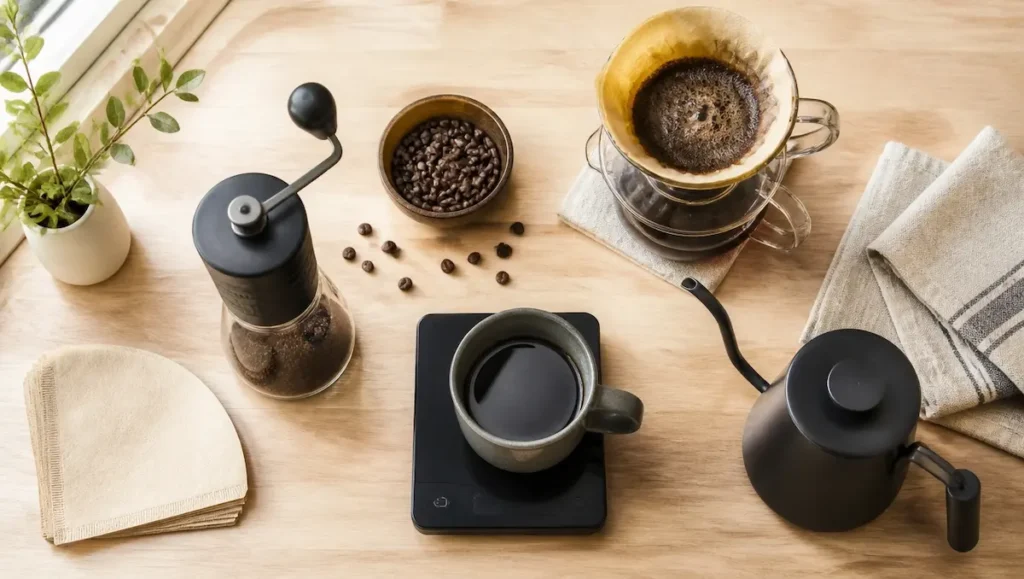
Be honest about the trade. An automatic brewer is the better buy when you brew four or more cups at a time, when mornings are rushed, or when more than one person in the house makes coffee and you want consistent results regardless of who pressed the button. Manual brewing remains better when you brew one cup of a delicate light roast, want to taste a new bean’s character across three different recipes, or have limited counter space. If that sounds like you, our how to brew pour-over for two guide and our best pour-over coffee makers roundup are the better starting points — and a $30 dripper plus a decent gooseneck kettle will outperform any machine on a single cup.
FAQs
Is an SCA-certified coffee maker really as good as manual pour-over?
For batches of four cups or more, a certified brewer with fresh grounds lands in the same quality window as competent manual brewing, because it hits the same temperature and extraction standards. Manual wins on single dialled-in cups and light roasts where you adjust the pour to the coffee’s behaviour.
What does SCA certification test?
Third-party lab testing against the SCA’s brewing and performance standards — water temperature at the grounds (roughly 92–96°C), brew time and flow, and extraction uniformity — per the SCA’s certified home brewer program and published coffee standards.
Which is the best SCA-certified coffee maker in 2026?
For most households, the OXO Brew 8-Cup (Certified 2025) — small batches, small footprint, thermal carafe. Choose the Braun MultiServe Plus (Certified 2024) for flexible batch sizes, the Café Specialty Drip for app scheduling and temperature control, the Fellow Aiden (Certified 2024) for single-cup quality and custom profiles, or the Bonavita BV1900TS if the budget is under $200.
Why aren’t the Breville Luxe Brewer or the Moccamaster KBGV Select in this list anymore?
Both are SCA certified, and both are still good machines — the Luxe Brewer Thermal remains one of the most capable certified brewers on the market. Neither was reliably available on Amazon.com at the time of this update, so we replaced both with certified machines that are. If availability returns, both belong back on any shortlist.
Do SCA-certified brewers use regular filters?
Most take standard #4 basket or cone paper filters. A few designs use proprietary flat-bottom papers — check the listing before buying a machine into a filter habit you already own.
Is a $400 brewer worth it over a $200 one?
Only if you will use what the extra money buys. The step from $200 to $300 mostly adds temperature control, app scheduling, and a better carafe; the step to $400 adds single-cup capability and repeatable brew profiles. If you brew a full carafe every morning and drink it black, the OXO or Braun will serve you just as well.
How long do these machines last?
Certification says nothing about lifespan. Expect five to eight years from a mainstream certified brewer with regular descaling; longer if you use filtered water and serviceable parts are available. Extended warranties are usually a worse deal than a water filter.
Sources
Certification and standards – Specialty Coffee Association — Certified Home Brewers list (certification years for the OXO, Braun, Café, Fellow and Bonavita entries) – Specialty Coffee Association — SCA Standards – SCA news — Introducing New SCA Certified Home Brewer: Aiden Precision Coffee Maker by Fellow – SCA news — Braun’s MultiServe Plus Coffee Maker with Cold Brew awarded SCA Home Brewer certification – SCA news — ZWILLING Enfinigy Drip Coffee Maker re-certified as SCA Home Brewer
Manufacturer product pages – OXO — 8-Cup Coffee Maker – OXO — 8-Cup Coffee Maker with Podless Single-Serve Function and Glass Carafe – Café Appliances — SCA certified coffee makers – Fellow — Aiden Precision Coffee Maker – Braun — MultiServe Plus Coffee Maker with Cold Brew (KF9370SI) – Bonavita — Enthusiast 8-Cup Drip Coffee Brewer – Melitta — Coffee filters collection
Related Posts
- Chemex Brewing Guide: How to Brew Clean, Bright Coffee (2026)
- Chemex vs. Hario V60: Which Pour-Over Is Better? (2026)
- Best Water Temperature for Pour Over Coffee (Complete Brewing Guide for Perfect Flavor)
- How to Pour Water for Pour Over Coffee (Step-by-Step Technique for Perfect Flavor)
- Pour Over Coffee Ratio Explained: How to Get the Perfect Brew